Description
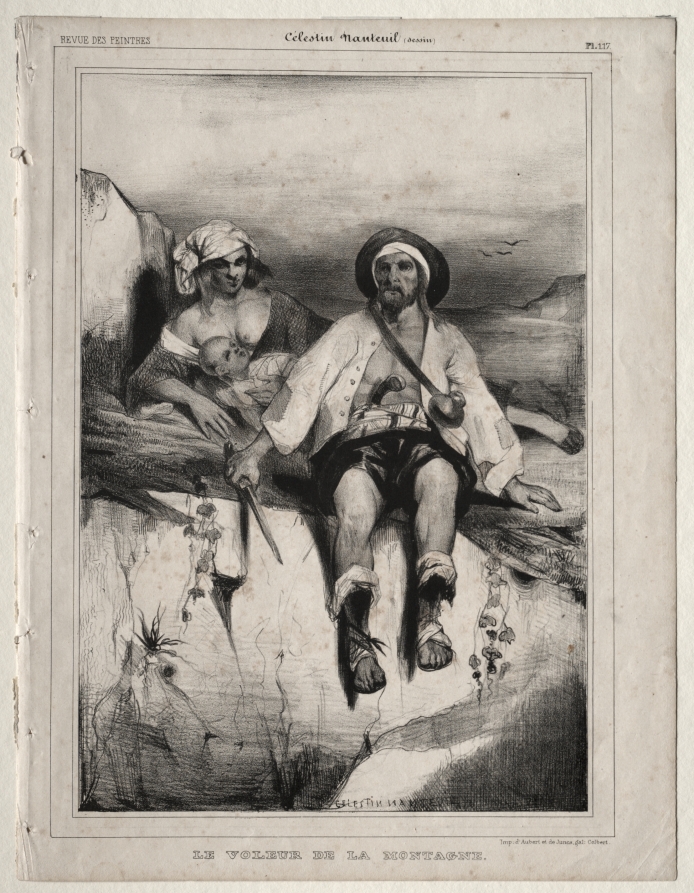
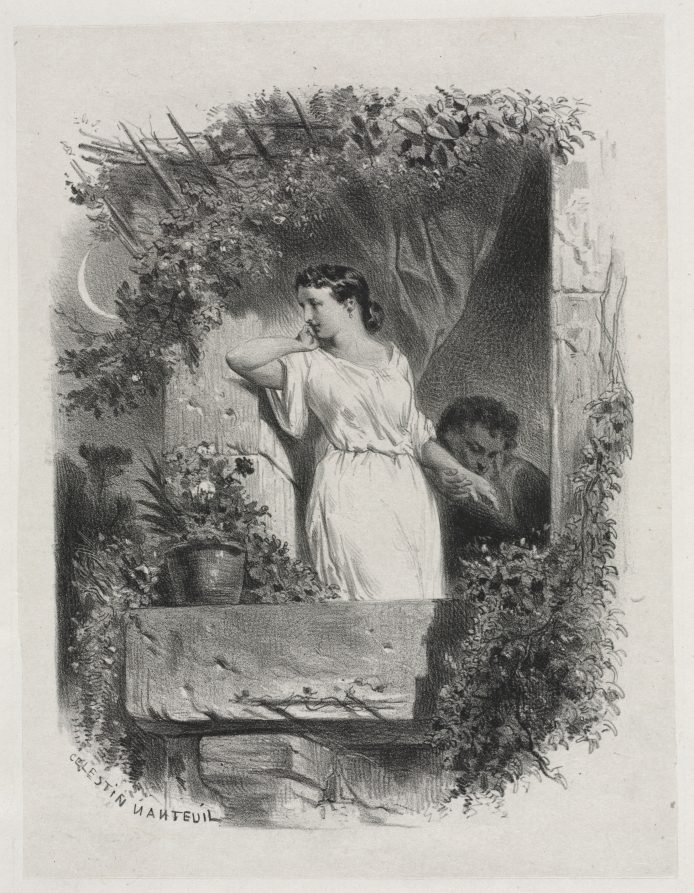
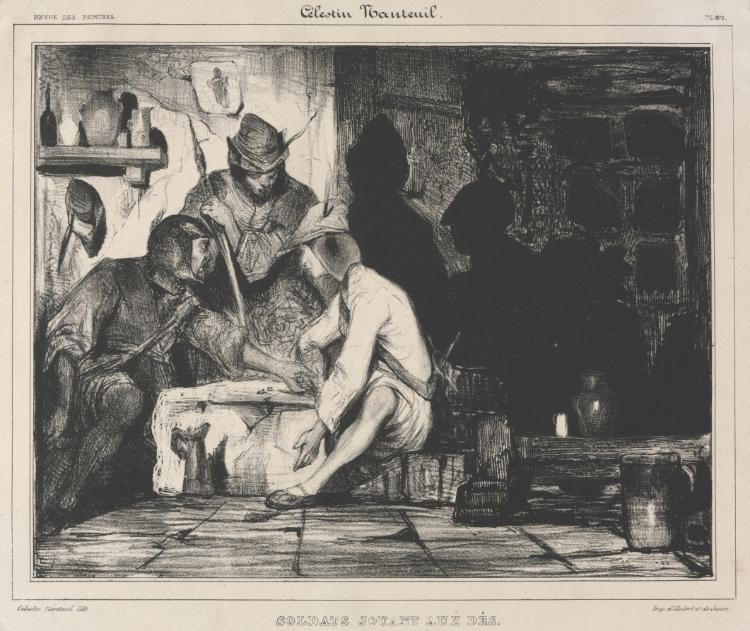
With its beautifully rendered trees, grassy slopes, and water bathed in late afternoon sunlight, this painting clearly suggests Nanteuil's love of nature. In 1837 he wrote to a friend: "I often spend several hours . . . looking at beautiful plants with large leaves, cut out like sumptuous lace, tall grasses in ponds, their color silky and the beautiful reflections they make in the water, the little flowers with thousands of colours the ground is embroidered with, all provide me with a source of enjoyment." Although the forest Nanteuil described seems very real, his painting includes a satyr. Seated on a stone near a stream, the half human, half goat mythological figure seems lost in the music he plays upon his pipes. Nanteuil is most famous for his lithographs and etchings; paintings by the artist are rather rare.
Provenance
Private collection, France. Paris sale, Drouot room 4, 23 November 1973, Hubert Maringe Commissaire-priseur. Galerie André Watteau, Paris. Mr. and Mrs. Noah L. Butkin, Cleveland. Given to the CMA on 20 October 1977.
Accession Number
1977.125
Medium
oil on fabric
Dimensions
Framed: 123.2 x 155.6 x 12.7 cm (48 1/2 x 61 1/4 x 5 in.); Unframed: 97 x 129.8 cm (38 3/16 x 51 1/8 in.)
Classification
Painting
Credit Line
Gift of Mr. and Mrs. Noah L. Butkin
Tags
Painting Neoclassical & Romantic (1751–1850) Oil Painting French Color: Orange Color: Gold
Background & Context
Background Story
Célestin François Nanteuil's "In the Forest" (1841) is a lyrical landscape depicting a sun-dappled woodland clearing with beautifully rendered trees, grassy slopes, and water bathed in late afternoon light. The painting clearly expresses Nanteuil's deep love of nature — in 1837, he wrote to a friend: "I often spend several hours... looking at beautiful plants with large leaves, cut out like sumptuous lace, tall trees swaying in the wind, and I return with my heart full and my head overflowing with ideas."
Nanteuil (1811–1873) was a French painter, illustrator, and engraver who occupied a distinctive position in the mid-nineteenth century between the academic landscape tradition and the emerging Barbizon School. He was closely associated with the Romantic literary world — he was a close friend of Victor Hugo and illustrated editions of works by Hugo, Balzac, and other leading French writers. His dual identity as a fine artist and an illustrator gave his paintings a narrative quality unusual in the pure landscape genre.
The painting reflects the influence of both the Barbizon painters and the earlier tradition of Claude Lorrain and the classical landscape. The composition is carefully constructed: the trees frame a view into the distance, creating a sense of depth and inviting the viewer to imagine walking deeper into the forest. The play of light through the canopy — a hallmark of forest painting from the Dutch tradition through the Impressionists — is rendered with particular skill, creating pools of golden sunlight on the forest floor that contrast with the cool greens of the阴影.
Nanteuil's literary connections profoundly shaped his artistic vision. His friendships with Hugo, Alexandre Dumas, and other writers of the French Romantic movement infused his work with a sense of landscape as a source of emotional and spiritual experience rather than merely visual pleasure. For the Romantics, the forest was a place of mystery, solitude, and communion with nature — a refuge from the artificiality of urban life and a space where the imagination could roam freely. Nanteuil's "In the Forest" embodies this Romantic vision, presenting the woodland not as a resource to be managed or a setting for human activity, but as a world unto itself — alive, beautiful, and worthy of sustained contemplation.
The painting also reflects the growing French interest in forest conservation during the 1840s. The Forest of Fontainebleau — the Barbizon painters' favored site — was under threat from commercial logging, and the artists' depictions of its beauty helped build public support for its preservation. Nanteuil's painting, with its loving attention to individual trees and forest ecology, participates in this conservationist impulse, presenting the forest as a treasure to be preserved rather than a resource to be exploited.
Cultural Impact
Nanteuil's dual role as painter and illustrator bridged the gap between fine art and literary culture in mid-nineteenth-century France, demonstrating that landscape painting could serve both aesthetic and narrative functions.
Why It Matters
This sun-dappled forest scene embodies the Romantic conviction that nature is a source of spiritual renewal — a lyrical woodland painted by an artist whose deep love of trees and forests informed both his visual art and his literary illustrations.