Description
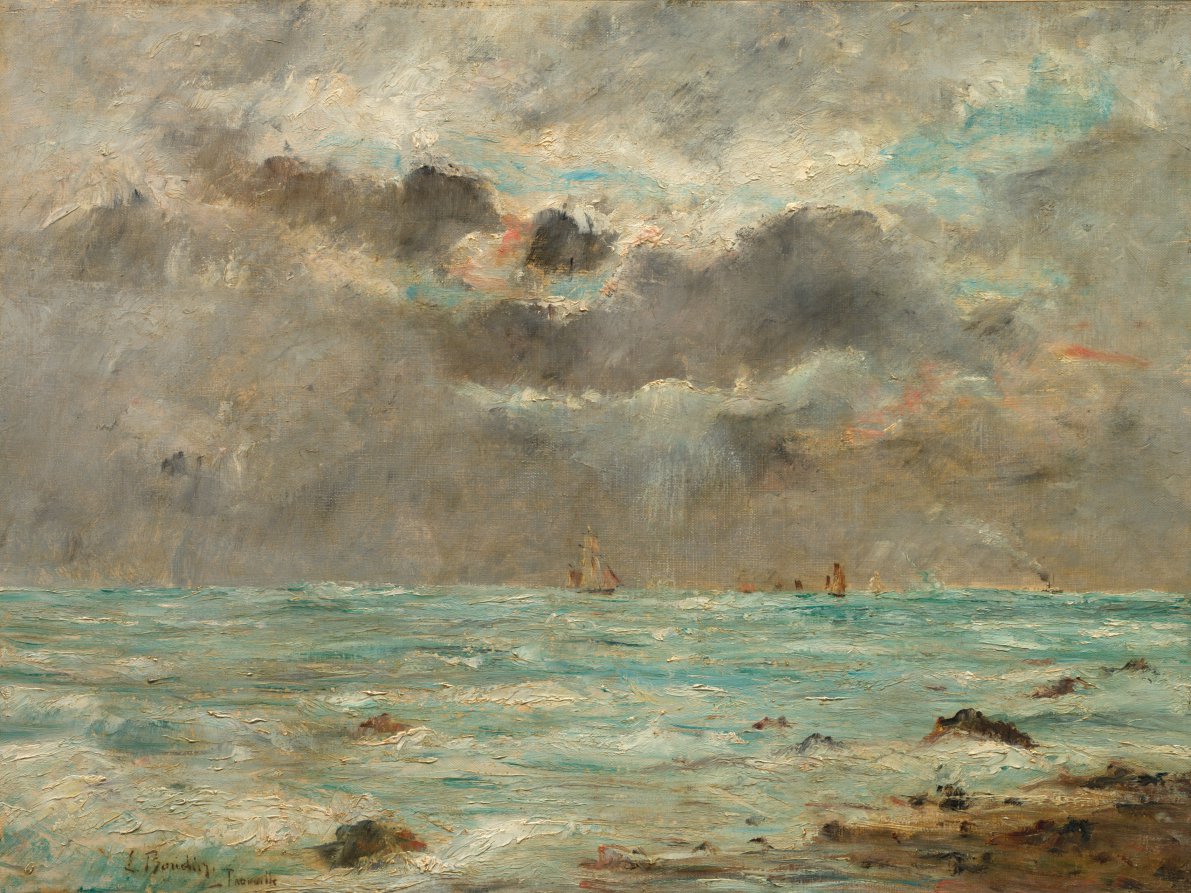
Eugène Boudin is best known for inspiring Impressionist artists, especially a young Claude Monet, to paint outdoors. This drawing belongs to a series that Boudin made throughout much of his career depicting seascapes with dramatic skylines onsite. He favored pastel, the powdery medium used here, for its portability and directness, allowing him to capture the dramatic effects of nature as they shifted.
Provenance
Studio of the artist [1824-1898; Lugt 828] (1860-1898); (his posthumous studio sale, Hotel Drouot, Paris, March 20-21, 1899, probably one of nos. 243–54) (1899); Dr. Gustav Rau [1922-2002], Stuttgart (?-2002); (his sale, Kunsthaus Lempertz, Cologne, May 25, 2013, no. 650, for the UNICEF Germany Foundation, sold to Le Claire Kunst, Hamburg) (2013); (Le Claire Kunst, Hamburg, sold to Nancy F. and Joseph P. Keithley, Shaker Heights, OH) (2013-2014); Nancy F. and Joseph P. Keithley, Shaker Heights, OH, given to the Cleveland Museum of Art, Cleveland, OH (2014-2020); Cleveland Museum of Art, Cleveland, OH (2020-)
Accession Number
2020.116
Medium
pastel on gray wove paper mounted on thin paperboard
Dimensions
Sheet: 21.5 x 28.7 cm (8 7/16 x 11 5/16 in.)
Classification
Drawing
Credit Line
Nancy F. and Joseph P. Keithley Collection Gift
Tags
Drawing Impressionist & Modern (1851–1900) Pastel Paper Board French Color: Teal Color: Gray
Background & Context
Background Story
Seascape with Open Sky (1860) is one of Boudin's earliest important works, demonstrating the qualities that would establish him as the king of the skies. The painting's emphasis on the open sky—the title makes the sky the primary subject—reveals Boudin's revolutionary conviction that the sky was not merely the background for seascape but its most important element. This emphasis distinguished Boudin from earlier marine painters who treated the sky as a setting for ships and water. The year 1860 is significant: Boudin was thirty-six and had been painting the Normandy coast for over a decade, but his reputation was still largely local. The open sky of this seascape—vast, luminous, and handling the full complexity of clouds, light, and atmospheric depth—demonstrates the artistic ambition that would eventually earn him national recognition. The seascape format itself—pure sea and sky without significant land or narrative elements—was relatively unusual in 1860 marine painting, which typically included harbors, ships, or coastal features for compositional interest. Boudin's reduction to sea and sky argues that these elements alone could sustain a painting—a position that aligned him with the most advanced artistic thinking of his time and anticipated the Impressionist engagement with pure landscape.
Cultural Impact
Boudin's sky-dominated seascapes influenced the development of Impressionist landscape painting, establishing the sky as a primary rather than secondary subject. The paintings influenced Monet, who credited Boudin with teaching him to see the sky. The open-sky seascape format influenced later marine painters who similarly valued atmospheric effect over topographical detail. The 1860 painting also influenced the critical recognition of Boudin as a significant rather than regional artist.
Why It Matters
This painting matters because it represents an early statement of the artistic principle that would define Boudin's career and influence Impressionism: the sky is the landscape's most important element, and the artist's primary task is to capture its ever-changing beauty. This principle—that atmosphere matters more than topography—was fundamental to the Impressionist reorientation of landscape painting.