Description
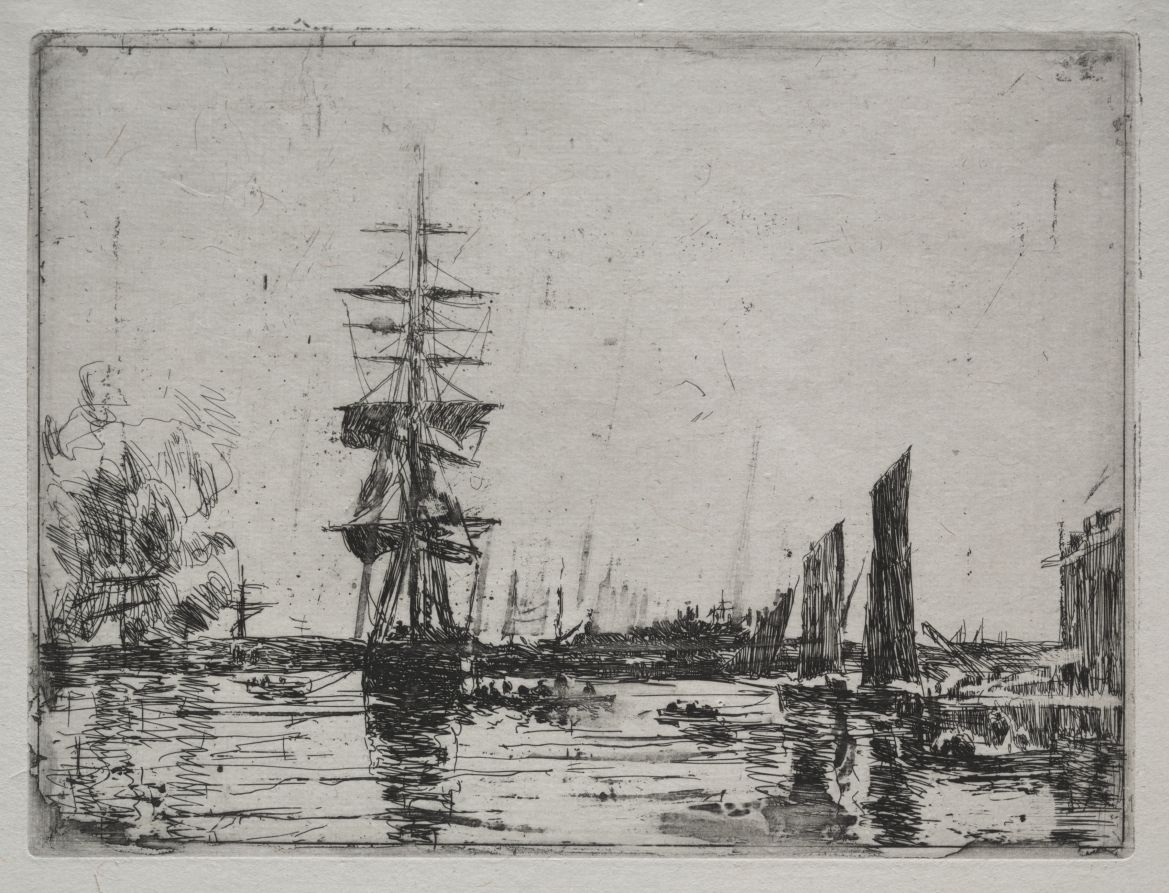
This painting treats a common theme in Eugène Boudin's mature art: ships at harbor. Boudin typically did not depict the busy commercial life or human tasks related to ships; rather, he seemed always to strive for an overall mood of calm, harmony, and light. Although Boudin's brushwork was quite sketchy at this time, he was still able to suggest the complex sails and structures of large vessels. Here he rubbed light tones around the ships' masts, often overlapping the darker lines of the wood and rigging with white or gray tones as if to evoke the passing wind and shifting positions common to nautical life.
Provenance
Gustave Hoche, Paris. His sale (vente Gustave H. . .), Paris, Drouot, 22 February 1895 (lot 13), ff 900 (perhaps bought in) (price according to Frick Library copy). His sale (vente de M. X . . .), Paris, Drouot, 18 March 1898 (lot 11), ff 560. Coralie Walker Hanna, Cleveland. Gift of Leonard C. Hanna to the CMA in 1939.
Accession Number
1939.165
Medium
oil on wood panel
Dimensions
Framed: 80.5 x 116 x 10 cm (31 11/16 x 45 11/16 x 3 15/16 in.); Unframed: 46.7 x 37.8 cm (18 3/8 x 14 7/8 in.)
Classification
Painting
Credit Line
Gift of Leonard C. Hanna Jr., for the Coralie Walker Hanna Memorial Collection
Tags
Painting Impressionist & Modern (1851–1900) Oil Painting Panel Painting French Color: Brown Color: Gray
Background & Context
Background Story
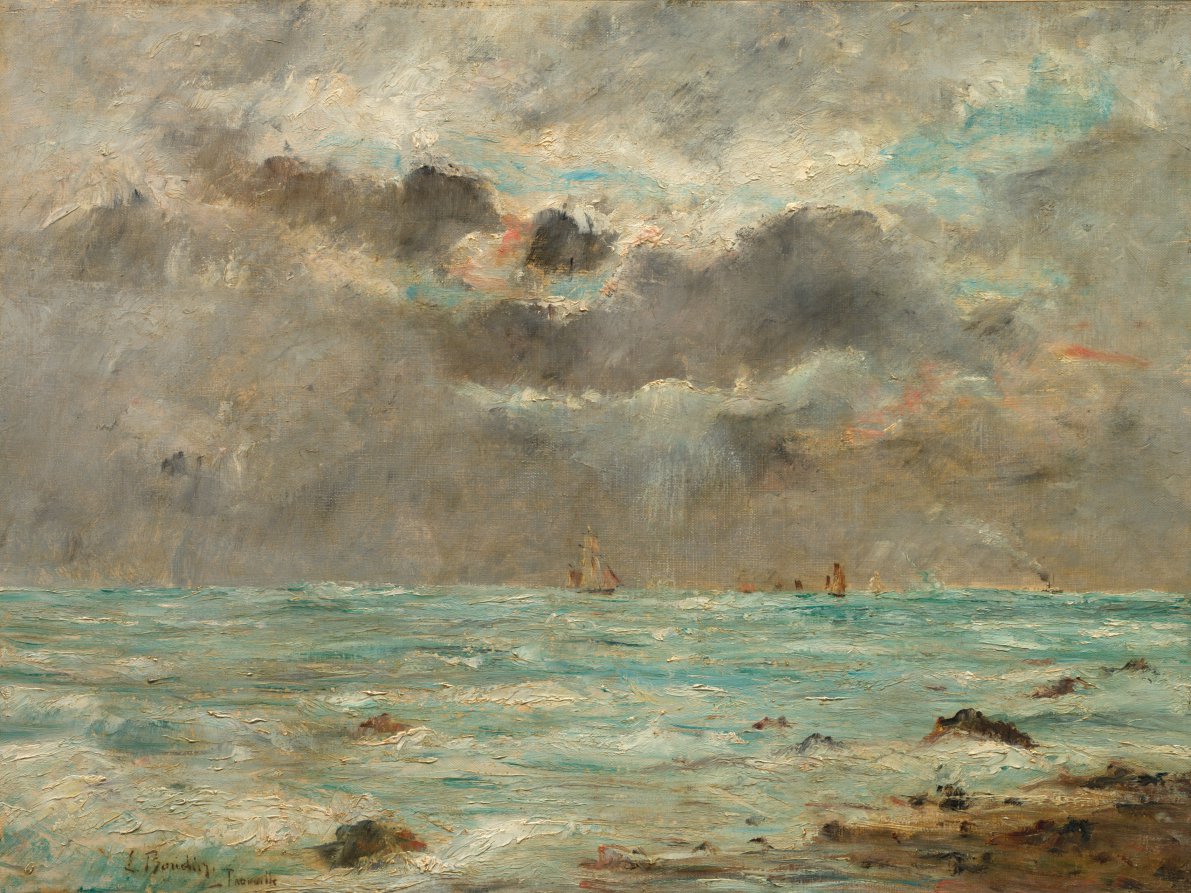
The Dock of Deauville (1891) depicts the harbor infrastructure of Deauville—the resort that had been developed as a fashionable alternative to Trouville and had, by 1891, become one of Europe's most exclusive destinations. The dock—where fishing boats and pleasure craft shared harbor space—represented Deauville's dual identity as working port and fashionable resort. Boudin's late painting captures the dock with the authority of an artist who had been painting Normandy's harbors for over three decades. The year 1891, seven years before Boudin's death, finds the artist still engaged with the subjects that had defined his career but now approaching them with the mature style's economy and assurance. The dock's visual character—boats, buildings, and the harbor's sheltered water—provides the compositional elements that Boudin arranges with lifelong expertise. His treatment of the dock's reflection in the harbor water—doubling the scene's visual complexity—demonstrates his mastery of water's reflective effects. The painting also documents Deauville's harbor at a specific moment—before the 20th-century developments that would transform the resort into a playground of international high society and before the fishing industry's decline would alter the harbor's character.
Cultural Impact
Boudin's Deauville dock paintings influenced how the resort's maritime infrastructure was represented, documenting the working harbor that coexisted with fashionable tourism. The paintings influenced later marine painters who similarly found subjects in harbor infrastructure. The 1891 dock painting also influenced how Deauville's history was understood, recording the period when fishing and fashion coexisted in the same harbor.
Why It Matters
This painting matters because it documents Deauville's harbor at a specific historical moment—the late 19th century, when the working port and the fashionable resort existed in an equilibrium that would not survive the 20th century. Boudin's authoritative late painting preserves this equilibrium with the informed attention of someone who had watched it develop over decades.