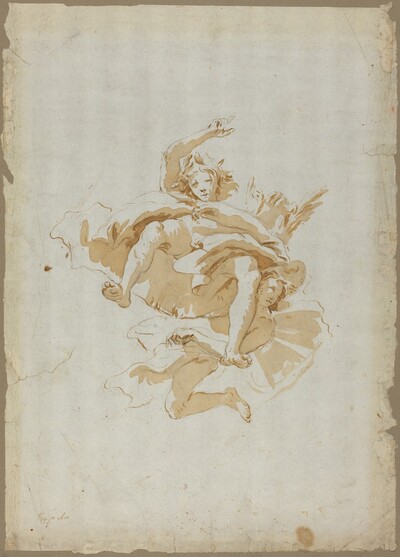
Provenance
Carl William Broemel (the artist) [1891-1984], Cleveland, OH (1924); The Cleveland Museum of Art, Cleveland, OH (May 7, 1924)
Accession Number
1924.1241
Medium
watercolor
Dimensions
Image: 36.8 x 51.4 cm (14 1/2 x 20 1/4 in.)
Classification
Drawing
Credit Line
Hinman B. Hurlbut Collection
Tags
Drawing Early Modern (1901–1950) Watercolor American Color: Teal Color: Gray
Background & Context
Background Story
Carl William Broemel (1885-1955) was an American watercolorist associated with the Washington, D.C. art scene, known for his luminous watercolors that captured the effects of light and atmosphere with a subtlety that distinguished his work from the more vigorous American watercolor tradition. Air and Sunshine from 1924 exemplifies Broemel's approach: a scene reduced to its atmospheric essentials, with the title suggesting that air and sunshine themselves are the subjects rather than the landscape features they illuminate. The watercolor medium allows Broemel to capture the transparency of air and the luminosity of sunshine with a directness and freshness that oil painting cannot match.
Cultural Impact
Broemel's watercolors participate in the American watercolor renaissance of the early 20th century, when American painters rediscovered watercolor as a medium capable of serious artistic expression rather than just amateur sketching. Air and Sunshine demonstrates the medium's capacity for capturing atmospheric effects—transparency, luminosity, the movement of air—that were central to American modernist painters' interest in the effects of light and atmosphere.
Why It Matters
Air and Sunshine is Broemel's watercolor reduced to atmospheric essentials: the transparency of air and the luminosity of sunshine as subjects in themselves, not just as effects that illuminate a landscape. The 1924 date places this in the American watercolor renaissance, when watercolor was rediscovered as a medium for serious artistic expression.