Description
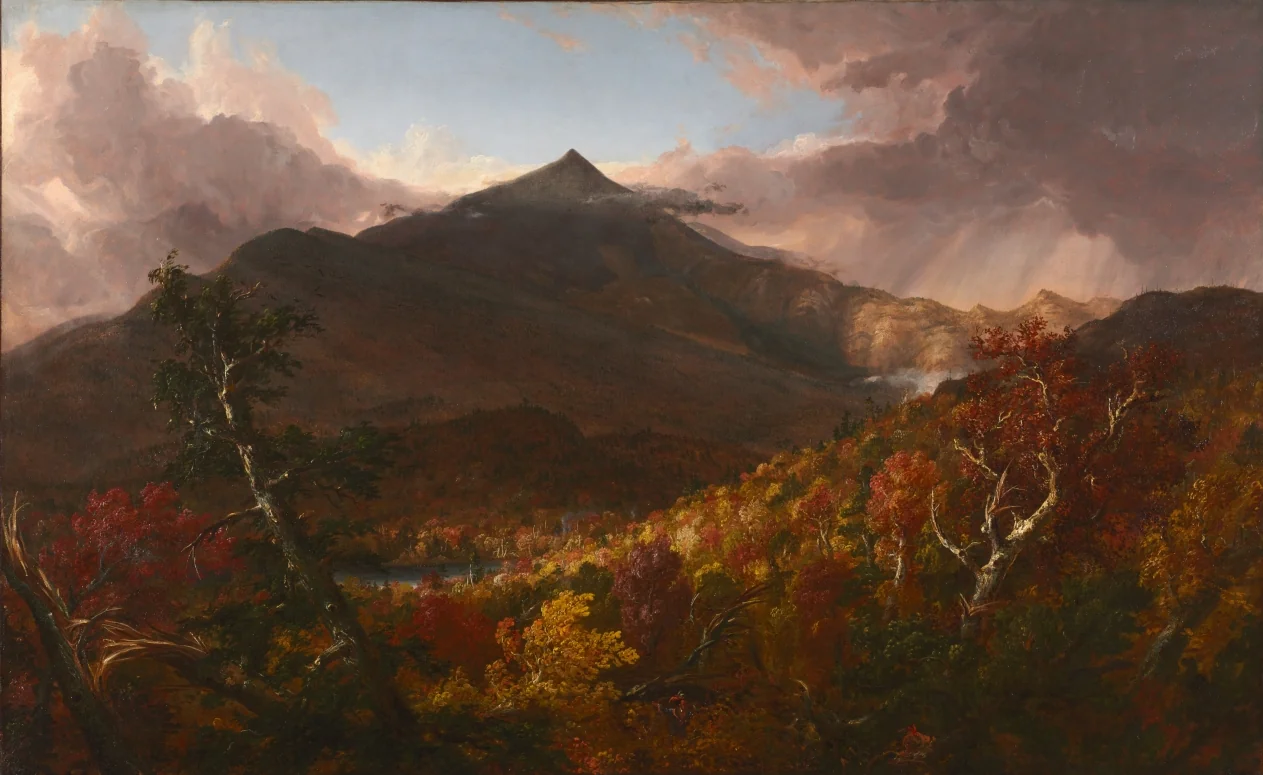
Championing the American wilderness, Cole declared, "We are still in Eden," in his Essay on American Scenery, published two years before he painted this view of the Adirondacks. The artist sketched the scene in early summer, but when he created the painting in his studio, he rendered it in a dramatic blaze of fall colors. Such a choice likely had nationalistic overtones; he once proclaimed that autumn was "one season where the American forest surpasses all the world in gorgeousness."
Cole included two Indigenous men in the painting’s right foreground foliage. At this time, the Adirondacks remained home to many Native Americans long after most had been forcibly removed from land east of the Mississippi River. While continuing to live, hunt, and fish in the area, these Algonquian and Iroquoian peoples were compelled to significantly adapt their existence amid increasing White settlement and its attendant lumber, mining, and tourist industries.
Cole included two Indigenous men in the painting’s right foreground foliage. At this time, the Adirondacks remained home to many Native Americans long after most had been forcibly removed from land east of the Mississippi River. While continuing to live, hunt, and fish in the area, these Algonquian and Iroquoian peoples were compelled to significantly adapt their existence amid increasing White settlement and its attendant lumber, mining, and tourist industries.
Provenance
Dr. George Ackerly [d. 1842], New York, NY, to his daughter, Emma Ackerly1 (1838); Emma Ackerly (By `839 - `847); Jonathan G. and Emma Ackerly Chapman, sold to Nicholas Matthews1 (1847-); Nicholas M. Matthews [1858-1930], Baltimore, MD (Until 1914); (American Art Association, Matthews collection sale, Feb. 17, 1914, no. 61, possibly sold to T. Austin) (1914); Possibly T. Austin (1914-1916); (Anderson Galleries, New York, NY, Matthews collection sale, Jan. 17, 1916, no. 55, sold to Holland Galleries) (1916); (Holland Galleries, New York, NY, sold to the Cleveland Museum of Art) (1916-1917); The Cleveland Museum of Art, Cleveland, Ohio (1917-)
Accession Number
1917.1335
Medium
oil on canvas
Dimensions
Framed: 132.5 x 193.5 x 13 cm (52 3/16 x 76 3/16 x 5 1/8 in.); Unframed: 99.8 x 160.6 cm (39 5/16 x 63 1/4 in.)
Classification
Painting
Credit Line
Hinman B. Hurlbut Collection
Tags
Painting Neoclassical & Romantic (1751–1850) Oil Painting Canvas American Color: Orange
Background & Context
Background Story
View of Schroon Mountain, Essex County, New York, After a Storm (1838) depicts the Adirondack landscape of upstate New York with the atmospheric power that distinguishes Cole's best wilderness subjects. Schroon Mountain, in Essex County near Lake Champlain, provided Cole with a subject that combined geological drama—the mountain's massive form rising above the surrounding landscape—with the atmospheric effects of a clearing storm. The after-the-storm subject allowed Cole to demonstrate his skill in rendering the specific quality of light that follows rain: broken clouds, shafts of sunlight, and the saturated colors of wet foliage created a landscape of extraordinary atmospheric richness. The 1838 date places this during Cole's most productive wilderness period, when he was exploring the Adirondacks and Catskills and developing the observational landscape method that the Hudson River School would adopt. Cole's treatment of Schroon Mountain combines the geological accuracy of a surveyor's view with the atmospheric poetry of a Romantic landscape—the mountain's massive form is rendered with topographical precision, but the storm's aftermath gives the scene an emotional intensity that pure documentation could not provide. The painting also documents the Adirondack landscape before the logging and development that would alter it in the following decades.
Cultural Impact
Cole's Adirondack paintings influenced how the American wilderness was represented in art, establishing the mountain-as-monument convention that later Hudson River School painters would adopt. The after-the-storm subject influenced how atmospheric effects were rendered in American landscape painting, establishing approaches that Church and Bierstadt would develop further. The Schroon Mountain subject influenced how the Adirondacks were perceived, connecting the region to the artistic tradition that was revealing its beauty.
Why It Matters
This painting matters because it captures the Adirondack wilderness at a specific atmospheric moment—the clearing after a storm—that demonstrates how observational precision and emotional intensity can coexist in a single landscape, arguing that the American wilderness is most truthfully represented when both its physical reality and its atmospheric poetry are honored.

![Saint Bernard and Saint Catherine of Alexandria with the Virgin of the Annunciation [right panel]](https://api.nga.gov/iiif/e6890364-4d99-4684-a62b-5060ee3c3446/full/400,/0/default.jpg)