Description
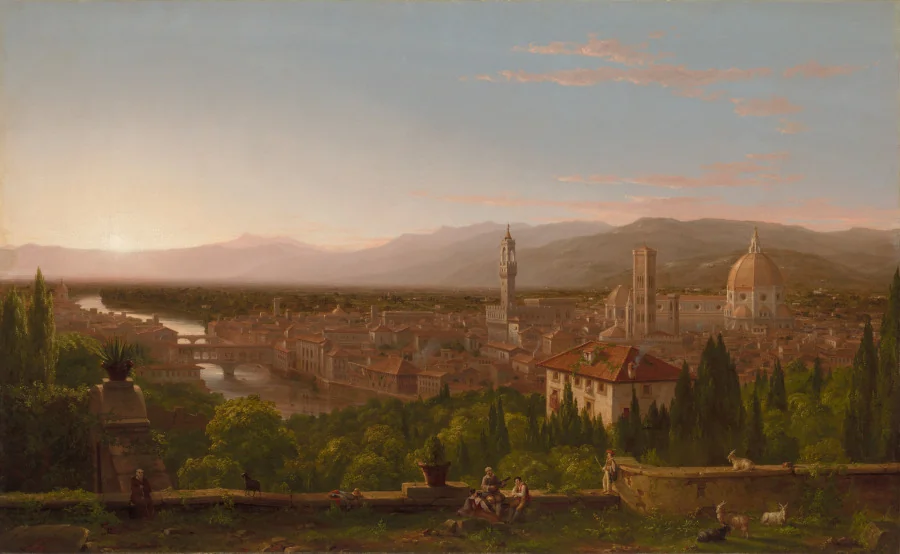
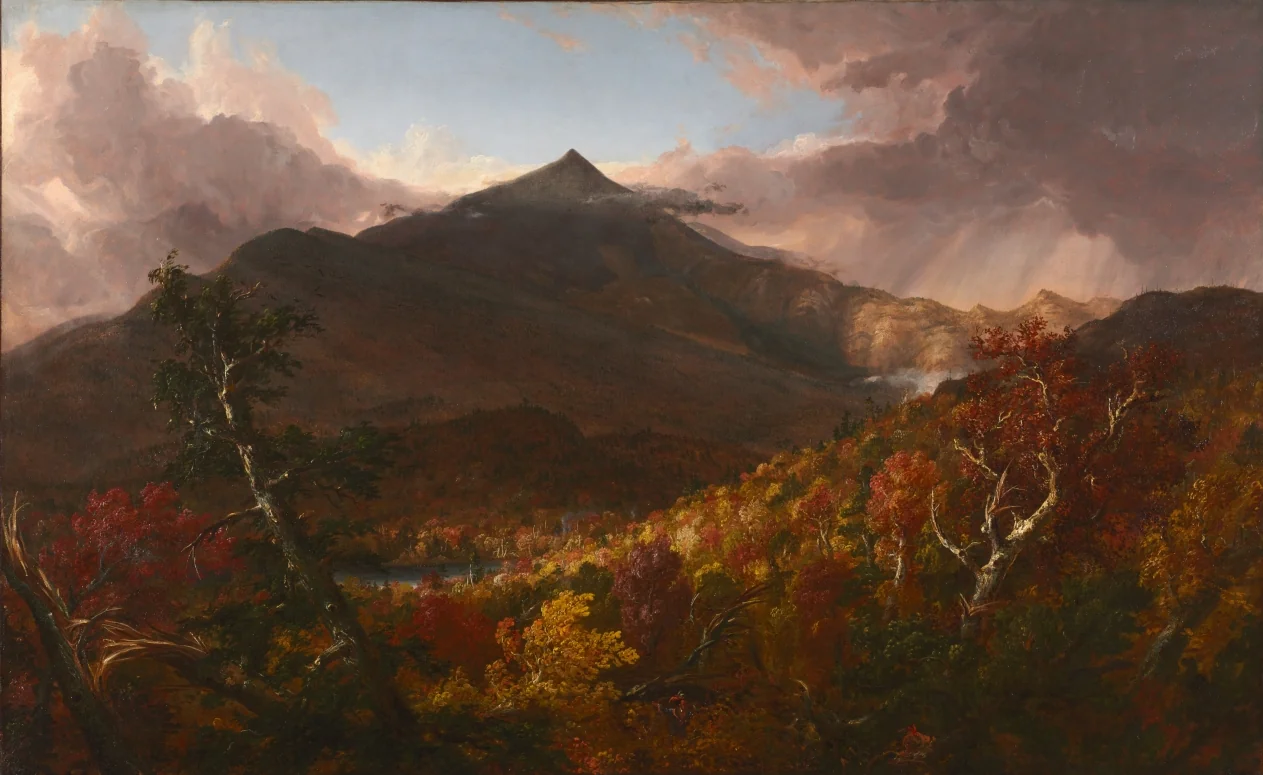
Cole visited Italy in 1831 and made a small pencil sketch of this vista of Florence shortly before sunset. In his New York studio six years later, he transformed the drawing into this large oil painting, adding picturesque humans and goats to the foreground. Exhibiting View of Florence alongside a painting of the Catskill Mountains in New York in 1837, Cole set out to prove that he had mastered the very different landscapes of the Old and New Worlds.
Provenance
The Cleveland Museum of Art, Cleveland, Ohio (1961-); (Victor Spark, New York, NY, sold to the Cleveland Museum of Art) (1960-1961); Francis Moro, New York, NY, sold to Victor Spark1 (Until 1960); Private collector, New York, NY, sold to Francis Moro1 (?); (Antique store, New York, NY, sold to a private collector)1 (?); Henry James, Sr. [1811-1882], New York, NY1 (By 1854-?); Edward James, New York, NY, probably to his brother, Henry James, S1 (By 1848-before 1854); Jonathan Mason, Boston1 (by 1839); Possibly Mr. Hunt, Boston1 (1838-1839?)
Accession Number
1961.39
Medium
oil on canvas
Dimensions
Framed: 125.4 x 186.7 x 9.2 cm (49 3/8 x 73 1/2 x 3 5/8 in.); Unframed: 99.5 x 160.4 cm (39 3/16 x 63 1/8 in.)
Classification
Painting
Credit Line
Mr. and Mrs. William H. Marlatt Fund
Tags
Painting Neoclassical & Romantic (1751–1850) Oil Painting Canvas American Color: Orange Color: White
Background & Context
Background Story
View of Florence (1837) represents Cole's engagement with the European landscape that had profoundly influenced his artistic development. Cole traveled to Italy in 1829-32, and the Italian landscape—its architecture, its vegetation, and the particular quality of Mediterranean light—provided subjects that complemented his American wilderness paintings. Florence, with its dome by Brunelleschi dominating the skyline and its surrounding Tuscan hills, offered one of the most recognizable landscape compositions in European art—a composition that Cole had studied during his Italian sojourn. The 1837 date places this shortly after Cole's return from Italy, when the European experience was still fresh in his artistic memory. His treatment of the Florentine view combines the topographical tradition with the atmospheric sensitivity that his American practice had developed. The dome of the cathedral, visible across the Tuscan landscape, provides the compositional anchor that organizes the painting's spatial depth. Cole's View of Florence also reflects the artistic pilgrimage tradition: American painters who visited Europe brought back not only personal artistic development but also visual documents of the cultural heritage that American artists claimed as their own. The painting thus serves dual purposes—a record of Cole's European experience and an argument for the cultural continuity between European tradition and American innovation.
Cultural Impact
Cole's European landscape paintings influenced how American artists engaged with the European tradition, establishing the artistic pilgrimage as a legitimate and productive practice. The paintings influenced how Italian scenery was represented in American art, offering views that documented the cultural heritage that American artists inherited. The View of Florence influenced how the relationship between American and European art was understood, arguing for continuity rather than opposition.
Why It Matters
This painting matters because it documents Cole's engagement with the European landscape tradition that had shaped his artistic development—the view of Florence that he carried in memory and translated into a painting that argued for the cultural continuity between the Old World and the New.
![Saint Bernard and Saint Catherine of Alexandria with the Virgin of the Annunciation [right panel]](https://api.nga.gov/iiif/e6890364-4d99-4684-a62b-5060ee3c3446/full/400,/0/default.jpg)