Description
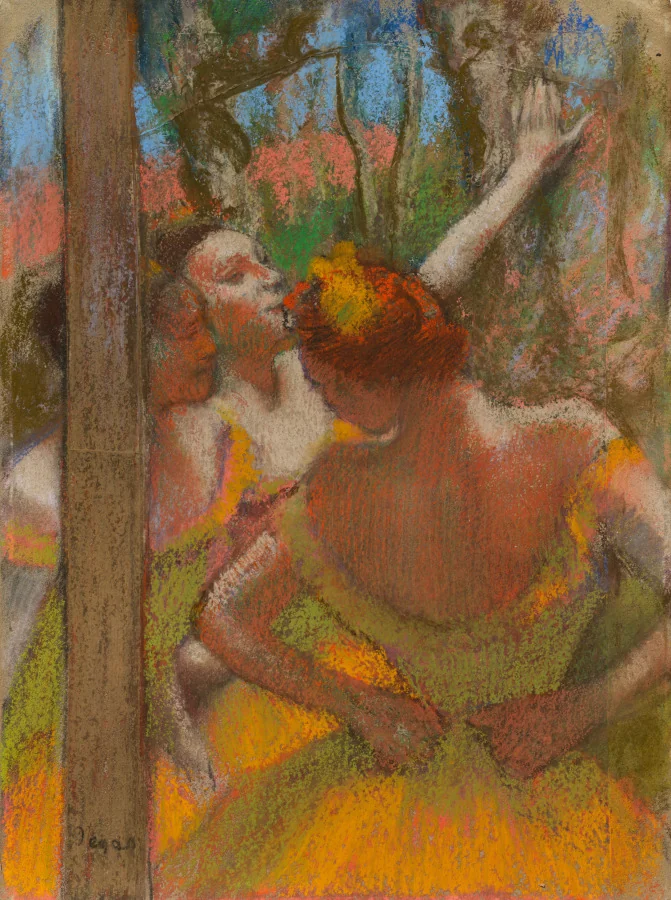
Degas depicted the ballet in more than 1,000 paintings, prints, pastels, and sculptures. He preferred private, offstage moments to glamorous curtain calls or artfully constructed compositions. Here, three dancers stretch together in the wings, unaware of the viewer’s presence. Powdery layers of yellow, orange, and pink pastel create a rough surface characteristic of Degas’s late work in the medium. He invented special techniques that allowed him to build layer upon layer of color with varying degrees of opacity and transparency. This pastel’s rich surface and intense, vibrating palette is the result of such innovative methods.
Provenance
Studio of the artist, sold to Durand-Ruel, Paris (1896-1897); (Durand-Ruel, Paris, transferred to Durand-Ruel, New York (1897-1898); (Durand-Ruel, New York, sold to Mr. and Mrs. Jeptha H. Wade, Cleveland, OH) (1898-1900); Mr. [1857–1926] and Mrs. [1857–1917] Jeptha H. Wade II, Cleveland, given to the Cleveland Museum of Art, Cleveland, OH (1900-1916); Cleveland Museum of Art, Cleveland, OH (1916-)
Accession Number
1916.1043
Medium
pastel with charcoal on tracing paper mounted on paper and backed with gray board
Dimensions
Sheet: 55.7 x 41.4 cm (21 15/16 x 16 5/16 in.)
Classification
Drawing
Credit Line
Gift of Mr. and Mrs. J. H. Wade
Tags
Drawing Impressionist & Modern (1851–1900) Pastel Charcoal Paper Board French Color: Orange Color: Gold
Background & Context
Background Story
This late pastel of dancers demonstrates Degas at his most radical. By 1896, his eyesight was failing badly, and he compensated by working in pastel with increasing freedom and intensity. The tracing paper support allowed him to transfer and rework compositions, but it also created a translucent ground that gives these late works their distinctive luminosity. The dancers are no longer individual portraits but near-abstract arrangements of color and movement — bodies compressed, repeated, and reshuffled like cards in a deck.
Cultural Impact
Degas's late pastels are among the most forward-looking works of the 19th century. The simplification of form, the emphasis on color blocks over outline, and the radical cropping all point toward 20th-century abstraction. These works were misunderstood and even mocked when first exhibited, but Matisse and Picasso studied them with reverence. The tracing paper support — a cheap, industrial material — adds another layer of innovation: Degas was willing to use anything that served his artistic purpose.
Why It Matters
These late pastels are Degas's final, greatest achievement. Failing eyesight forced him to work by touch and memory, and the result is art that has moved beyond vision into pure sensation.