Provenance
Purchased by Langdon Warner [1881–1955], as agent of the Cleveland Museum of Art (1917); The Cleveland Museum of Art, Cleveland, OH (1917–)
Accession Number
1917.1001
Medium
hanging scroll: ink and color on paper
Dimensions
Overall: 99.3 x 43.4 cm (39 1/8 x 17 1/16 in.)
Classification
Painting
Credit Line
Gift of the John Huntington Art and Polytechnic Trust
Tags
Painting Baroque (1600–1750) Ink Paper Japanese Color: Orange
Background & Context
Background Story
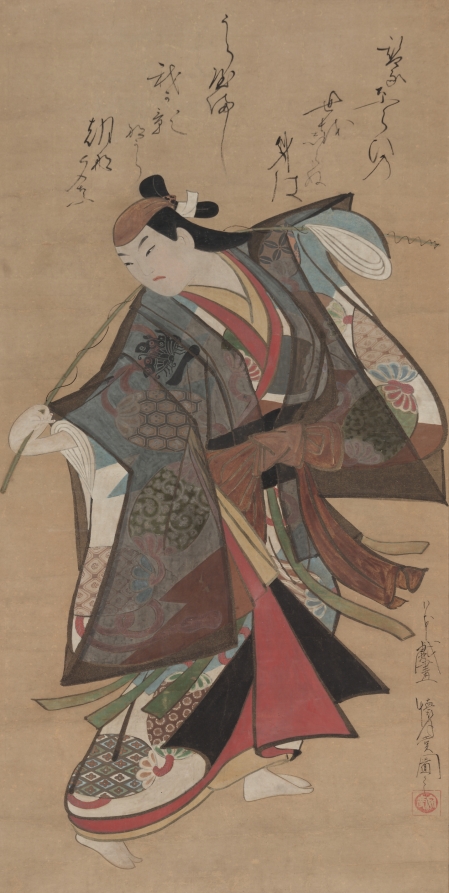
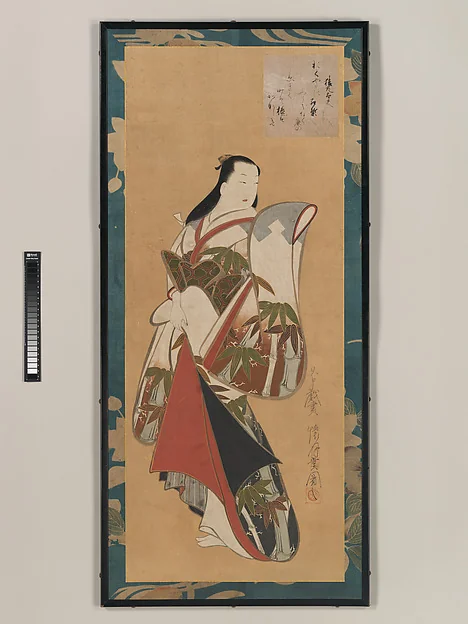
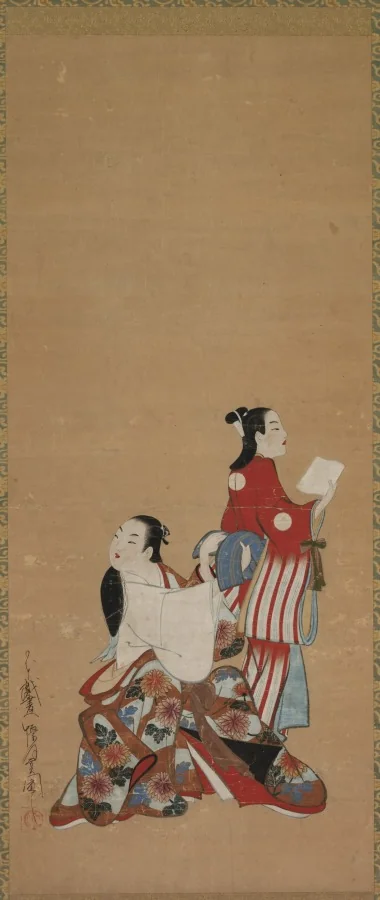
Kaigetsudo Ando (active c. 1700-1714) was a Japanese ukiyo-e painter and print designer known for the large-scale paintings of courtesans that are his most distinctive works. Courtesan and Attendant depicts a courtesan with her attendant in the bold, linear manner that distinguishes Kaigetsudo's best work from the more detailed ukiyo-e painting of his contemporaries. The bold outlines and simplified forms of Kaigetsudo's courtesan paintings represent a distinctive moment in ukiyo-e—the moment when the bold, linear manner of early ukiyo-e painting was at its most accomplished, before the more detailed manner of the mid-18th century would become dominant.
Cultural Impact
Courtesan and Attendant is important in the history of Japanese ukiyo-e because it demonstrates the bold, linear manner that distinguishes Kaigetsudo's best work from the more detailed ukiyo-e of the mid-18th century. Kaigetsudo's large-scale paintings of courtesans represent a distinctive moment in ukiyo-e—the moment when the bold, linear manner of early ukiyo-e painting was at its most accomplished—and his influence on the development of ukiyo-e painting and print design was profound.
Why It Matters
Courtesan and Attendant is Kaigetsudo's bold ukiyo-e: a courtesan with her attendant rendered in the bold outlines and simplified forms that distinguish his most distinctive work. The painting represents a distinctive moment in ukiyo-e when the bold, linear manner of early ukiyo-e painting was at its most accomplished, before the more detailed mid-18th century manner became dominant.