Description
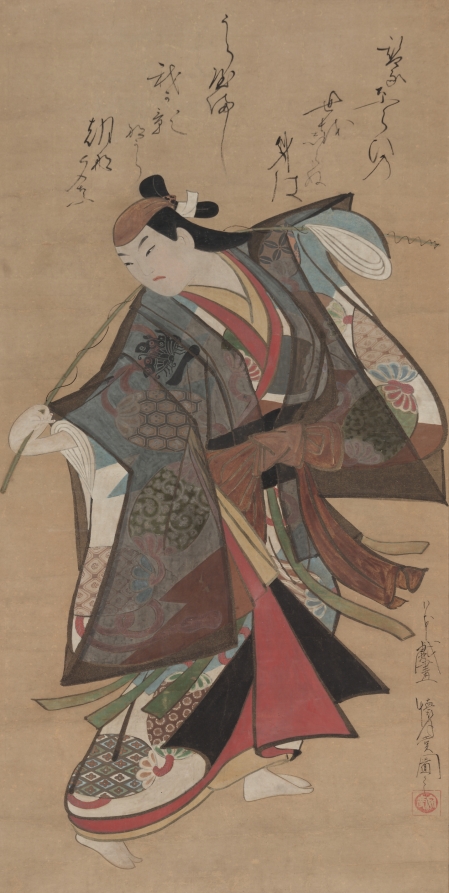
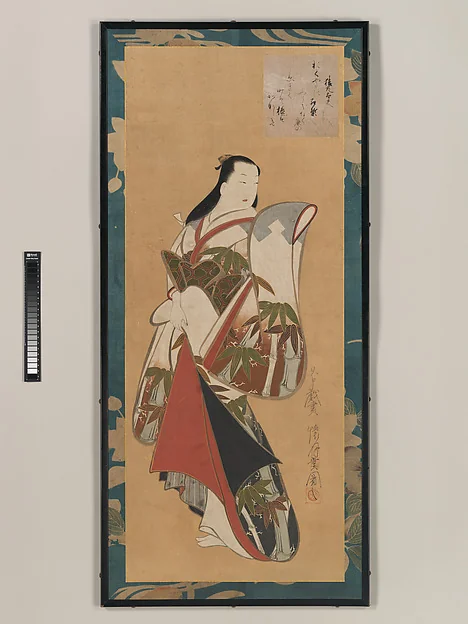
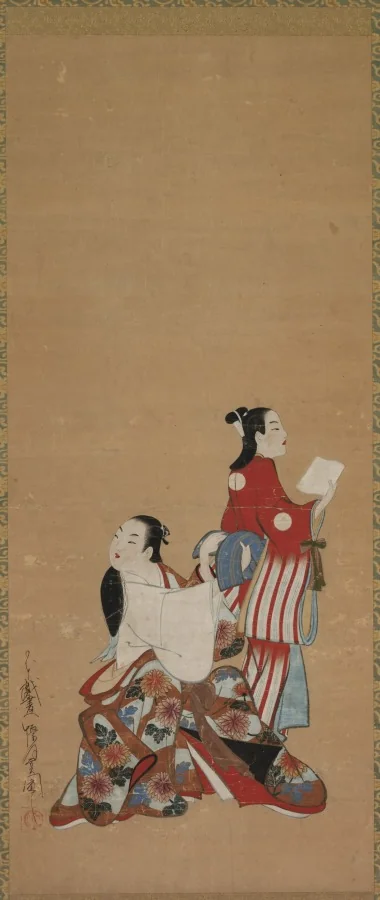
Paintings of the courtesans who provided men with a sophisticated menu of appealing fashions, flattery, witty banter, music, dancing, and sexual services in the Yoshiwara district of the city of Edo (Tokyo) were the bread and butter of the Kaigetsudō studio, in whose style this work is painted. Their paintings emphasized bold, sweeping calligraphic ink lines in rendering the figures’ forms, along with high-contrast colors and patterns in their typically solitary subjects’ garments. Aside from the occasional prop or poem, the space around the dramatic figure was left entirely blank.
Provenance
(Kozo Yabumoto, Hyogo, Japan, sold to Mr. and Mrs. Kelvin Smith) (?–1973); The Kelvin Smith Collection, Cleveland, OH, given by Mrs. Kelvin [Eleanor Armstrong] Smith [1899–1998] to the Cleveland Museum of Art (1973–1985); The Cleveland Museum of Art, Cleveland, OH (1985–)
Accession Number
1985.264
Medium
hanging scroll; ink and color paper
Dimensions
Overall: 182.9 x 53.4 cm (72 x 21 in.); Overall: 181.6 x 47.8 cm (71 1/2 x 18 13/16 in.); Painting only: 95.7 x 35.5 cm (37 11/16 x 14 in.); Painting only: 97.4 x 35.5 cm (38 3/8 x 14 in.)
Classification
Painting
Credit Line
The Kelvin Smith Collection, given by Mrs. Kelvin Smith
Tags
Painting Baroque (1600–1750) Ink Paper Japanese Color: White
Background & Context
Background Story
Kaigetsudo Ando (active early 1700s) was a Japanese painter known as the founder of the Kaigetsudo school, whose large-scale paintings of courtesans make him one of the most important painters of the early Edo period. Courtesan from the 1700s depicts a courtesan in the large-scale, boldly composed manner that distinguishes Kaigetsudo's best work from the more delicate painting of his contemporaries. Kaigetsudo was known for his large-scale paintings of courtesans that combined bold composition with the elegant manner of the early Edo period, and the 1700s date places this in the period when the Kaigetsudo school was producing its most accomplished work.
Cultural Impact
Courtesan is important in the history of Japanese painting because it demonstrates the large-scale, boldly composed manner that Kaigetsudo brought to courtesan paintings as the founder of the Kaigetsudo school. Kaigetsudo's large-scale courtesan paintings—combining bold composition with the elegant manner of the early Edo period—represent one of the most important developments in Edo period painting, and the 1700s painting shows this development at its most bold.
Why It Matters
Courtesan is Kaigetsudo's bold Edo courtesan: a courtesan rendered in the large-scale, boldly composed manner of the founder of the Kaigetsudo school. The 1700s painting shows the combination of bold composition with elegant manner that makes Kaigetsudo one of the most important painters of the early Edo period.