Provenance
Paulding Farnham, New York; Emerson McMillin (New York sale 1913); Charles W. Harkness, New York (1916); Edward S. Harkness, New York
Accession Number
1927.387
Medium
oil on canvas
Dimensions
Unframed: 39.3 x 67.3 cm (15 1/2 x 26 1/2 in.)
Classification
Painting
Credit Line
The Charles W. Harkness Gift
Tags
Painting Impressionist & Modern (1851–1900) Oil Painting Canvas American Color: Orange
Background & Context
Background Story
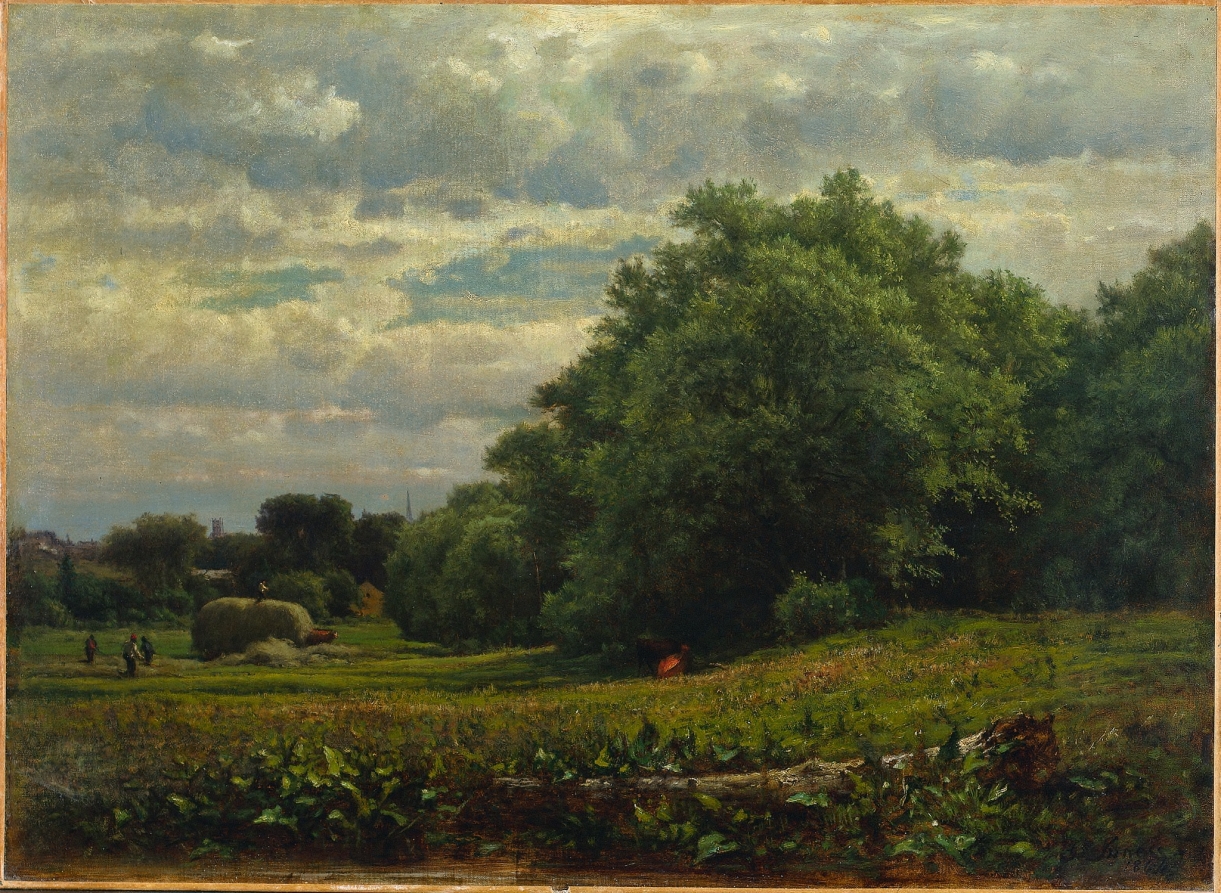
Durham, Connecticut (1858) is an early work depicting the Connecticut River Valley town of Durham—one of New England's most productive agricultural communities. The painting dates from Inness's formative period, when he was developing the approach to landscape that would eventually produce the mature Tonalist style. The Durham landscape—with its broad valley, fertile fields, and characteristic New England architecture—provided the kind of settled, working landscape that would remain Inness's preferred subject throughout his career. The year 1858 places this work during Inness's early engagement with Hudson River School conventions: the composition likely reflects the influence of Asher Durand and other second-generation Hudson River painters who emphasized naturalistic observation. Yet even in this early work, Inness's distinctive preference for atmosphere over topography is visible—the landscape's specific features are subordinated to the overall mood of light and air that would become his signature. Durham, Connecticut was also significant as the location of the Durham Agricultural Fair, the oldest agricultural fair in Connecticut, and Inness's painting captures the agricultural prosperity that the fair celebrated.
Cultural Impact
Inness's early Connecticut landscapes influenced the development of American Tonalist painting by demonstrating how Hudson River School conventions could be adapted toward more atmospheric ends. The paintings influenced how the Connecticut River Valley was represented in American art, establishing conventions for depicting its characteristic valley scenery. The Durham subject specifically contributed to the visual record of Connecticut's agricultural communities at a specific historical moment.
Why It Matters
This painting matters because it provides a key document in the development of Inness's personal style—the moment when Hudson River School influence began to give way to the Tonalist vision that would define his mature work. For art historians, it illuminates how artistic innovation emerges from the revision of existing conventions rather than their rejection.