Description
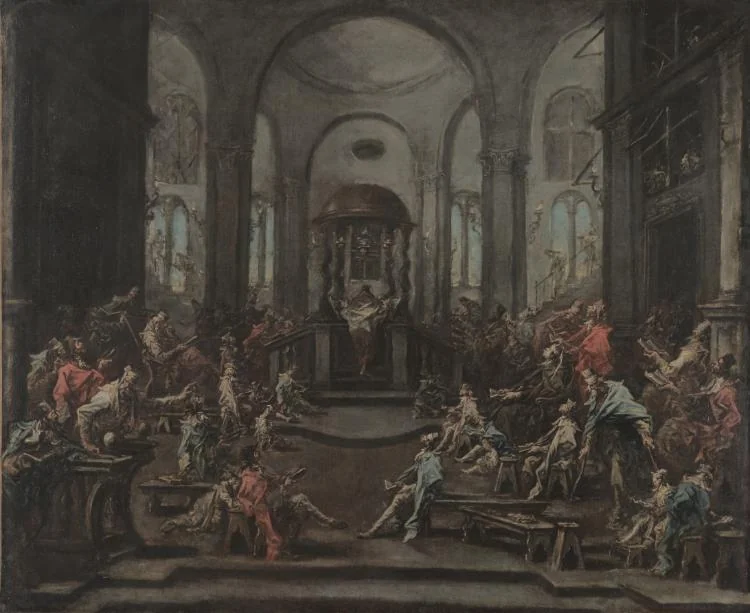
The Jewish synagogue was among Magnasco's most frequently painted subjects, here presented in a mystical and imaginative way. Expansive architectural space creates room for a multitude of tiny, fantastical figures with elongated limbs. These characters respond to the service with emotion and expressive gestures. Flashes of light dash across the surface against a dark, muted palette of earthy tones suggesting an otherworldly presence. The composition invites the viewer to enter the space and experience the service. Though he used characteristic elements of Baroque composition and was strongly influenced by Venetian painting, Magnasco's loose brushwork, elongated figures, and mysterious subject matter set him apart. Magnasco peers into a world of which he was not part: he was not Jewish and probably perceived Jews as outsiders. At the dawn of the Enlightenment in Europe progressive aristocratic families commissioned paintings by Magnasco, suggesting the painter's support for Enlightenment ideals which included religious tolerance, but Magnasco's personal views on Judaism in Italy remain unknown.
Provenance
Private collection, sold Hotel Drouot, Paris, 1928; D'Atri Gallery (Paris, France); Benno Geiger, 1882-1965 (Vienna, Austria); Italico Brass (Venice, Italy), 1870-1943, sold through Harold Parsons to the Cleveland Museum of Art, 1930.; The Cleveland Museum of Art, Cleveland, OH (1930-)
Accession Number
1930.22
Medium
oil on canvas
Dimensions
Framed: 140.5 x 167.5 x 6 cm (55 5/16 x 65 15/16 x 2 3/8 in.); Unframed: 122 x 148.5 cm (48 1/16 x 58 7/16 in.)
Classification
Painting
Credit Line
Purchase from the J. H. Wade Fund
Tags
Painting Baroque (1600–1750) Oil Painting Canvas Italian Color: Brown
Background & Context
Background Story
Interior of a Synagogue is one of Magnasco's most distinctive subjects—a depiction of Jewish worship in a period when such subjects were extremely rare in Italian painting. Magnasco painted several synagogue interiors, drawn from the Jewish communities of northern Italy (particularly Livorno and Venice), and his treatment is notable for its respectful attention to the details of Jewish ritual and its characteristically dramatic use of light streaming through high windows into a dark interior. The elongated figures of the worshippers, the rabbinical scholars bent over their texts, and the architectural setting all receive Magnasco's signature rapid brushwork, creating an image of religious devotion that is simultaneously specific and visionary.
Cultural Impact
Magnasco's synagogue interiors are among the few depictions of Jewish religious life in 18th-century Italian art, and their respectful treatment distinguishes them from the anti-Jewish caricatures that were more common in the period. Magnasco was drawn to marginal and outsider communities—monks, beggars, Jews, and prisoners—and his synagogue paintings suggest an empathy with religious devotion in its most intense and least conventional forms.
Why It Matters
Interior of a Synagogue is Magnasco's most socially significant subject: a respectful depiction of Jewish worship in a period when such images were rare. The dramatic light streaming through the windows illuminates the worshippers with the same visionary intensity that Magnasco brought to his Catholic subjects—devotion recognized across religious boundaries.