Description
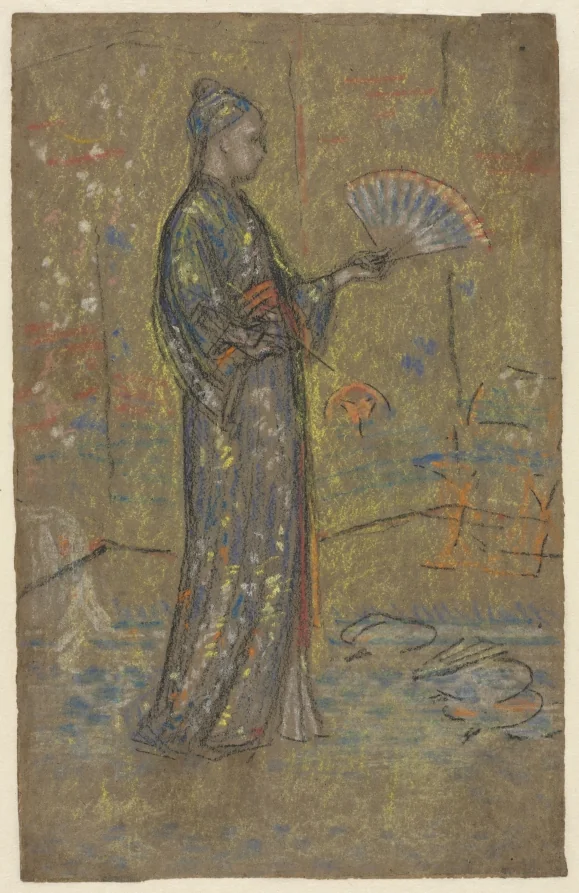
In 1872 Whistler was commissioned to contribute two designs to complete the decorative scheme of 35 monumental portrait mosaics installed in the south court of the South Kensington Museum in London (now the Victoria and Albert Museum). A celebration of the arts, the mosaics represented male artists throughout history; Whistler’s two designs attempted to correct the gender imbalance. His subjects were a woman at a spindle and a Japanese woman painting a fan. Here, a brush is poised in the figure’s right hand—notice the sharp diagonal line above the orange butterfly—as she pauses to contemplate the fan she is painting. The commission went unfulfilled, and all that survives is this pastel study.
Provenance
[]
Accession Number
1933.222.a
Medium
black chalk and pastel
Dimensions
Sheet: 27.9 x 17.6 cm (11 x 6 15/16 in.); Secondary Support: 38.5 x 28.9 cm (15 3/16 x 11 3/8 in.)
Classification
Drawing
Credit Line
Gift of Mrs. Henry A. Everett for the Dorothy Burnham Everett Memorial Collection
Tags
Drawing Impressionist & Modern (1851–1900) Pastel American Color: Brown
Background & Context
Background Story
Japanese Woman Painting a Fan from c. 1872 is one of Whistler's most beautiful works on paper, depicting a woman in Japanese dress painting a fan in the combination of black chalk and pastel that allows both linear definition and coloristic subtlety. The subject—a woman painting a fan—is itself a reference to the Japanese aesthetic that Whistler championed throughout his career, and the drawing's combination of Japanese subject and Western technique demonstrates the cultural synthesis that Whistler's Japonisme achieved at its best. The c. 1872 date places this in the period when Whistler was deeply engaged with Japanese art and culture, decorating his famous Peacock Room with Japanese-inspired motifs.
Cultural Impact
Whistler's Japanese subjects are among the most important works in the history of Japonisme because they demonstrate how Japanese aesthetics could be synthesized with Western techniques to create works that are neither Japanese nor Western but something new. Japanese Woman Painting a Fan is simultaneously a reference to Japanese culture and a demonstration of Whistler's own drawing technique—a synthesis of East and West that defines the best Japonisme.
Why It Matters
Japanese Woman Painting a Fan is Whistler's Japonisme at its most beautiful: a Japanese subject rendered in black chalk and pastel with Western technique, creating a synthesis of East and West that defines the most creative form of cultural influence. The c. 1872 date places this in Whistler's most productive Japoniste period, when Japanese aesthetics and Western technique were achieving their most creative synthesis.