Description
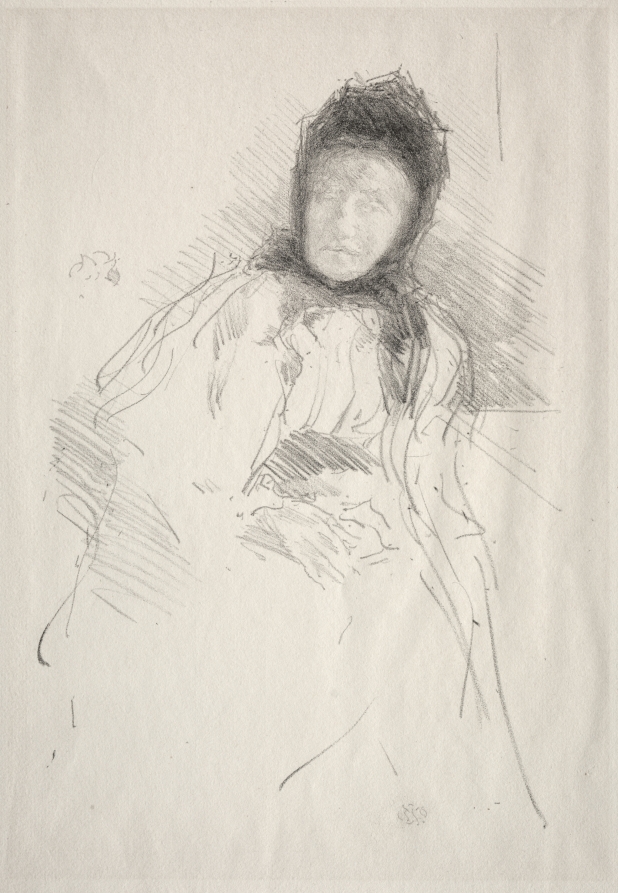
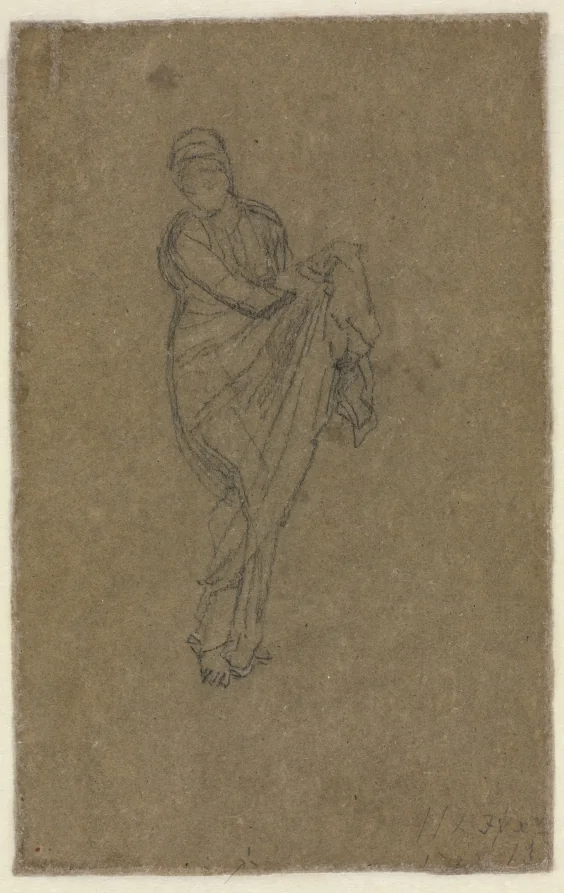
After being expelled from the U.S. Military Academy at West Point, Whistler made his way to Europe, where he pursued the life of the artist-bohemian, first in Paris, and then in London. Whistler was a pioneer in appreciating the effects of Japanese prints, and his art is characterized by an Asian subtlety and delicacy. Whistler signed his work with a monogram representing a butterfly, which appears just below the hand of the model in this drawing.
Provenance
[]
Accession Number
1933.222.b
Medium
black chalk or crayon
Dimensions
Sheet: 27.9 x 17.6 cm (11 x 6 15/16 in.); Secondary Support: 38.5 x 28.9 cm (15 3/16 x 11 3/8 in.)
Classification
Drawing
Credit Line
Gift of Mrs. Henry A. Everett for the Dorothy Burnham Everett Memorial Collection
Tags
Color: Brown
Background & Context
Background Story
The verso of Whistler's double-sided sheet features "Standing Woman Holding Up Her Dress," executed in black chalk or crayon. This drawing shows a woman in Western dress, gathering her skirt—a gesture that reveals the artist's interest in the fall of fabric and the movement of drapery. Unlike the recto's explicit Japonism, this study is pure observation, likely drawn from a model in Whistler's studio. The black chalk medium allows for rapid, fluid strokes, capturing the momentary gesture with freshness and spontaneity. Whistler was known for his insistence on drawing from life, training his eye to capture the essential character of a pose with minimal means. The contrast between the two sides of this sheet is illuminating: the recto engages with an exotic, stylized Japanese world, while the verso returns to the familiar Western body in its everyday reality. Together, they show an artist moving between two aesthetic worlds, absorbing the lessons of Japanese art while remaining grounded in the Western studio tradition of figure drawing from life.
Cultural Impact
This double-sided sheet provides a rare window into Whistler's creative process, showing him simultaneously engaged with Japonist fantasy and realist observation, two poles of his artistic personality.
Why It Matters
The verso drawing reveals the foundation of Whistler's art: a commitment to direct observation and the disciplined study of the human figure that underlay even his most stylistically adventurous works.