Description
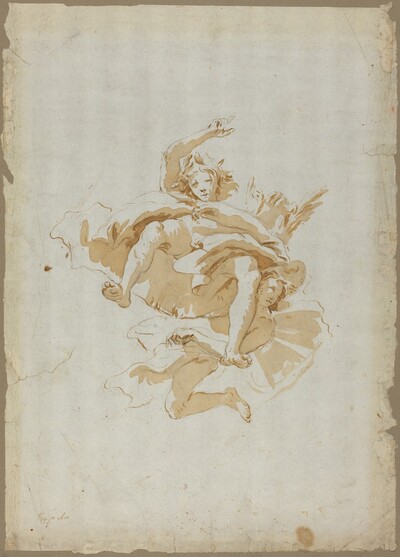
Universally considered one of the greatest artists of the Italian Renaissance, Michelangelo devoted four years to painting the vast ceiling fresco in the Sistine Chapel. This preparatory study portrays one of the 20 athletic male nudes, known as ignudi, who serve as supporting figures at each corner of the Old Testament scenes painted down the center of the ceiling. Michelangelo worked out the positioning of the ignudi in red chalk drawings before beginning to paint each section of wet plaster. The energy and monumentality of the figure in red chalk, whose body extends beyond the sheet, suggests the heroic athleticism of Michelangelo’s sculpture.
Provenance
Pierre Crozat, Paris (L. 3612), his sale 1741 (1741); Pierre Jean Mariette (L. 1852), Paris, his sale 1775-76, lot 236 (1775-76); Bürckel family, Vienna; Dr. Alexander de Frey, Temesvar, Romania, his sale, 1933, lot 7 (as school of Michelangelo) (1933); with Wildenstein & Co., New York (1934-37); purchased by Henry G. Dalton (1862-1939), Cleveland (1937); by descent to his nephews George S. and Harry D. Kendrick, Cleveland (1939); gift to The Cleveland Museum of Art, Cleveland, OH (1940-)
Accession Number
1940.465.a
Medium
red chalk over black chalk or charcoal
Dimensions
Sheet: 34.3 x 24.3 cm (13 1/2 x 9 9/16 in.); Secondary Support: 34.4 x 24.4 cm (13 9/16 x 9 5/8 in.)
Classification
Drawing
Credit Line
Gift in memory of Henry G. Dalton by his nephews George S. Kendrick and Harry D. Kendrick
Tags
Color: Orange Color: White
Background & Context
Background Story
This red chalk drawing (1510–1511) by Michelangelo is a more detailed study of the ignudo (nude youth) positioned above the Prophet Daniel on the Sistine Chapel ceiling. Where the companion sheet (299038) explores the overall pose and composition, this study focuses more intensely on the figure's torso, shoulders, and the rotation of the upper body that gives the ignudo its characteristic dynamism. Michelangelo's red chalk technique is on full display: parallel hatching follows the contours of the muscles, modeling form through the density and direction of the lines. The drawing feels immediate and alive, as if Michelangelo's hand moved across the paper with the same energy and certainty that conceived the figure. The Sistine ignudi are among the most famous nudes in all of art—they serve no narrative function but exist as pure expressions of Michelangelo's belief in the beauty and dignity of the human body as created by God. This study shows how Michelangelo worked out the precise anatomical relationships that would give each ignudo its unique character and sense of contained energy.
Cultural Impact
Michelangelo's Sistine preparatory drawings are foundational documents of High Renaissance art, studied by artists for centuries as the ultimate expression of disegno—the intellectual foundation of painting through drawing.
Why It Matters
This focused anatomical study reveals the extraordinary intellectual and physical discipline behind Michelangelo's Sistine Ceiling, where every muscle and sinew of the ignudi was considered with scientific precision and artistic genius.