Description
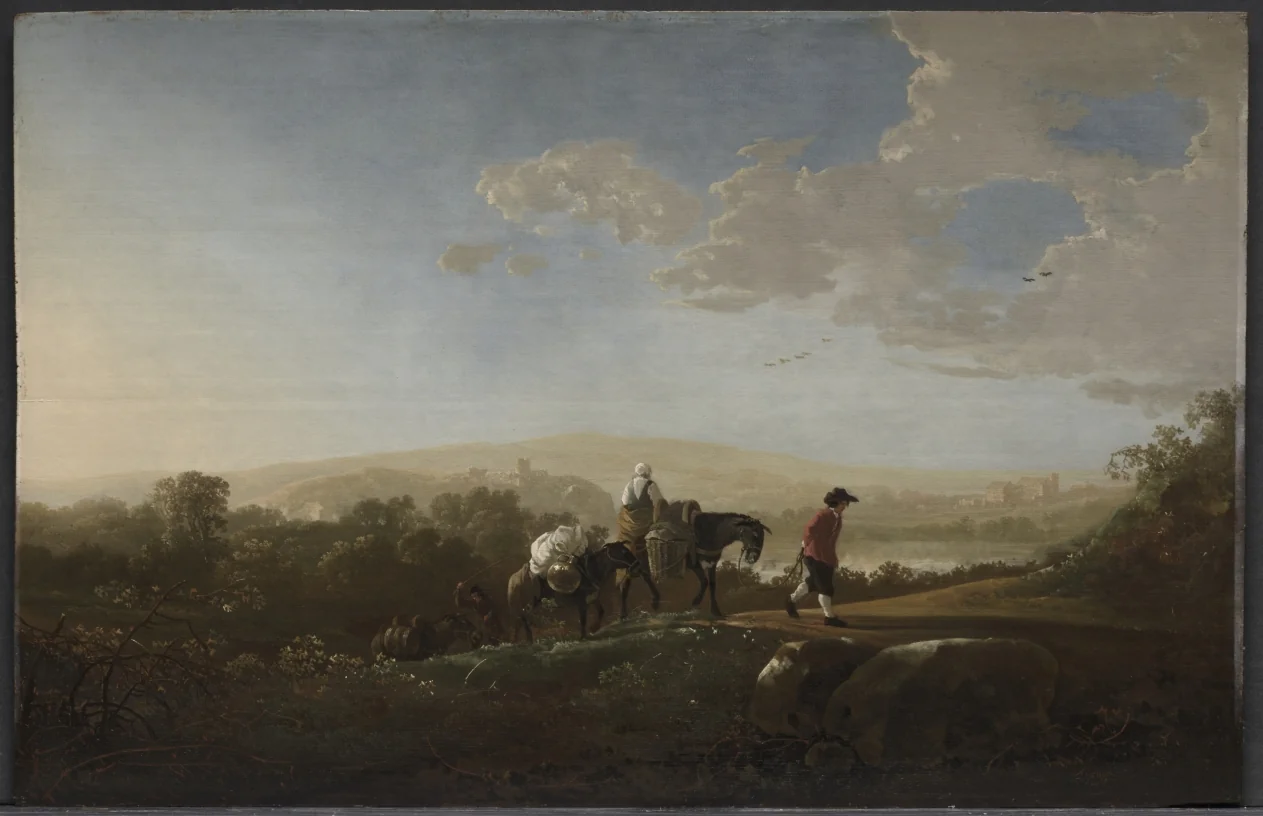
While many Dutch painters focused on depicting the local countryside, others were inspired by the hilly topography, golden sunlight, and picturesque monuments of Italy. Although Aelbert Cuyp never visited Italy, this serene and beautifully preserved panel demonstrates his skill in evoking the idyllic qualities of a distant land.
Provenance
Johan van der Linden van Slingeland, Dordrecht (sale:Yver, Dordrecht, August 22, 1785, no. 87);; Sir Simon Clarke, London (sale: Christie's, London, May 14, 1802);; George Hibbert, London (sale: Christie's, London, June 13,1829, no. 66);; Richard Foster, London (sale: Christie's, November 14, 1835);; Henry Bevan, London, 1842;; Sir John Dean Paul (grandson of Henry Bevan); [A. Wertheimer, London];; Alfred de Rothschild, London;; [Galerie Charles Brunner, Paris, 1912, no. 7];; John L. Severance, Cleveland, 1923, upon his death, held in trust by the estate; Estate of John L. Severance, 1936, by bequest to the Cleveland Museum of Art, 1942.
Accession Number
1942.637
Medium
oil on wood
Dimensions
Framed: 70.8 x 96.6 x 9 cm (27 7/8 x 38 1/16 x 3 9/16 in.); Unframed: 48 x 74.5 cm (18 7/8 x 29 5/16 in.)
Classification
Painting
Credit Line
Bequest of John L. Severance
Tags
Painting Baroque (1600–1750) Oil Painting Dutch Color: Brown Color: Gray
Background & Context
Background Story
Travelers in Hilly Countryside (c. 1650) represents Cuyp's engagement with landscape types beyond his usual flat Dutch terrain. The hilly countryside—rare in the Netherlands—suggests either a foreign setting (the Rhineland, where Dutch painters sometimes traveled) or an imagined landscape influenced by Italianate conventions. The travelers, making their way through terrain more dramatic than typical Dutch flatland, provide narrative interest and compositional structure while testing Cuyp's ability to render varied topography. The painting demonstrates Cuyp's versatility: the artist famous for flat, sun-drenched pastures also handled hilly, forested terrain with assurance. The travelers themselves—whether merchants, pilgrims, or tourists—represent the mobility that characterized Dutch Golden Age society. Dutch citizens traveled extensively for business and pleasure, and landscape paintings of travelers celebrated this mobility while providing the narrative hook that engaged viewers. The 1650 dating places this in Cuyp's middle period, when he was expanding his geographical and compositional range before settling into the golden pastoral mode that would dominate his later production.
Cultural Impact
Cuyp's varied landscape paintings influenced the broader Dutch tradition of travel landscape, contributing to how journeys through landscape were represented in art. The paintings influenced English landscape painters who also worked in hilly terrain—particularly those in the Welsh and Lake District traditions. The subject also influenced how the Dutch Republic's commercial mobility was culturally represented and celebrated.
Why It Matters
This painting matters because it demonstrates that Cuyp's artistic achievement was not limited to his signature pastoral mode. His ability to handle hilly, forested, and varied terrain shows a broader technical range than his most famous works suggest. For art historians and collectors, it reveals a more versatile Cuyp than the artist of golden pastures—enriching our understanding of Dutch landscape painting's full scope.

![Saint Bernard and Saint Catherine of Alexandria with the Virgin of the Annunciation [right panel]](https://api.nga.gov/iiif/e6890364-4d99-4684-a62b-5060ee3c3446/full/400,/0/default.jpg)