Accession Number
1942.889
Medium
oil on canvas
Dimensions
Unframed: 25.5 x 51 cm (10 1/16 x 20 1/16 in.)
Classification
Painting
Credit Line
Gift of Mrs. S. Prentiss Baldwin
Tags
Painting Impressionist & Modern (1851–1900) Oil Painting Canvas American Color: Yellow Color: Green
Background & Context
Background Story
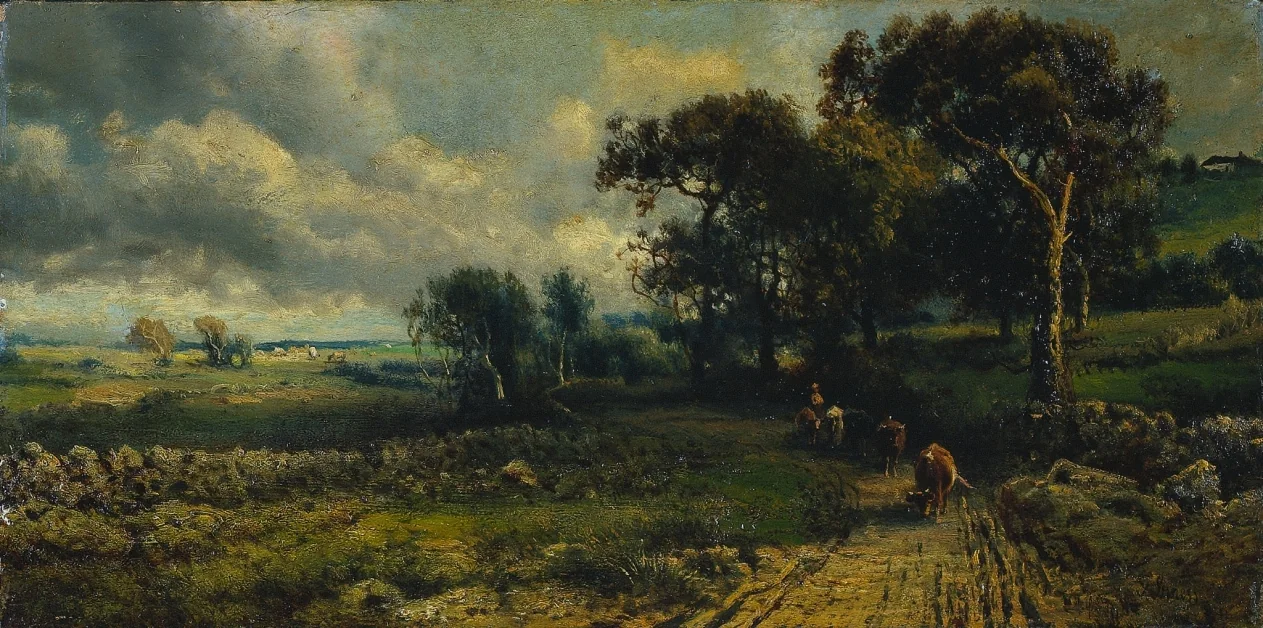
Fleecy Clouds (1881) represents Inness's lifelong engagement with the American sky as landscape painting's most important element. The title's specific reference to the clouds' quality—fleecy, suggesting softness, lightness, and the particular texture of cumulus clouds on a fine day—reveals how closely Inness observed atmospheric conditions. For Inness, the sky was not merely background for the landscape; it was the landscape's determining element, creating the light, the color, and the mood that gave the scene its character. The year 1881 places this during the period when Inness was consolidating his mature style and producing some of his most admired works. The painting likely emphasizes the clouds' visual effect—their shadows on the landscape below, the light breaking between them, and the atmospheric depth they create—rather than cataloging their meteorological details. Inness's Tonalist approach treats the clouds as elements in a unified atmospheric composition: their forms are suggested rather than delineated, their edges dissolve into the surrounding sky, and their function is to modulate the light that illuminates the entire scene. The painting's specific reference to cloud quality also connects Inness to the broader 19th-century scientific interest in atmospheric phenomena—a cultural context that gave landscape painting both artistic and intellectual significance.
Cultural Impact
Inness's cloud paintings influenced how the American sky was represented in art, establishing conventions for atmospheric painting that influenced later American Tonalist and Luminist painters. The paintings influenced the broader tradition of sky painting in American landscape art, demonstrating that the sky could be the primary subject rather than merely the background. The cloud subject influenced how American weather and atmospheric conditions were visually understood and represented.
Why It Matters
This painting matters because it demonstrates Inness's conviction that atmosphere—not topography—is landscape painting's essential subject. The fleecy clouds create the light that defines the landscape below, making them the scene's true protagonists. This emphasis on atmosphere over form distinguishes Tonalism from the Hudson River School and anticipates the atmospheric abstraction of early American modernism.