Provenance
Unidentified collector's mark, grey stamp "C", verso (not in Lugt); Valerius Röver (1686-1739), Delft (Lugt 2984a-c), album 6, no. 14; his widow, Delft (1739-1761); with Hendrik de Leth (1761); Johann Goll van Franckenstein (1722-1785) and his son (1750-1821), Amsterdam (1761); Emile Wauters, Brussels (Lugt 911, lower right, in black ink) (-1926); [his sale Frederick Muller & Co., Amsterdam, 15-16 June 1926, lot 172] (1926); Henry Oppenheimer, London (Lugt 1351, not stamped); (1926-1936); [his sale, Christie's, London, 10, 13-14 July 1936, lot 305, cat. by K.T. Parker] (1936); Mr. and Mrs. David Birnbaum, New York (1942); with Mortimer Brandt Gallery, New York (1943); Cleveland Museum of Art, Cleveland OH, USA (1943-)
Accession Number
1943.341
Medium
black chalk and brush and brown wash; framing lines in pen and black ink
Dimensions
Sheet: 37.8 x 26.2 cm (14 7/8 x 10 5/16 in.)
Classification
Drawing
Credit Line
Purchase from the J. H. Wade Fund
Tags
Color: White
Background & Context
Background Story
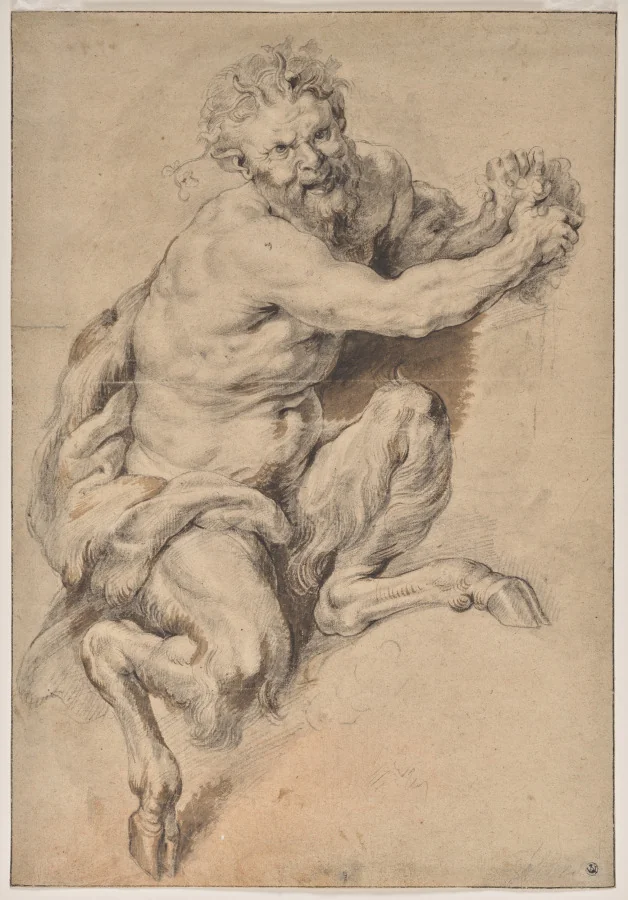
Peter Paul Rubens, the preeminent Flemish Baroque painter, created this dynamic drawing of a faun after 1616–18, a period when his workshop in Antwerp was at peak productivity. Executed in black chalk with brush and brown wash, the sheet demonstrates Rubens's extraordinary ability to suggest volume, movement, and vitality with minimal means. The brown wash—applied with a brush over the chalk underdrawing—creates pools of shadow that give the faun's muscular body a sense of three-dimensional mass and dramatic chiaroscuro.
The subject is a faun, a half-human, half-goat creature from Roman mythology associated with the god Faunus and the rustic realm of woodlands, wine, and untamed instinct. The faun grasps a bunch of grapes, symbolizing Bacchic excess and the sensual pleasures of the harvest. His head is thrown back, mouth slightly open, in an expression of ecstatic abandon. Rubens captures the creature's hybrid nature: the human torso rendered with anatomical precision, the pointed ears and small horns marking his supernatural identity. The rapid, confident strokes of the chalk define musculature with a fluency that only a master draftsman could achieve.
This drawing likely served as a study for a larger composition—possibly a Bacchanalian scene or a tapestry design. Rubens maintained a vast workshop producing paintings for the courts of Europe, and drawings like this were essential tools of his creative process. They allowed him to capture fleeting poses and refine figural ideas before committing them to the final canvas. The sheet bears the distinctive energy of Rubens at his most spontaneous, a testament to drawing as an act of thinking on paper.
Cultural Impact
Rubens transformed Flemish Baroque painting by synthesizing the monumental energy of Michelangelo, the color of Titian, and the naturalism of Northern Renaissance traditions. His drawings were foundational to his workshop practice—studied, copied, and disseminated across Europe through engravings. This faun drawing connects to the broader Renaissance and Baroque fascination with antique sculpture and bacchic themes, a thread running from the Hellenistic Faun of Praxiteles to Rubens's own painted bacchanals in the Louvre and the Hermitage. The vigorous chalk-and-wash technique influenced generations of draftsmen, from Van Dyck to Delacroix.
Why It Matters
A masterful demonstration of Rubens's draftsmanship—bold, energetic, and sculptural—capturing the bacchantic spirit of antiquity with Baroque exuberance.