Description
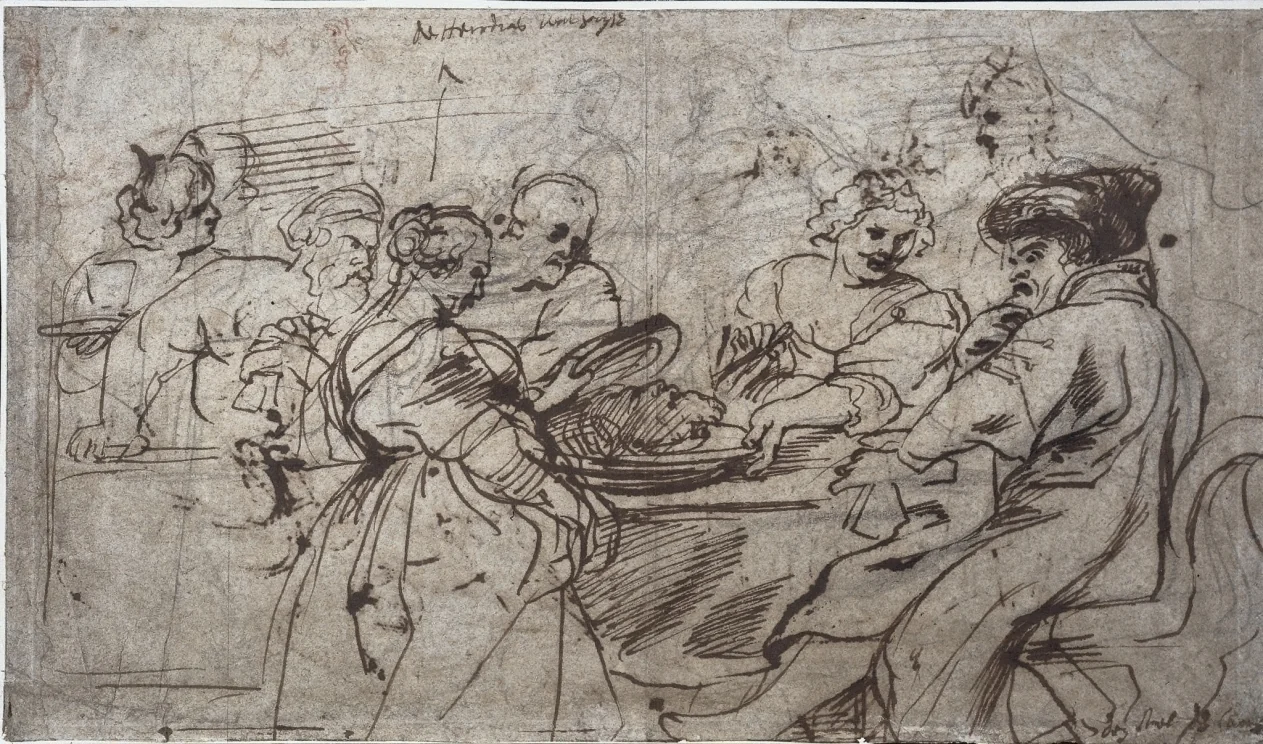
Peter Paul Rubens had a large studio in Antwerp and used drawing to prepare for large paintings as well as to direct the many pupils who assisted him. Striking in its immediacy, the drawing on the recto of this sheet of paper is a preparatory study for the Feast of Herod painting now at the Scottish National Gallery in Edinburgh. Herod, wearing a large cap and wrapped in a mantle, shrinks back in horror as Salome uncovers a charger that holds the head of Saint John the Baptist. Smiling, Herodias grabs the platter with her left hand and, in a chilling detail, gestures toward the charger with a fork. Rubens wrote what is usually interpreted as “Herodias somewhat higher” at the top of the sheet. The verso of the sheet depicts a sketch for another story featuring a change of fortune at the hands of a vengeful woman, Tomyris with the Head of Cyrus. Rubens made two paintings of the subject (now in Paris and Boston). A rare theme, the story tells of Queen Tomyris who, avenging the death of her son in battle, collects the head of his murderer Cyrus in a bag of human blood. Tomyris is shown seated under a canopy holding a scepter, while the servants before her handle Cyrus’s head. Rubens wrote “plus spatij” (more space) in the center of the sheet.
Provenance
Unidentified collector (Lugt 622, verso, lower right, in black ink, probably Austrian collection c. 1800); English private collection (According to Burchard and d'Hulst, Antwerp, 1956); [Herbert N. Bier]. Purchased by the Cleveland Museum of Art in 1954.
Accession Number
1954.2.a
Medium
pen and brown ink, with black and red chalk, touched with white gouache
Dimensions
Sheet: 27.2 x 47.2 cm (10 11/16 x 18 9/16 in.); Secondary Support: 27.6 x 47.3 cm (10 7/8 x 18 5/8 in.)
Classification
Drawing
Credit Line
Delia E. Holden and L. E. Holden Funds
Tags
Drawing Baroque (1600–1750) Ink Gouache Flemish Color: Brown Color: Gray
Background & Context
Background Story
The Feast of Herod is a preparatory drawing for one of the most dramatic scenes in Rubens' oeuvre: the moment when Salome presents the head of John the Baptist to Herod at a banquet. The drawing, executed in pen and brown ink with black and red chalk and touches of white gouache, shows Rubens' working method at its most revealing—the rapid pen strokes establish the composition, the chalk adds tonal modeling, and the white gouache provides highlights that anticipate the final painting's dramatic lighting. The verso of the sheet contains a different composition (Tomyris with the Head of Cyrus), making this a double-sided working document that reveals Rubens' ability to think in compositions.
Cultural Impact
The Feast of Herod was one of Rubens' most horrific and dramatic subjects, and this drawing shows him working through the compositional problems of fitting a gruesome subject into the social setting of a banquet. The drawing medium allows for rapid experimentation—the pen strokes are quick and decisive, and the chalk and gouache add tonal modeling that would be refined in the final painting. The combination of media indicates a serious preparatory study, not a quick sketch.
Why It Matters
The Feast of Herod drawing is Rubens' thinking process made visible: pen for composition, chalk for modeling, gouache for highlights, and the rapid strokes of a master who knows exactly what he wants but is still working out how to get there. The recto/verso format shows an artist who thinks in compositions, using both sides of the paper.