Description
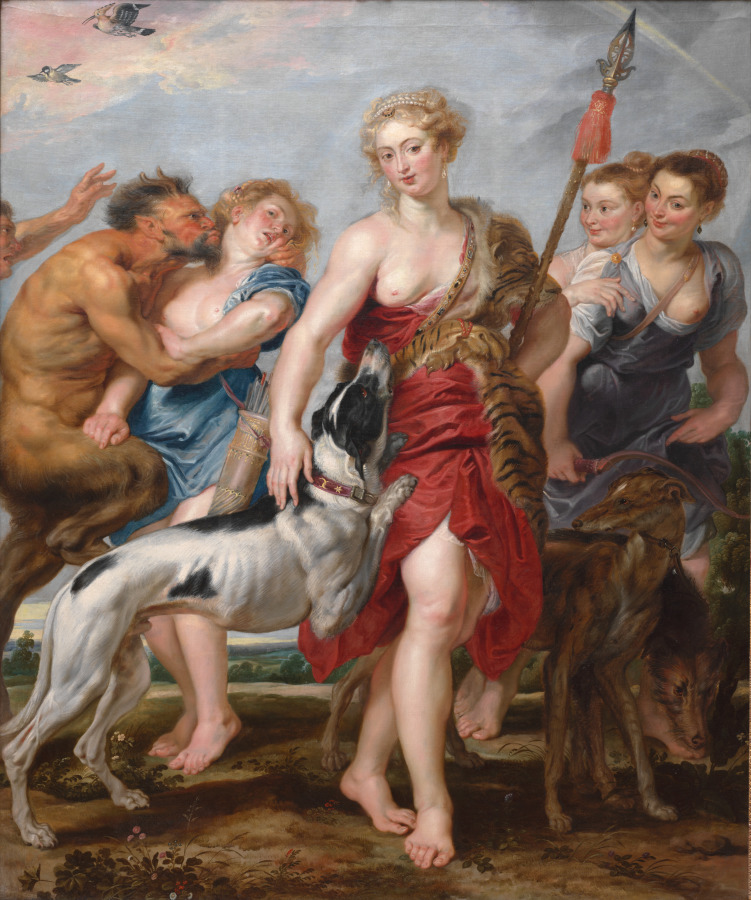
This work is likely a copy after Rubens’s oil sketch for the Triumph of the Eucharist tapestry series. Isabella, daughter of King Phillip II of Spain, commissioned the tapestries for a royal monastery in Madrid. The finished tapestries still hang there today, and the original oil sketch is in the Museo del Prado, Madrid.
Provenance
Madrazo (Madrid, Spain);; M. Thiers, President of the French Republic (Paris, France);; Duchesse de Bauffremont (Paris, France);; E. Warneck (Paris, France);; - 1891 Durand-Ruel (Paris, France);; 1891 - 1914 Mr. and Mrs. Jeptha H. Wade (Gates Mills, Ohio), by gift to the Cleveland Museum of Art, 1916.
Accession Number
1916.1037
Medium
oil on wood
Dimensions
Framed: 129.5 x 96.5 x 8.5 cm (51 x 38 x 3 3/8 in.); Unframed: 74.1 x 105.7 cm (29 3/16 x 41 5/8 in.)
Classification
Painting
Credit Line
Gift of Mr. and Mrs. J. H. Wade
Tags
Painting Baroque (1600–1750) Oil Painting Flemish Color: Orange
Background & Context
Background Story
The Triumph of the Church is a modello (preparatory oil sketch) for one of the tapestry series that Rubens designed for the convent of the Descalzas Reales in Madrid. The subject—the Church triumphant over paganism and heresy—was a central theme of Counter-Reformation iconography, and Rubens' composition presents it with the dynamism and physical exuberance that characterize his best work. The Church, personified as a female figure, rides in a chariot pulled by symbolic animals, trampling the fallen figures of paganism beneath its wheels. The composition is a tour de force of Baroque movement, with every element arranged to convey the forward momentum of the advancing Church.
Cultural Impact
The Triumph of the Church was one of Rubens' most important Counter-Reformation commissions, and the tapestry series for which this modello was prepared was among the most significant religious art projects of the early 17th century. Rubens' ability to translate complex theological concepts into dynamic visual compositions made him the preferred artist of the Counter-Reformation Church, and this modello demonstrates why: the abstract concept of the Church's triumph is made physically immediate through the energy of the composition and the sensuous beauty of the figures.
Why It Matters
The Triumph of the Church is Rubens' Counter-Reformation iconography at its most dynamic: an abstract theological concept transformed into a baroque pageant of movement, energy, and sensuous beauty. The modello format reveals Rubens' thinking process—the first draft of a composition that would become a monumental tapestry series.