Description
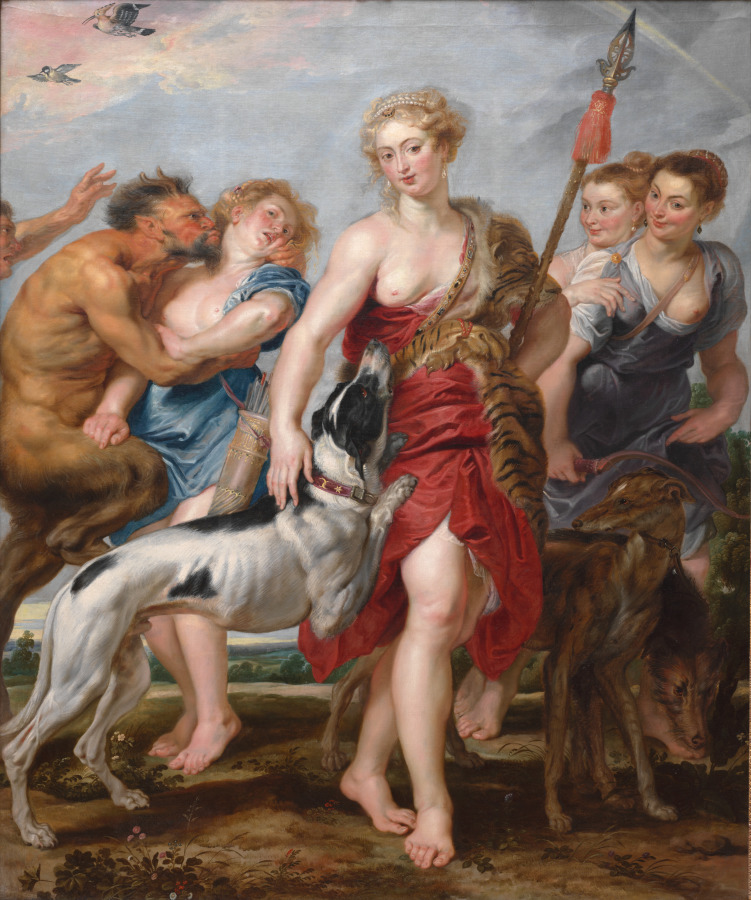
Isabella Brant was Rubens’s first wife. He painted her many times in many different ways before she died at the age of 35 (she is a model for a nymph in the other work by Rubens in this room). This intimate portrait, painted at least five years before her death, suggests the close relationship between the painter and sitter through the warm palette, the luscious brushstrokes, and her lively expression.
Provenance
The Cleveland Museum of Art, Cleveland, Ohio (1947-); Rosenberg and Stiebel and Pinakos, Inc./Rudolf Heinemann, New York, NY, sold to the Cleveland Museum of Art) (1947); Heirs of Marcus Kappel, sold to Rosenberg and Stiebel with Pinakos, Inc./Rudolf Heinemann (1930-1947); (Kappel estate sale, Paul Cassirer und Hugo Helbing, Berlin, Nov. 25, 1930, no. 16, withdrawn) (1930); Estate of Marcus Kappel (1919-1930); Marcus Kappel [1839-1919], Berlin (1914-1919); (Hugh Blaker [1873–1936], Old Isleworth, Middlesex, England, sold to Marcus Kappel (1914); (Glanusk sale, Sotheby's, London, April 29, 1914, no. 88, sold to Hugh Blaker) (1914); Lord Glanusk (1914)
Accession Number
1947.207
Medium
oil on wood
Dimensions
Framed: 83 x 73.5 x 9 cm (32 11/16 x 28 15/16 x 3 9/16 in.); Unframed: 53 x 46 cm (20 7/8 x 18 1/8 in.)
Classification
Painting
Credit Line
Mr. and Mrs. William H. Marlatt Fund
Tags
Color: Brown
Background & Context
Background Story
This intimate portrait of Isabella Brant (1591–1626), the first wife of Peter Paul Rubens, was painted around 1620–25, the final years of their thirteen-year marriage before her sudden death from plague. Isabella was the daughter of Jan Brant, a city clerk of Antwerp, and the niece of Rubens's mentor Otto van Veen. She married Rubens in 1609, the same year he secured his position as court painter to the Archdukes Albert and Isabella, and the portrait radiates the warmth and prosperity of this golden period of his life.
Rubens depicts Isabella in a black dress with a white millstone ruff collar—the height of Burgundian-Flemish fashion—against a dark background. The lighting falls softly across her face, illuminating her features with an almost Vermeer-like gentleness. Her expression is serene, her eyes meeting the viewer's with quiet confidence. Rubens's brushwork in the face is subtle and blended, while the dress and ruff are handled with broader, more confident strokes that reveal his Flemish training in rendering textures—the crisp linen of the collar, the stiffness of the embroidered bodice. The warm flesh tones, built up through thin glazes over a brown ground, show Rubens's mastery of the oil medium.
This portrait belongs to Rubens's most personal production: the paintings of his family. He also drew Isabella in chalk, painted her with their children, and featured her as a model for religious figures. The portrait's small scale (roughly 64 × 47 cm) suggests it was made for private display, likely in the artist's own home—the magnificent Rubenshuis in Antwerp, which he designed and built himself. When Isabella died in 1626, Rubens inscribed her tomb with words of profound grief. He would later marry Helena Fourment, but Isabella remained enshrined in his art as the companion of his most ambitious years.
Cultural Impact
This portrait is a masterwork of Flemish Baroque portraiture and a deeply personal document of one of art history's most consequential marriages. Rubens revolutionized European painting through his synthesis of Northern naturalism and Italian Renaissance warmth, and this portrait exemplifies his ability to combine official grandeur with intimate humanity. Isabella Brant's face appears in several of Rubens's religious and mythological compositions, making this portrait a key to understanding the artist's use of loved ones as models.
Why It Matters
A tender, luminous portrait of Rubens's beloved first wife, combining the grandeur of Flemish Baroque portraiture with deeply personal emotional warmth.