Accession Number
1946.292
Medium
watercolor with pastel over graphite
Dimensions
Sheet: 30.6 x 45.7 cm (12 1/16 x 18 in.)
Classification
Drawing
Credit Line
In memory of Ralph King, gift of Mrs. Ralph King; Ralph T. Woods, Charles G. King; and Frances King Schafer
Tags
Drawing Early Modern (1901–1950) Watercolor Pastel Graphite & Pencil American Color: Gold Color: Teal
Background & Context
Background Story
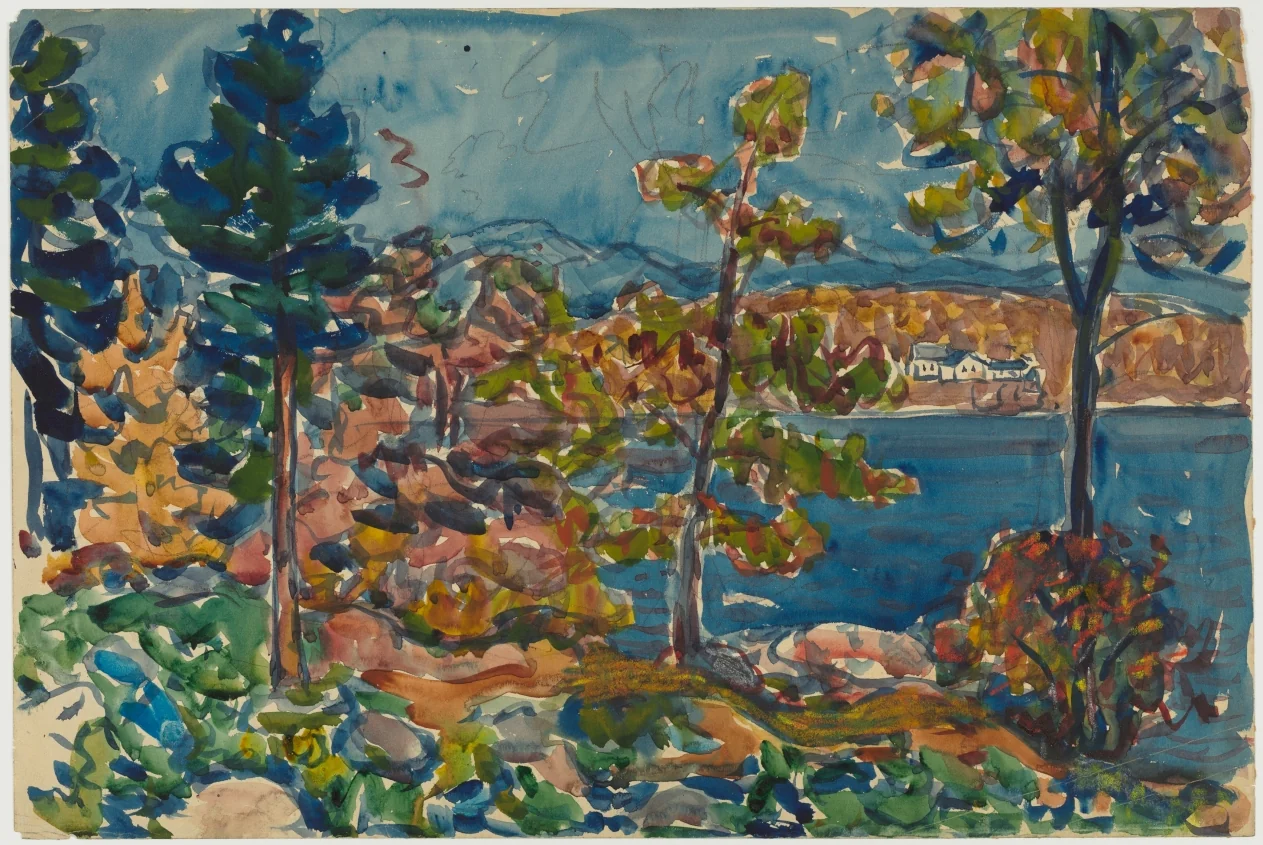
By the Shore (c. 1905-1915) is a quintessential Prendergast subject—the seaside promenade where urban leisure met the Atlantic coast that provided New England's most distinctive recreational landscape. Prendergast's shore scenes consistently present the beach as a social space: the figures are not swimming or sunbathing in the modern sense but promenading—displaying themselves and observing others in the ritual of seaside leisure that defined the American middle class's engagement with the coast. The title's generality—By the Shore rather than a specific location—suggests that Prendergast was pursuing the universal rather than the particular: the shore as an experience rather than a place. The date range (1905-15) places this during Prendergast's mature period, when his decorative approach was at its most accomplished. His treatment of the shore scene demonstrates the method that distinguishes his work: the figures are arranged in a pattern across the horizontal expanse of beach and water, creating a decorative composition where the individual figures serve the overall pattern rather than the pattern serving the figures. The color—bright, clear, and deployed in patches that create visual rhythm rather than spatial depth—gives the shore scene a decorative intensity that more naturalistic treatments could not achieve.
Cultural Impact
Prendergast's shore paintings influenced how American seaside leisure was represented in modern art, establishing the promenade as a significant decorative subject. The paintings influenced later American artists who similarly found decorative subjects in the boundary between land and water. By the Shore influenced how the relationship between pattern and representation was understood in American painting.
Why It Matters
This painting matters because it represents Prendergast's most characteristic subject—the seaside promenade where urban leisure meets the Atlantic coast—with the decorative method that makes his work unique in American painting. The figures arranged in pattern across the shore's horizontal expanse argue that the experience of seaside leisure is best represented through decorative composition rather than naturalistic description.