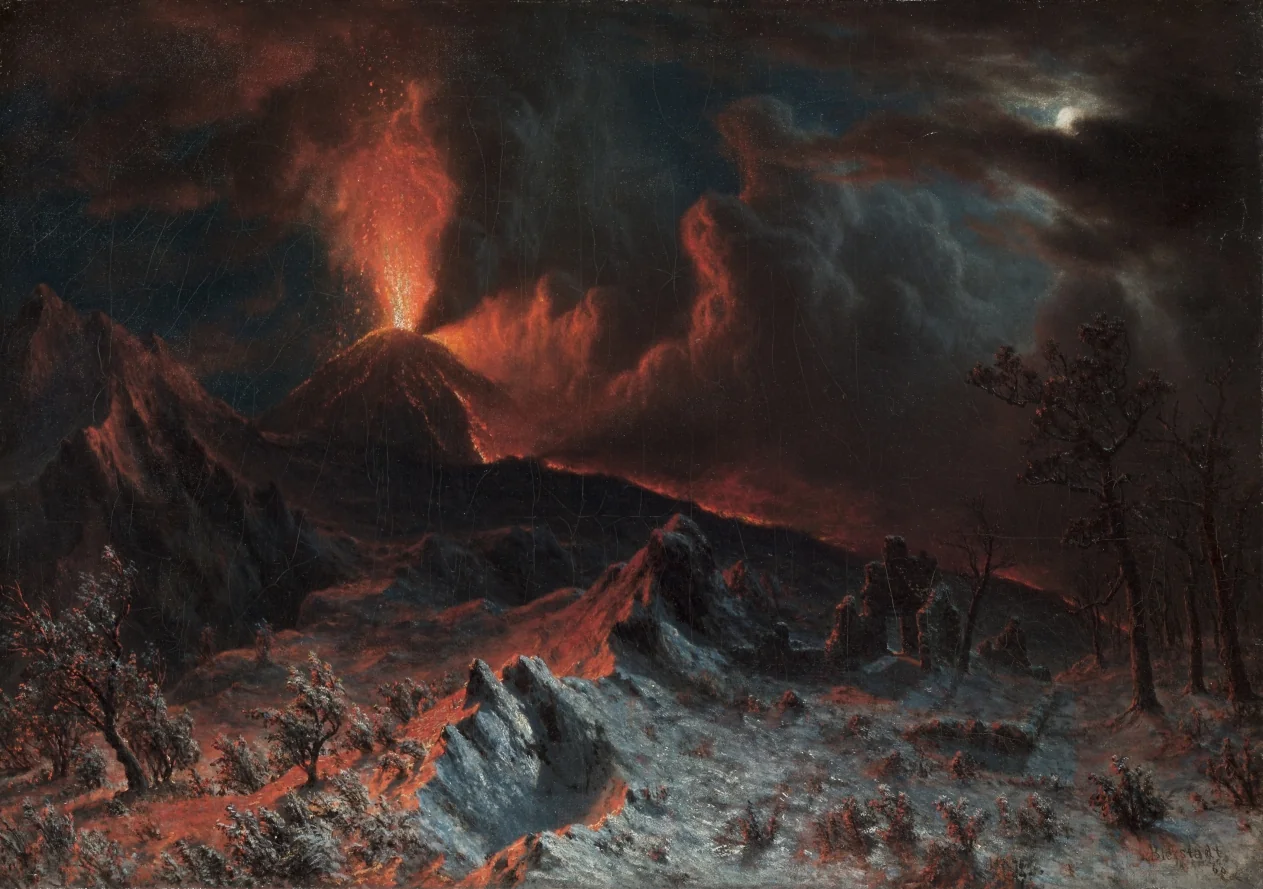
Description
For centuries, artists and tourists were attracted to Mount Vesuvius, a volcano near Naples. This awe-inspriing, not to say terrifying, natural wonder destroyed the ancient Roman city of Pompeii, and continued to erupt from time to time, as it does to this day. While living in London in 1868, Albert Bierstadt heard that Vesuvius had erupted once again, and rushed immediately to Italy. It is not certain that the artist actually saw the cataclysm, although the painting presents a convincing image of the ash and lava spewed by the volcano. This is a smaller version of a larger canvas now lost.
Provenance
[]
Accession Number
1949.541
Medium
oil on canvas
Dimensions
Framed: 62 x 77 x 9 cm (24 7/16 x 30 5/16 x 3 9/16 in.); Unframed: 42.6 x 60.7 cm (16 3/4 x 23 7/8 in.)
Classification
Painting
Credit Line
Gift of S. Livingstone Mather, Philip Richard Mather, Katherine Hoyt (Mather) Cross, Katherine Mather McLean and Constance Mather Bishop
Tags
Painting Impressionist & Modern (1851–1900) Oil Painting Canvas American Color: Red Color: Brown
Background & Context
Background Story
Mount Vesuvius at Midnight is one of Bierstadt's most dramatic European subjects—the erupting volcano painted at night, with its columns of fire and smoke rising against the dark sky. The choice of midnight as the time of day maximizes the contrast between the eruption's fire and the surrounding darkness, creating a sublime spectacle that appeals directly to the 19th-century taste for dramatic natural phenomena. The painting was likely inspired by one of Vesuvius' periodic eruptions in the 1860s, which attracted artists and tourists from across Europe.
Cultural Impact
Volcanic eruptions were among the most popular subjects in 19th-century painting because they embodied the sublime—the aesthetic category of overwhelming natural power that Edmund Burke and Immanuel Kant had defined as the highest form of aesthetic experience. Bierstadt's Vesuvius at Midnight is a textbook example of the volcanic sublime, combining fire, darkness, scale, and danger in a single composition that leaves the viewer in no doubt about nature's supremacy over human endeavor.
Why It Matters
Mount Vesuvius at Midnight is Bierstadt's European sublime at its most theatrical: an erupting volcano painted at the hour of maximum contrast, when fire meets darkness and nature's power is displayed in its most dramatic form. The painting is pure spectacle, and Bierstadt is its master showman.

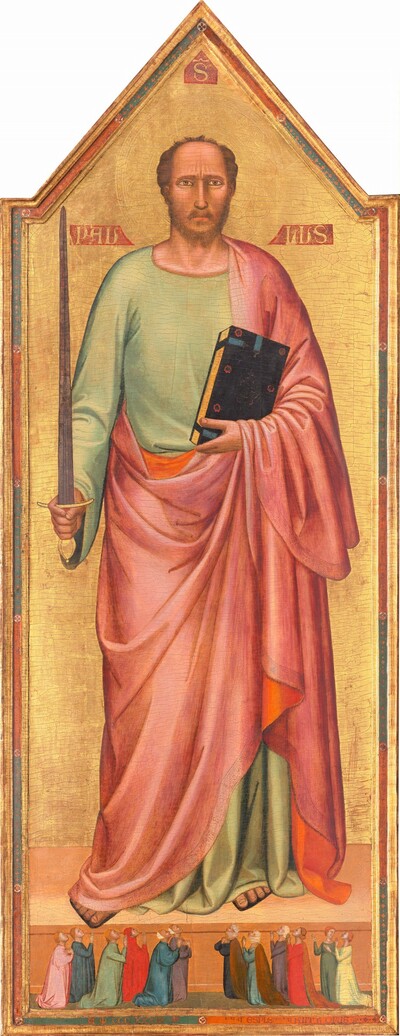
![Saint Bernard and Saint Catherine of Alexandria with the Virgin of the Annunciation [right panel]](https://api.nga.gov/iiif/e6890364-4d99-4684-a62b-5060ee3c3446/full/400,/0/default.jpg)