Description
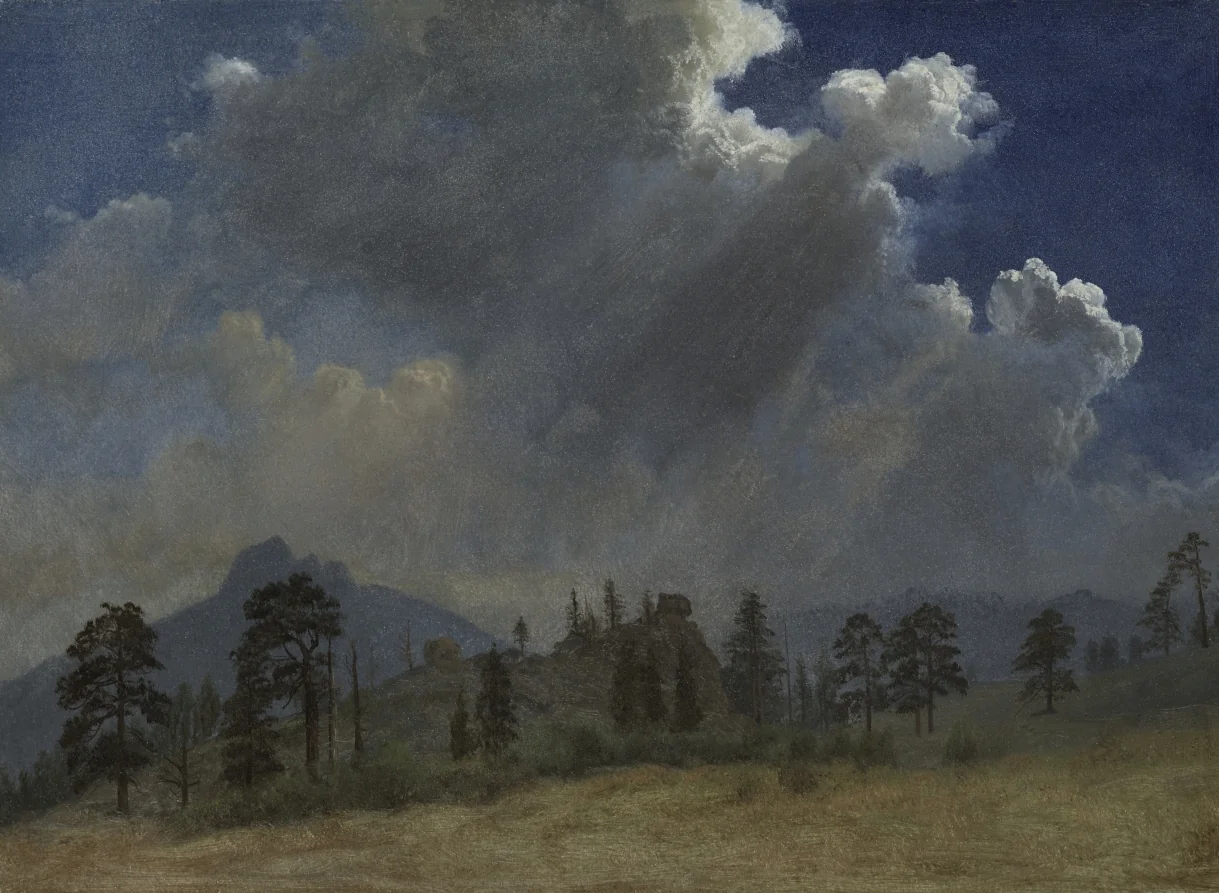
Albert Bierstadt made his first journey West in 1859, opening the eyes of other American artists to the potential for inspiration in the Western landscape. This atmospheric study is generally associated with his inaugural 1859 trip, but may also belong to a later Western visit in 1870. The low horizon and vividly observed sky place the painting within the tradition of European plein air (open air) oil sketching, similar to the work of John Constable. Even though the landscape occupies only a small portion of the scene, the different species of trees are carefully distinguished and the rocky outcrops are characteristic of the Western terrain where Bierstadt was traveling.
Provenance
English Collection; (Davis & Langdale, New York,d 1982).
Accession Number
1982.37
Medium
oil on paper mounted on canvas
Dimensions
Unframed: 35 x 47 cm (13 3/4 x 18 1/2 in.)
Classification
Painting
Credit Line
Mr. and Mrs. William H. Marlatt Fund
Tags
Painting Impressionist & Modern (1851–1900) Oil Painting Canvas American Color: Gray
Background & Context
Background Story
Fir Trees and Storm Clouds is a study-scale work that reveals Bierstadt's approach to landscape in its most concentrated form. The fir trees and approaching storm are rendered on paper (later mounted on canvas) with a directness and economy that his larger, more finished canvases sometimes sacrifice to spectacle. The paper support and the smaller scale suggest that this was a field study or a compositional idea rather than a finished exhibition piece, and it retains the freshness and spontaneity of a work painted directly from nature rather than constructed in the studio.
Cultural Impact
Bierstadt's smaller works on paper are among his most appealing because they reveal his direct engagement with the landscape without the amplification that his large canvases provide. The fir trees are specific trees rather than generic conifers, and the storm clouds are a specific weather event rather than a theatrical backdrop. This specificity is the quality that his contemporaries most valued in his work and that his critics most often missed.
Why It Matters
Fir Trees and Storm Clouds is Bierstadt at his most direct and specific: a study-scale work where the trees are individual and the storm is real rather than theatrical. The paper support and the smaller scale retain the freshness of direct observation—exactly the quality that made his best field studies more convincing than his most spectacular exhibition canvases.
![Saint Bernard and Saint Catherine of Alexandria with the Virgin of the Annunciation [right panel]](https://api.nga.gov/iiif/e6890364-4d99-4684-a62b-5060ee3c3446/full/400,/0/default.jpg)