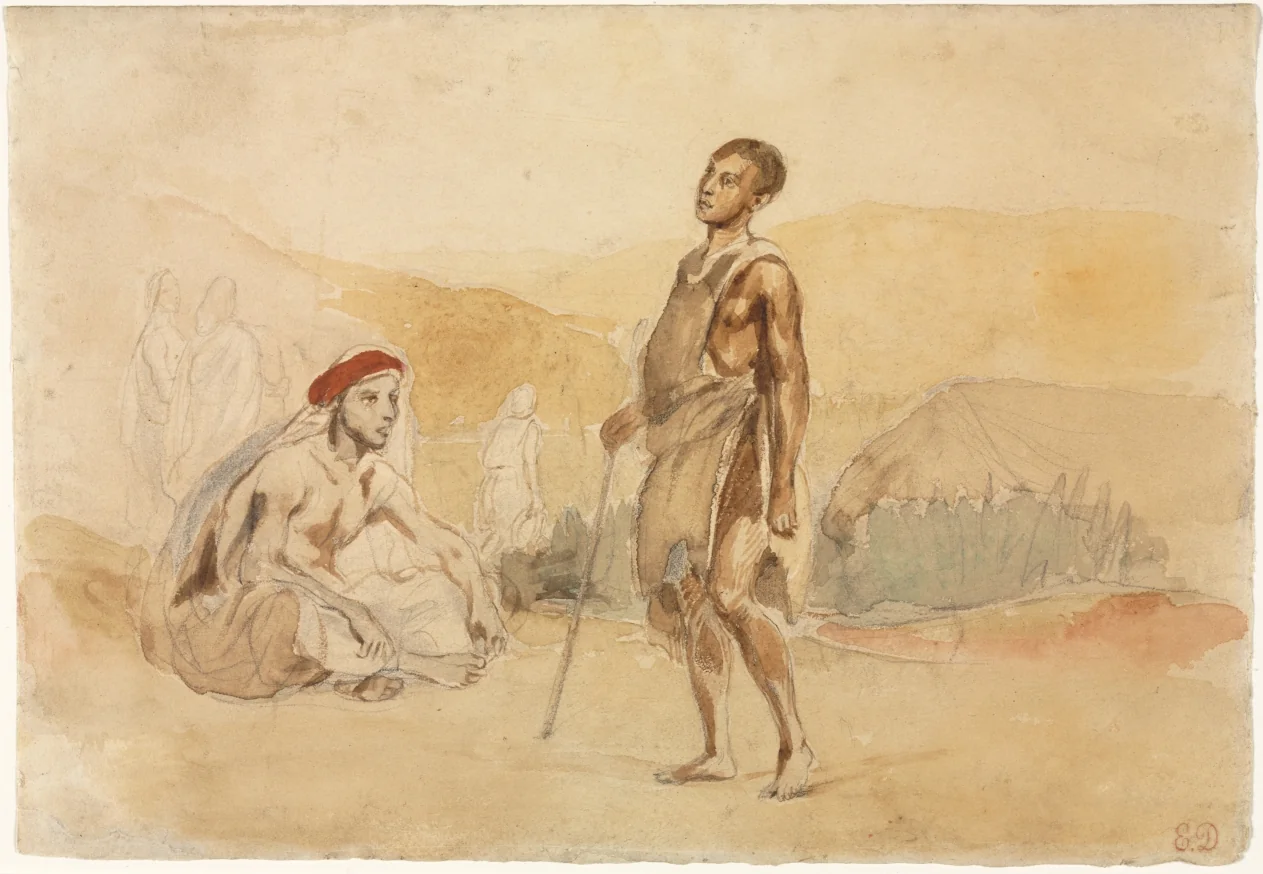
Provenance
Delacroix estate (Lugt 838, lower right, stamped in red ink) (both Colta Ives and Meg Grasselli indicated that there is some confusion regarding this stamp and a fake stamp used by Delacroix's student Pierre Andrieu, see notes); artist's estate sale, Paris, experts Petit and Tedesco, 17-29 Feb. 1864, no. 571. Alfred Robaut, Paris (Lugt Suppl. 2140c-d, not stamped or inscribed) (according to departmental catalogue sheet).
Accession Number
1951.484
Medium
watercolor over graphite
Dimensions
Sheet: 18.7 x 27.2 cm (7 3/8 x 10 11/16 in.)
Classification
Drawing
Credit Line
Mr. and Mrs. Lewis B. Williams Collection
Tags
Color: Orange Color: White
Background & Context
Background Story
Eugène Delacroix, the leader of French Romantic painting, created this luminous watercolor in 1832 during his six-month journey to Morocco—a trip that transformed his art and, through him, the course of modern painting. Delacroix traveled as part of a diplomatic mission led by the Comte de Mornay to the court of Sultan Abd al-Rahman II in Meknes. Unlike his academic contemporaries, who painted the Middle East from imagination using props and costumes, Delacroix worked directly from observation in watercolor, capturing the light, color, and daily life of North Africa with unprecedented authenticity.
This watercolor depicts a group of Moroccans in the countryside—a scene of pastoral tranquility observed by Delacroix during his travels. The figures are loosely sketched in graphite, then washed over with transparent layers of watercolor: warm ochres, deep blues, and soft greens that shimmer with the dry heat of the Moroccan landscape. Delacroix's watercolor technique was extraordinarily fluid; he allowed the pigments to bleed and bloom across the paper, creating atmospheric effects that a more controlled hand would have lost. The white of the paper is left exposed in places to suggest the intense North African sunlight.
Delacroix was overwhelmed by Morocco. "It is beautiful!" he wrote in his journal. "It is like the time of the Romans and the Greeks—the men of antiquity are here, walking the streets." He filled seven sketchbooks with watercolors, drawings, and notes, documenting everything from architecture to horse trappings to Jewish weddings. The experience confirmed his Romantic conviction that color was the primary vehicle of emotion in painting. Returning to France, he produced major canvases inspired by his Moroccan sketches—including Women of Algiers in Their Apartment (1834)—that revolutionized French painting with their vibrant palette and exotic subject matter.
Cultural Impact
Delacroix's Moroccan watercolors are foundational documents of Orientalism in 19th-century art, but more importantly, they liberated European painting from the brown tonalities of the Neoclassical palette. The brilliant colors and direct observational method Delacroix developed in Morocco directly influenced the Impressionists and Post-Impressionists. Renoir, Monet, and especially Matisse (who visited Morocco himself in 1912–13) built upon Delacroix's breakthrough. This watercolor stands at the beginning of a chain that leads from Romanticism to Fauvism.
Why It Matters
A radiant watercolor from Delacroix's transformative Moroccan journey, capturing North African light and life with a freshness and immediacy that changed the course of color in European painting.