Description
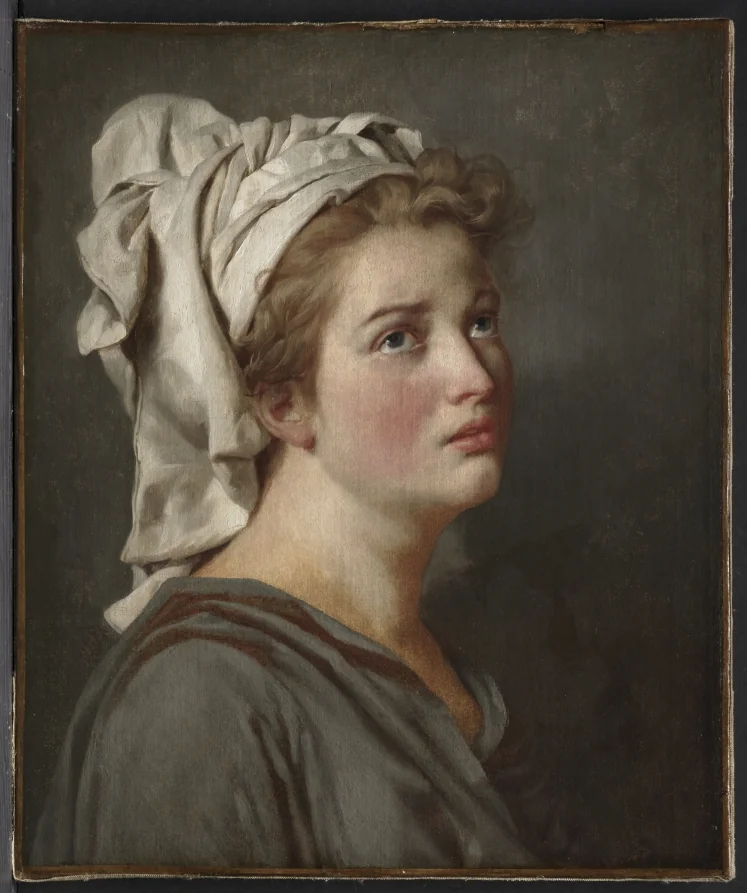
Known as a tête d'expression or "expressive head," this painting represents an essential part of the academic training of history painters who specialized in religious, mythological, or historical subjects. In 1760, such exercises became standard at the École des Beaux-Arts (School of Fine Arts) in Paris, then known as Académie royale de peinture et de sculpture. Focusing on the relationship between morality and beauty, the goal of a history painter is not only to create a pleasing image, but also to represent the emotions of the soul.
Provenance
Sale?: Hôtel de Bullion, Didot Collection, Paris, France, 6 April 1825 (lot 114). (6 April 1825); Sale: Baron Gros, Paris, France, November-1 December 1835 (lot 127). (November-1 December 1835); Augustin Alexandre Dumont (1801-1884), Paris, France; Mme Audard (by 1913); Henry G. Dalton (1862-1932), Cleveland, OH, left to his grandson, George S. Kendrick (by 1929-1932); George S. Kendrick (1899-1979), Cleveland, OH, gifted to the Cleveland Museum of Art (1932-1952); The Cleveland Museum of Art, Cleveland, OH (1952-)
Accession Number
1952.542
Medium
oil on canvas
Dimensions
Framed: 76 x 66 x 8 cm (29 15/16 x 26 x 3 1/8 in.); Unframed: 55.2 x 46 cm (21 3/4 x 18 1/8 in.)
Classification
Painting
Credit Line
Gift of George S. Kendrick
Tags
Color: Brown Color: Gray
Background & Context
Background Story
Jacques-Louis David, the undisputed master of French Neoclassicism, painted this intriguing portrait of a young woman in a turban around 1780, just as the final years of the Ancien Régime were giving way to revolutionary ferment. The painting dates from the period when David was establishing his reputation after winning the Prix de Rome and returning from his formative years in Italy. It shows the artist working in a more intimate, spontaneous mode than the grand historical canvases that would make him famous.
The sitter's identity is unknown, which contributes to the painting's enigmatic quality. She wears a white turban wrapped elegantly around her head, a fashion accessory that had become popular in French portraiture through the influence of Orientalist taste and the vogue for turbaned figures in the works of Jean-Étienne Liotard and other pastelists. Her dress is simple but refined—a white garment that reveals one shoulder in a manner suggesting classical drapery rather than contemporary fashion. This classicizing touch reflects David's immersion in antique art during his years in Rome.
David's technique in this canvas is notably softer and more painterly than his later, harder-edged neoclassical style. The flesh is built up through subtle glazes, with warm ochres and pinks creating a lifelike complexion. The turban is rendered with broad, fluid strokes of creamy white and pale blue shadows. David's signature is visible in the attention to the sitter's expression: her gaze is direct but unreadable, carrying a hint of amusement or challenge that captivates the viewer.
This was the David who, just a few years earlier, had returned from Italy determined to reform French painting. He would soon produce The Oath of the Horatii (1784) and become the artistic voice of the French Revolution. But here, in this modest portrait, we see another David—the sensitive observer, the student of human character, the colorist working in a Venetian-inspired mode before the severity of Neoclassicism fully claimed him.
Cultural Impact
This portrait offers a rare glimpse of Jacques-Louis David working in an intimate, pre-revolutionary mode, before the grand history paintings that would define Neoclassicism. It reveals the breadth of his talent beyond political propaganda and classical severity, and documents the intersection of troubadour style, Orientalist fashion, and neoclassical sensibility in late 18th-century French culture. The portrait stands as a counterpoint to David's public persona, showing the private, sensuous side of the artist who would become Robespierre's cultural commissar.
Why It Matters
A rare and enchanting portrait from the young David, this work captures the artist at a crossroads—between rococo intimacy and neoclassical austerity, between private observation and public ambition.