Description
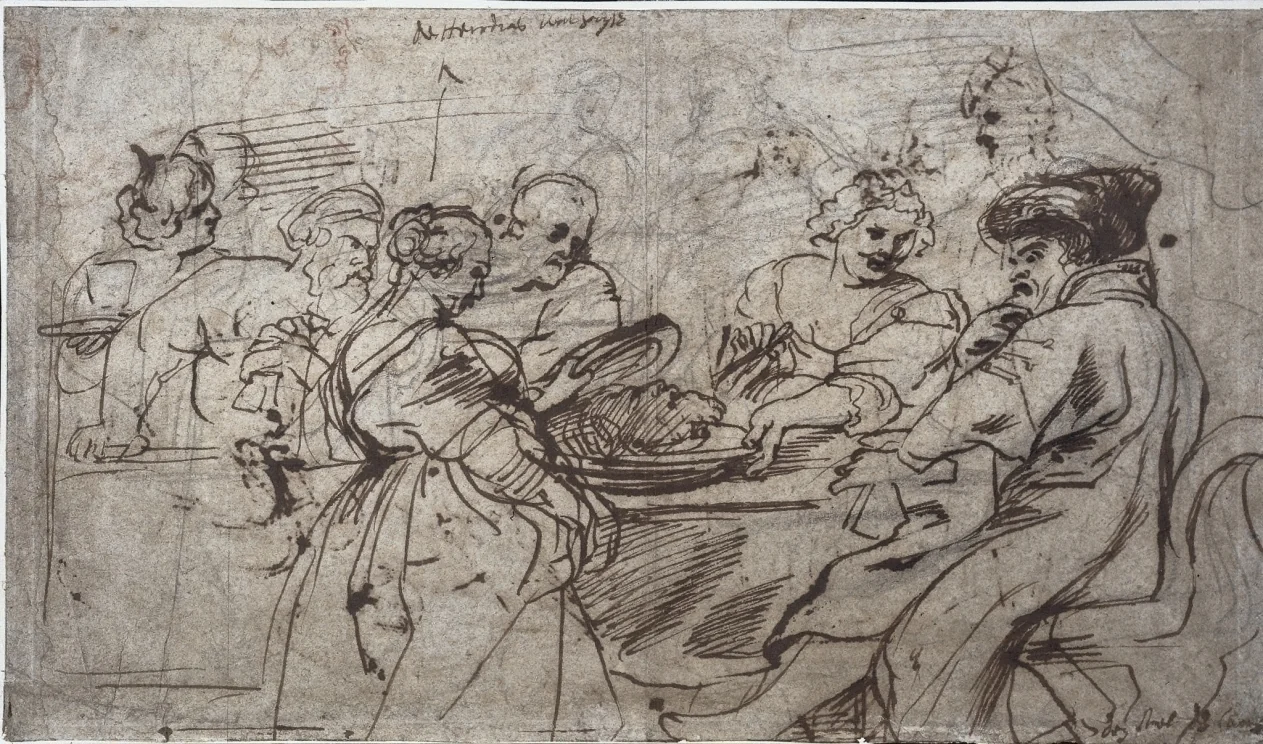
Peter Paul Rubens had a large studio in Antwerp and used drawing to prepare for large paintings as well as to direct the many pupils who assisted him. Striking in its immediacy, the drawing on the recto of this sheet of paper is a preparatory study for the Feast of Herod painting now at the Scottish National Gallery in Edinburgh. Herod, wearing a large cap and wrapped in a mantle, shrinks back in horror as Salome uncovers a charger that holds the head of Saint John the Baptist. Smiling, Herodias grabs the platter with her left hand and, in a chilling detail, gestures toward the charger with a fork. Rubens wrote what is usually interpreted as “Herodias somewhat higher” at the top of the sheet. The verso of the sheet depicts a sketch for another story featuring a change of fortune at the hands of a vengeful woman, Tomyris with the Head of Cyrus. Rubens made two paintings of the subject (now in Paris and Boston). A rare theme, the story tells of Queen Tomyris who, avenging the death of her son in battle, collects the head of his murderer Cyrus in a bag of human blood. Tomyris is shown seated under a canopy holding a scepter, while the servants before her handle Cyrus’s head. Rubens wrote “plus spatij” (more space) in the center of the sheet.
Provenance
Unidentified collector, probably Austria (Lugt 622) (ca. 1800-1900); Private collection, England (ca. 1900-1953); with Herbert N. Bier, London (1953); Cleveland Museum of Art, Cleveland, OH (1954-)
Accession Number
1954.2
Medium
pen and brown ink, with black and red chalk, touched with white gouache
Dimensions
Sheet: 27.2 x 47.2 cm (10 11/16 x 18 9/16 in.); Secondary Support: 27.6 x 47.3 cm (10 7/8 x 18 5/8 in.)
Classification
Drawing
Credit Line
Delia E. Holden and L. E. Holden Funds
Tags
Color: Brown Color: Gray
Background & Context
Background Story
This remarkable double-sided drawing by Peter Paul Rubens, dating from around 1637–38, presents two dramatic scenes from ancient and biblical history on a single sheet. The recto shows 'The Feast of Herod'—the grisly banquet at which Salome presents the head of John the Baptist to her stepfather Herod Antipas. The verso depicts 'Tomyris with the Head of Cyrus'—the Scythian queen who, after defeating the Persian emperor Cyrus the Great, allegedly immersed his head in a vessel of blood, fulfilling her vow of vengeance.
Rubens executed the drawing in pen and brown ink, with black and red chalk, touched with white gouache—a multi-media approach that gave him extraordinary flexibility. The recto is the more finished side: the banquet table recedes diagonally into space, with Herod recoiling at the gruesome offering while Salome, elegant and impassive, presents the platter. The combination of pen (for crisp contours) and colored chalks (for tonal modeling) creates a richness that approaches a painted sketch. The verso, by contrast, is more quickly drawn, capturing Tomyris's triumphant fury with vigorous, spiraling pen lines.
These two subjects—both involving a ruler confronted with a severed head—demonstrate Rubens's interest in parallel histories and moral exempla from different cultures. The pairing may have been intended for a series of engravings or for a tapestry cycle. Rubens's workshop produced hundreds of such drawings, which were translated into prints by professional engravers and disseminated throughout Europe.
In 1637–38, Rubens was in his late sixties, still working despite increasingly debilitating gout. He had largely withdrawn from court life and was painting for his own pleasure and for a circle of discerning collectors. This drawing, with its double narrative of feminine power and vengeance, belongs to the intensely visual, morally serious yet dramatically charged world of his late work.
Cultural Impact
This drawing exemplifies Rubens's synthesis of Northern and Southern European artistic traditions—the pen-and-ink technique rooted in Dürer and the German Renaissance, the dramatic chiaroscuro and figural dynamism drawn from Italian Baroque. The recto-verso format preserves the artist's working process, showing how he developed two compositions on a single sheet. Rubens was one of the last great artists to operate a large-scale workshop producing drawings for reproductive engraving, and this sheet represents that collaborative system at its peak.
Why It Matters
A spectacular double-sided drawing from Rubens's mature years, pairing two scenes of dramatic vengeance with virtuoso technique in pen, chalk, and gouache—a masterclass in Baroque storytelling.