Description
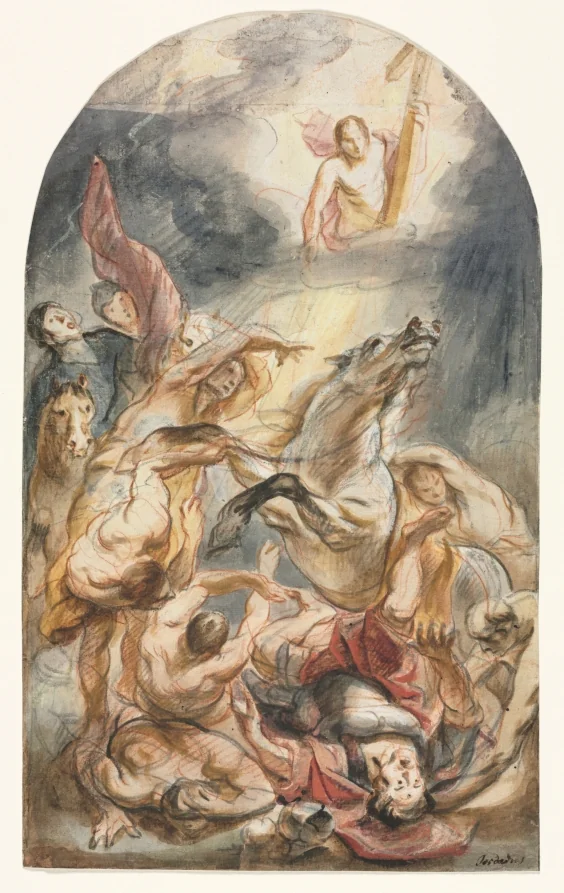
Jacob Jordaens was a prominent artist working in Antwerp in the 17th century. Though influenced in his use of powerful forms and vibrant color by his contemporary, Peter Paul Rubens, Jordaens was notably more realist in his tendencies. This drawing and its companion drawing in the Cleveland Museum of Art's collection (1954.367) are studies for a painting depicting the Conversion of St. Paul that Jordaens made for the the abbey church at Tongerlo, near Antwerp, in around 1647 (now lost). According to the Bible, in the year following the death of Jesus Christ, Saul of Tarsus (who became Saint Paul) was on the road to Damascus. He was suddenly surrounded by a brilliant light from above, heard the voice of Christ, and became a believer. In this work, Jordaens illustrated the climactic moment when Saul is thrown to the ground by the force of Christ's voice and blinding light. Jordaens used a combination of chalks and wet media such as ink and watercolor to create a swirling mass of bodies bathed in light.
Provenance
Duke Albert of Sachsen-Teschen (according to cma files). Graphische Sammlung Albertina, Vienna (Lugt 1259-60, not stamped, according to cma files). Otto Burchard (according to cma files). [Heinrich Eisemann, London].
Accession Number
1954.366
Medium
Black and red chalk, pen and black and gray ink, brush and brown wash, watercolor, and gouache, heightened with white gouache; framing lines in red chalk and graphite (right edge)
Dimensions
Sheet: 32.9 x 19.9 cm (12 15/16 x 7 13/16 in.)
Classification
Drawing
Credit Line
Delia E. Holden and L. E. Holden Funds
Tags
Drawing Baroque (1600–1750) Watercolor Ink Graphite & Pencil Gouache Flemish Color: Orange
Background & Context
Background Story
Jacob Jordaens (1593-1678) was the most important Flemish painter after Rubens, known for his robust, energetic style and his ability to handle both grand narrative subjects and intimate domestic scenes with equal skill. The Conversion of Saul with Horseman and Banner is a preparatory drawing for a painting of the biblical subject in which Saul (the future Saint Paul) is struck down by a divine light on the road to Damascus. The drawing's combination of media—black and red chalk for the underdrawing, pen and ink for the definitive lines, brush and wash for the tonal values, and gouache for the highlights—demonstrates the elaborate preparatory method that Jordaens brought to his most important commissions.
Cultural Impact
Jordaens's preparatory drawings are among the most technically accomplished in 17th-century Flemish art because they demonstrate the full range of baroque drawing media deployed in the service of a single composition. The Conversion of Saul drawing shows Jordaens working through the compositional problems of a complex multi-figure narrative: the rearing horse, the falling Saul, the divine light, and the panicking attendants all require careful arrangement, and the multiple media allow Jordaens to test different tonal and chromatic solutions before committing to the final painting.
Why It Matters
The Conversion of Saul with Horseman and Banner is Jordaens's preparatory method in full display: black and red chalk for underdrawing, pen and ink for definition, wash and gouache for tone and highlight—a complete working method visible on a single sheet. The drawing proves that Jordaens's apparently robust compositions were the result of meticulous preparation, layer by layer and medium by medium.