Description
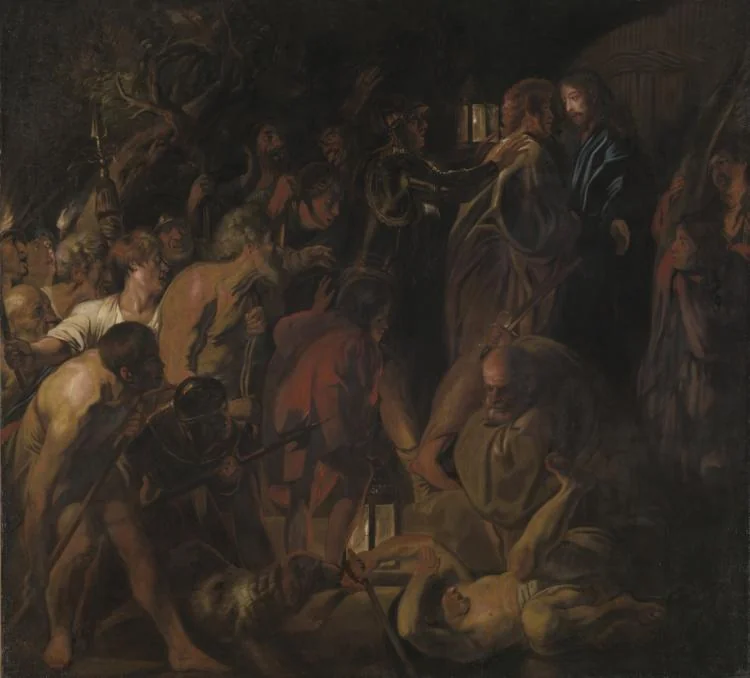
After the deaths of fellow Flemish painters Peter Paul Rubens in 1640 and Anthony van Dyck in 1641, Jordaens became the leading painter in his native Antwerp. In the seventeenth century, Antwerp underwent a Catholic Restoration, leading to numerous commissions for religious paintings. Jordaens's large work depicts the moment, set in the Garden of Gethsemane, in which Judas betrays Christ with a kiss, leading to the arrest of Jesus by Roman soldiers. The tense moment of betrayal is compounded by the violent reaction of apostle Peter in the foreground, who attacks Malchus, the servant of the High Priest who led the arrest. The lighting heightens the drama of the Passion of Christ, as the lanterns of the soldiers powerfully illuminate the night scene. Night scenes, also called nocturnes, are trademarks of the Northern painting tradition since the fifteenth century and demonstrate its continuing impact into the 1600s.
Provenance
Juergen Ovens; , upon his death, held in trust by the estate, 1691;; Estate of Juergen Ovens, 1691;; Possibly Count Otto Thott (GaunØ Castle, Denmark), (died 1785), by inheritance to Holger Reedtz, grandson of Otto Thott's maternal uncle, who took the name Reedtz-Thott in honor of his benefactor, Count Otto Thott, who had no male heirs;; Holger Reedtz-Thott (died 1797), by inheritance to Baron Otto Reedtz-Thott;; Otto Reedtz-Thott (doed 1862), by inheritance to Baron Kjeld Thor Tage Otto Reedtz-Thott;; Baron Kjeld Thor Tage Otto Reedtz-Thott (died 1923), by inheritance to Baron Otto Reedtz-Thott;; Baron Otto Reedtz-Thott (died 1927), by inheritance to Baron Axel Reedtz-Thott;; Baron Axel Reedtz-Thott (GaunØ Castle, Denmark) (sold, Sotheby's, London, July 10, 1968, no. 78); Agnew & Sons, London;; Pinakos, Inc., New York, sold to the Cleveland Museum of Art, 1970.
Accession Number
1970.32
Medium
oil on canvas
Dimensions
Framed: 249 x 271.5 x 8 cm (98 1/16 x 106 7/8 x 3 1/8 in.); Unframed: 225.5 x 246.3 cm (88 3/4 x 96 15/16 in.)
Classification
Painting
Credit Line
Leonard C. Hanna Jr. Fund
Tags
Painting Baroque (1600–1750) Oil Painting Canvas Flemish Color: Orange Color: Brown
Background & Context
Background Story
The Betrayal of Christ from the late 1650s is a late work by Jordaens, depicting the moment when Judas identifies Christ to the soldiers by kissing him in the Garden of Gethsemane. Jordaens's treatment is characteristically robust: the figures are large, the emotions are extreme, and the composition is organized as a dramatic confrontation rather than a contemplative scene. The late 1650s date places this in the period when Jordaens had become the leading painter in Antwerp after Rubens's death and Van Dyck's departure for England, and his late works show both the confidence of his position and the increasing influence of the Counter-Reformation on his choice of subjects.
Cultural Impact
Jordaens's late religious paintings show the influence of the Counter-Reformation on an artist who was better known for his genre scenes and domestic subjects. The Betrayal of Christ is a Counter-Reformation subject—a dramatic narrative that emphasizes the emotional intensity of the biblical story and the physical reality of Christ's suffering. Jordaens's robust, muscular treatment of the figures gives the scene a physical immediacy that complements the Counter-Reformation emphasis on the real, suffering body of Christ.
Why It Matters
The Betrayal of Christ is late Jordaens at his most physically intense: Judas's kiss, the soldiers' aggression, and Christ's acceptance all rendered with the robust, muscular energy that distinguishes Flemish Baroque at its most dramatic. The late date shows Jordaens as Antwerp's leading painter, commanding the Counter-Reformation narrative with the same physical energy he brought to his genre scenes.