Accession Number
1955.656
Medium
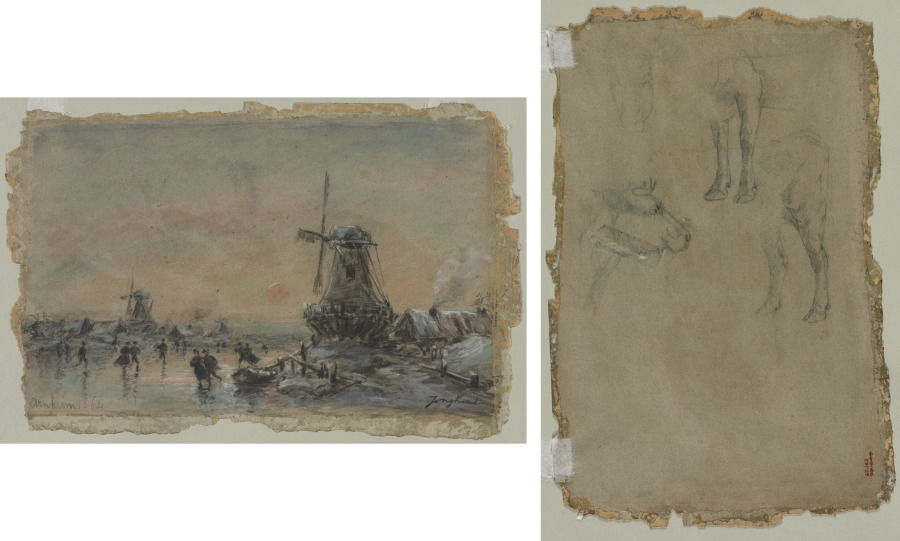
watercolor, gouache and black chalk; framing lines in black chalk
Dimensions
Sheet: 30.5 x 48.8 cm (12 x 19 3/16 in.)
Classification
Drawing
Credit Line
Mr. and Mrs. Lewis B. Williams Collection
Tags
Drawing Impressionist & Modern (1851–1900) Watercolor Gouache Dutch Color: Gray
Background & Context
Background Story
Le Havre was the port city where Jongkind first met the young Claude Monet in 1862, and this watercolor captures the harbor that would become one of Impressionism's most important settings — Monet's Impression, Sunrise (1872) depicts the same harbor. Jongkind renders the busy port with his characteristically economical technique: masts, rigging, and smokestacks are suggested in a few strokes of black chalk, while gouache highlights pick out the reflections on water. The city rises behind the harbor in a haze of sea air and industrial smoke.
Cultural Impact
This watercolor is a direct document of the artistic encounter that shaped Impressionism. Monet later wrote that Jongkind explained to him 'the whys and wherefores of his manner' and that these lessons were essential to his development. The harbor at Le Havre — its light, its water, its interplay of nature and industry — became Monet's foundational subject thanks to Jongkind's example.
Why It Matters
Le Havre is where it all began for Monet, and this watercolour by Jongkind captures the exact visual moment when one generation passed the torch to the next.