Provenance
[Lucien Lefebvre-Foinet, Paris] (according to old label, now removed and in folder for 1958.15). [Carroll Carstairs Gallery, New York] (according to departmental catalogue sheet for 1958.15: Mr. Hanna purchased this drawing and 1958.15 on 1 Dec 1938)
Accession Number
1958.16
Medium
watercolor
Dimensions
Sheet: 14.8 x 27.5 cm (5 13/16 x 10 13/16 in.); Secondary Support: 14.8 x 27.5 cm (5 13/16 x 10 13/16 in.)
Classification
Drawing
Credit Line
Bequest of Leonard C. Hanna Jr.
Tags
Drawing Neoclassical & Romantic (1751–1850) Watercolor French Color: Brown
Background & Context
Background Story
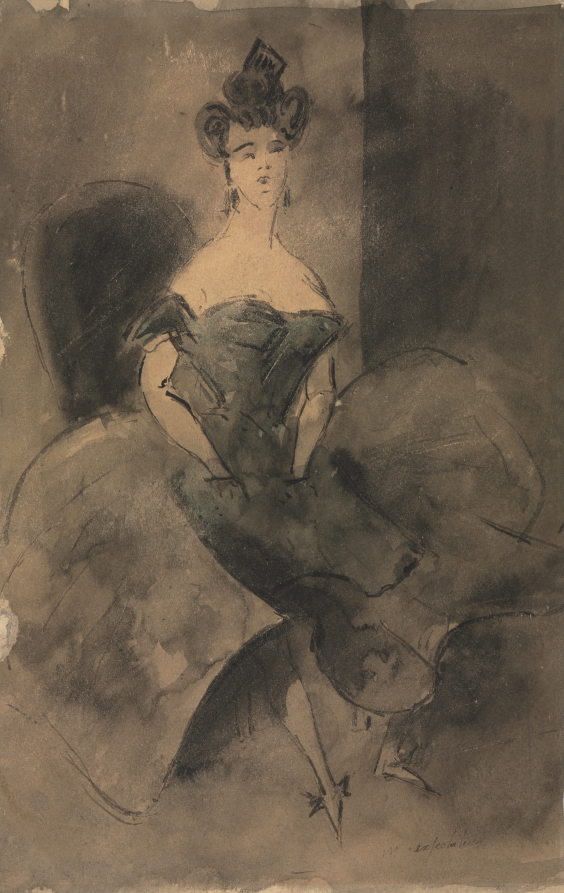
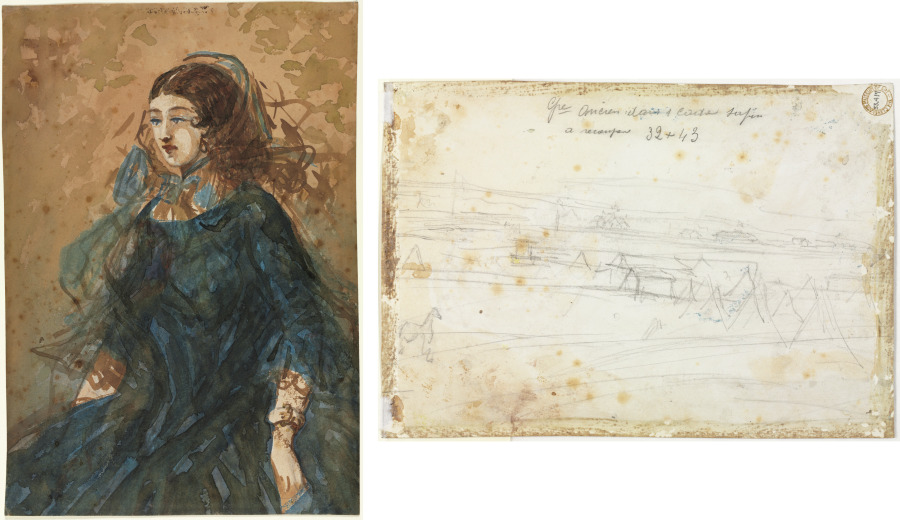
This second version of the carriage-in-the-Bois subject demonstrates Guys's habit of working the same social scene from different angles and in different media. Where the previous version used pen and ink with brown wash for a more linear treatment, this watercolor version sacrifices structural precision for atmospheric effect. The result is a more impressionistic but equally observant record of the same social ritual: the carriage, the promenade, and the display of fashion that defined the afternoon social round of the Parisian elite.
Cultural Impact
Guys's multiple versions of the same subject are not repetitions but variations — each one capturing a different aspect of the scene. The watercolor version emphasizes atmosphere and color over line and structure, producing a more ephemeral image that complements the more linear pen-and-wash version. Together they constitute a stereoscopic view of the same social moment, revealing more than either could alone.
Why It Matters
This second Carriage in the Bois de Boulogne is Guys varying his approach to the same subject: where the pen-and-wash version captures structure, this watercolor version captures atmosphere. The social ritual is the same, but the visual experience is different — and Guys understood that reality has multiple valid representations.