Description
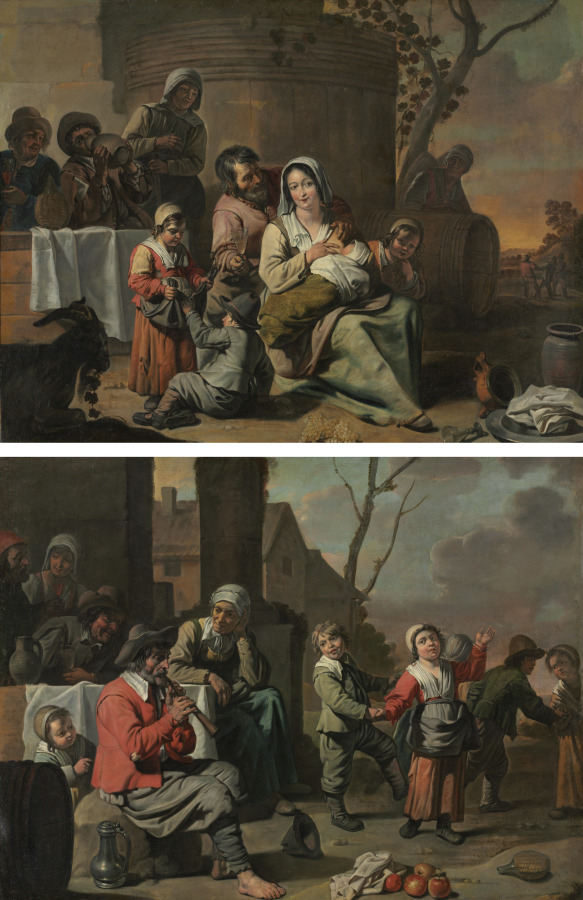
The mid-17th century saw revived interest in representations of the lower classes. Artists like the Le Nain brothers in France painted scenes that looked back to the Renaissance tradition of pastoral imagery. The Le Nain often depicted ordinary country folk going about their daily business, subjects and figures they remembered from their childhood in rural Laon. Considered a companion piece to Peasant Children Dancing (1958.175.2), Vintage Scene has also been attributed to the Master of the Béguins, a Flemish artist who worked in the manner of the Le Nain in Paris. Here, good-natured though bawdy men drink in the background shade, while a sweet-faced young woman in the center surrounded by chubby children flashes the viewer a coy smile that reveals her awareness of the slowly creeping hand of her drunk companion. While peasants drinking was a popular subject among Flemish artists, the theme of wine connects the subject with the grape harvest, which recalls the Le Nain's agricultural homeland in France. This use of both aesthetic and biographical aspects of the Le Nain's lives demonstrates the Master of Béguins's ability to absorb the stylistic and thematic lessons of the famous brothers.
Provenance
Count Ottone Ponte di Scarnafigi of Sardinia (died 1788);; Count Louis de Seyssel, (Turin, Italy), sold to Salmon Portland Halle, 1916; Salmon Portland Halle, upon his death, by inheritance to his wife; Mrs. Salmon Portman Halle, by gift to the Cleveland Museum of Art, 1958.
Accession Number
1958.175.1
Medium
oil on canvas
Dimensions
Framed: 111 x 142 x 8 cm (43 11/16 x 55 7/8 x 3 1/8 in.); Unframed: 92 x 121 cm (36 1/4 x 47 5/8 in.)
Classification
Painting
Credit Line
Gift of Mrs. Salmon P. Halle in memory of Salmon Portland Halle
Tags
Painting Baroque (1600–1750) Oil Painting Canvas French Color: Yellow Color: Gold
Background & Context
Background Story
Vintage Scene from the 1650s depicts a grape harvest in the French countryside, rendered with the restrained palette and quiet dignity that distinguish the Le Nain brothers' peasant paintings from the more boisterous Dutch genre tradition. The vintage—or grape harvest—was one of the most important annual events in rural France, and the Le Nain brothers' treatment emphasizes the communal labor of the harvest rather than the feasting and drinking that Dutch genre painters would have featured. The figures are engaged in productive work, and the composition gives them the monumental dignity that the Le Nain brothers brought to all their peasant subjects.
Cultural Impact
The Le Nain brothers' vintage scenes are important in the history of French painting because they establish the visual tradition of rural labor that would influence French art from the 17th century through Millet and the Barbizon School. The emphasis on productive work rather than festive excess distinguishes French peasant genre from its Dutch counterpart and establishes a tradition of respectful observation of rural life that would become one of the defining themes of French painting.
Why It Matters
Vintage Scene is the Le Nain brothers establishing the French tradition of respectful rural observation: a grape harvest depicted with the dignity of labor rather than the comedy of excess. The painting points forward to Millet and the Barbizon School, establishing a specifically French approach to peasant painting that emphasizes work over festivity.