Accession Number
1961.228
Medium
oil on paper mounted on canvas
Dimensions
Unframed: 33.1 x 47.8 cm (13 1/16 x 18 13/16 in.)
Classification
Painting
Credit Line
Gift of Helen Haseltine Plowden
Tags
Painting Impressionist & Modern (1851–1900) Oil Painting Canvas American Color: Orange
Background & Context
Background Story
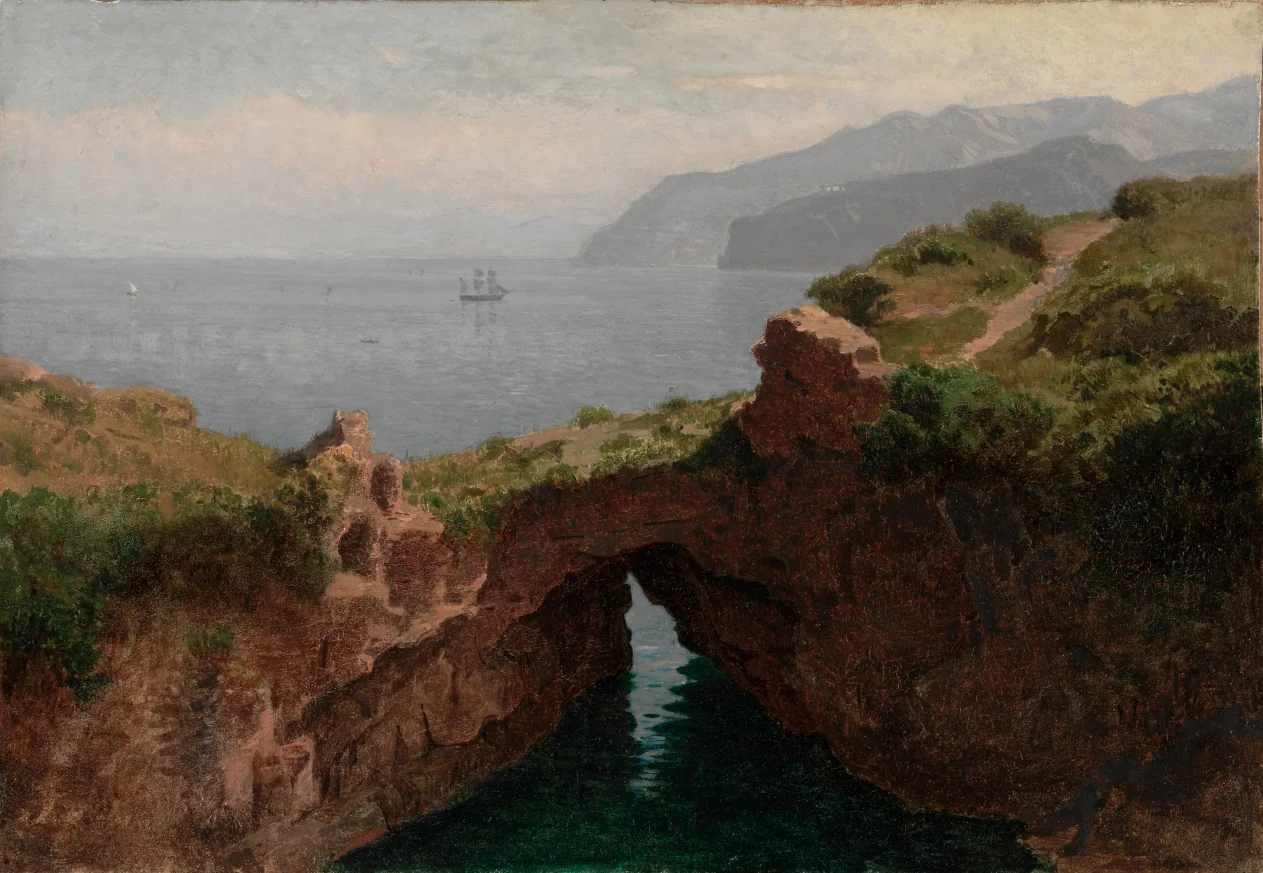
Natural Bridge, Sorrento from 1856 is an early work by Haseltine, depicting the famous natural rock formation on the Sorrentine coast with the geological precision and Luminist clarity that would become his signature. The oil on paper mounted on canvas format was common for Haseltine's Italian studies—the paper allowed rapid on-site work while the canvas mounting provided durability. The 1856 date places this in Haseltine's early Italian period, when he was developing the precise coastal landscape style that would make his reputation on both sides of the Atlantic.
Cultural Impact
Haseltine's early Italian studies are important documents in the development of his Luminist style because they show the geological precision and clear light of his mature work before it had been fully formulated. Natural Bridge, Sorrento from 1856 demonstrates the care with which Haseltine observed geological formations even at the beginning of his career—the same attention to strata and surface that would characterize his later work is already present in this early Italian study.
Why It Matters
Natural Bridge, Sorrento is early Haseltine with his geological precision already in place: the famous rock formation rendered with the care of a naturalist, even at the beginning of his career. The 1856 Italian study shows that Haseltine's Luminist clarity and geological accuracy were present from the start, waiting for the mature style that would bring them to full development.


![Saint Bernard and Saint Catherine of Alexandria with the Virgin of the Annunciation [right panel]](https://api.nga.gov/iiif/e6890364-4d99-4684-a62b-5060ee3c3446/full/400,/0/default.jpg)