Description
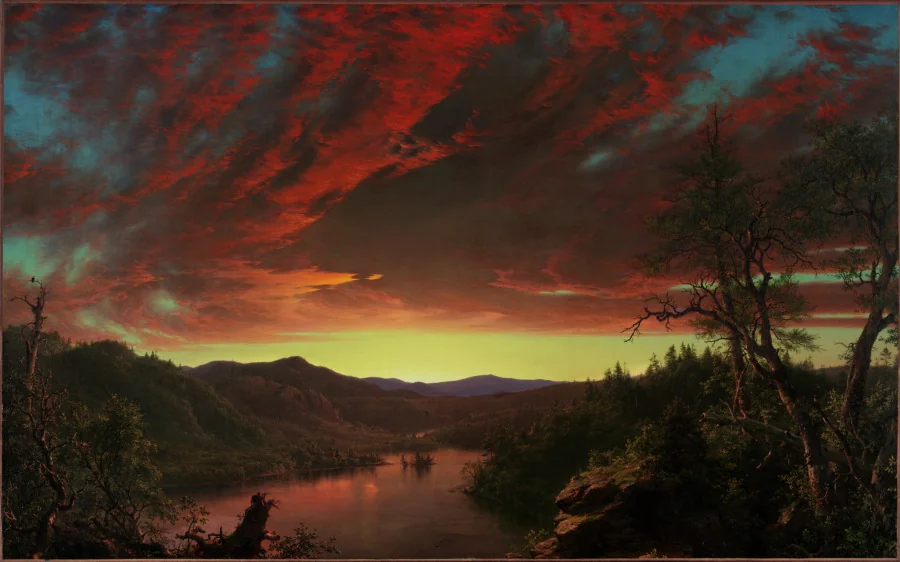
In his New York studio, Church painted this spectacular view of a blazing sunset over wilderness near Mount Katahdin in Maine, which he had sketched during a visit nearly two years earlier. Although Church often extolled the grandeur of American landscape in his work, this painting appears to have additional overtones. Created on the eve of the Civil War, the painting's subject can be interpreted as symbolically evoking the coming conflagration. Church's considerable technical skills and clever showmanship contributed to his fame as the premier artist of his generation. Rather than debut this painting in an annual exhibition with works by other artists as was the custom, Church instead exhibited it by itself at a prestigious art gallery. Coaxed by advance publicity and highly favorable press reviews, several hundred spectators flocked to admire it during its seven-week run.
Provenance
William T. Walters [1820-1894], Baltimore, MD, consigned to Samuel Putnam Avery for sale at Henry H. Leeds and Co. (1860-1864); (Henry H. Leeds and Co., New York, NY, Feb. 12-13, 1864) (1864); (Samuel Putnam Avery [1822-1904], New York, NY) (1864-1866); (Leeds and Minor at Old Dusseldorf Gallery, New York, NY, March 9, 1866, no. 174, sold to John Taylor Johnston) (1866); John Taylor Johnston [1820-1893], New York, NY (1866-1876); (Chickering Hall, John Taylor Johnston sale, Dec. 19-22, 1876, sold to John Work Garrett?) (1876); John Work Garrett [1820-1884], Baltimore, MD, by descent to his daughter, Mary E. Garrett? (1876-probably 1884); Mary E. Garrett [1854-1909], Baltimore, MD, sold to Robert de Forest (Probably 1884-at least 1902); Robert de Forest [1848-1931], Parkers Point, CT, by descent to his brother, Lockwood de Forest (After 1902-1931); Lockwood de Forest [1850–1932], Santa Barbara, CA, by descent to his son, Alfred Victor de Forest (1931-1932); Alfred Victor de Forest [1888-1945], Marlborough, NH, by descent to his son, Taber de Forest (1932-1945); Taber de Forest, Maine, sold to David McCoy (1945-early 1960s); David McCoy, Lyme, CT, sold to Robert Weimann (Early 1960s); Robert Weimann, Ansonia, CT, sold to the Cleveland Museum of Art (1962 or 1963-1965); The Cleveland Museum of Art, Cleveland, OH (1965-)
Accession Number
1965.233
Medium
oil on canvas
Dimensions
Framed: 124 x 185 x 13 cm (48 13/16 x 72 13/16 x 5 1/8 in.); Unframed: 101.6 x 162.6 cm (40 x 64 in.)
Classification
Painting
Credit Line
Mr. and Mrs. William H. Marlatt Fund
Tags
Painting Impressionist & Modern (1851–1900) Oil Painting Canvas American Color: Orange
Background & Context
Background Story
Twilight in the Wilderness is one of Church's most emotionally charged landscapes, depicting a sunset over an American wilderness with a chromatic intensity that borders on the apocalyptic. The 1860 date places the painting on the eve of the Civil War, and many viewers have read the painting's fiery sky as a premonition of the coming conflict. Whether or not Church intended this political reading, the painting's emotional intensity—its combination of sublime beauty and ominous atmosphere—reflects the growing national anxiety of the pre-war period. The composition eliminates all human presence, leaving only wilderness and sky in a composition that suggests nature's indifference to human concerns.
Cultural Impact
Twilight in the Wilderness was painted in the same year that South Carolina seceded from the Union, and its fiery sky has been interpreted as a visual metaphor for the coming conflagration of the Civil War. Whether or not Church intended this political reading, the painting's emotional intensity reflects the national mood of 1860—the sense that a catastrophe was approaching that would transform the American landscape forever. The absence of human presence reinforces this reading: nature is sublime and beautiful, but it is also indifferent to the political crisis that is about to engulf the nation.
Why It Matters
Twilight in the Wilderness is Church's most emotionally charged landscape: a fiery sunset over an empty wilderness, painted on the eve of the Civil War. The sky's chromatic intensity seems to prophesy the national catastrophe, and the absence of human presence suggests nature's indifference to the political crisis about to unfold.