Description
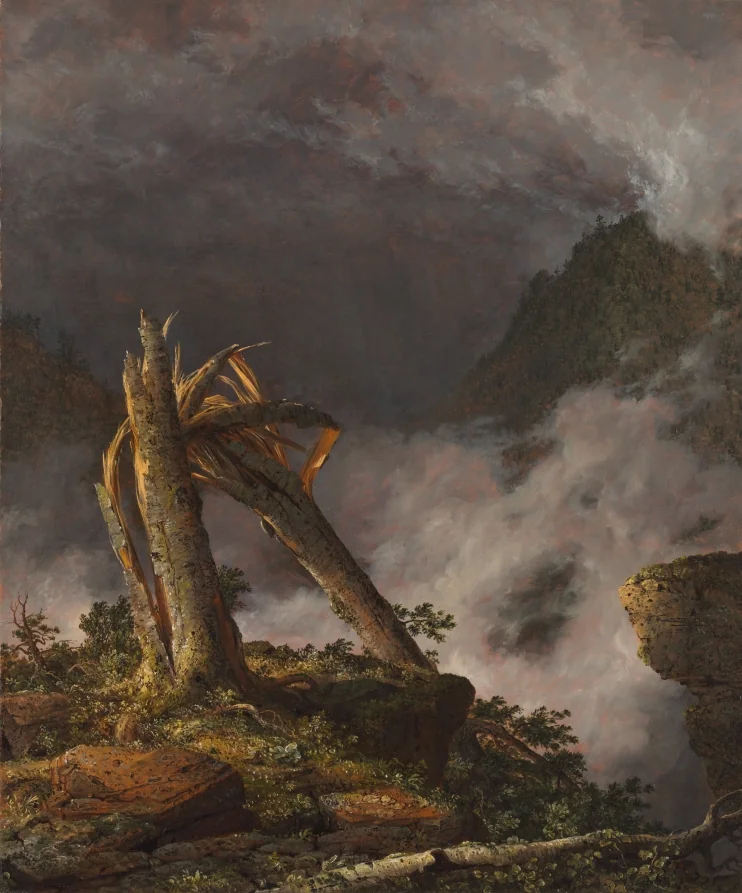
Dominating this composition is a lightning-blasted tree embodying nature's awe-inspiring power and endless cycle of life and death. A popular motif because of these associations, the blasted tree was favored by many landscape painters like Church, who prominently featured it here.
Provenance
Sold to E. G. Merrick, Clayton, NY (in family until 1967)-(Eldridge Gerry Merrick, E. G. Merrick II, Mrs. John P. Nevins (daughter), West Brattleboro, Vermont); Adams Davidson and Company, Washington, D. C. 1967; Hirschl and Adler, N. Y. Sold to CMA and the CMA's Prendergast The Road to the Village, New Hampshire, La Farge's Choir, and Durand's Scene among the Berkshire Hills, 10 May 1969.
Accession Number
1969.52
Medium
oil on canvas
Dimensions
Framed: 98.7 x 86.4 x 9.2 cm (38 7/8 x 34 x 3 5/8 in.); Unframed: 75.5 x 62.8 cm (29 3/4 x 24 3/4 in.); Former: 94.5 x 81.5 x 9 cm (37 3/16 x 32 1/16 x 3 9/16 in.)
Classification
Painting
Credit Line
Gift of various donors by exchange and Purchase from the J. H. Wade Fund
Tags
Painting Neoclassical & Romantic (1751–1850) Oil Painting Canvas American Color: Gold Color: Brown
Background & Context
Background Story
Storm in the Mountains from 1847 is an early work by Church, painted when he was only 21 and still under the influence of his teacher Thomas Cole. The painting shows the young artist working through the compositional and atmospheric devices that Cole had developed for the American sublime: the dramatic foreground, the distant mountain peak, and the storm that sweeps across the landscape providing both atmospheric drama and moral symbolism. The painting is competent and ambitious, but it lacks the panoramic sweep and topographic specificity that would distinguish Church's mature work from Cole's more allegorical approach.
Cultural Impact
Storm in the Mountains is a key document in Church's artistic development because it shows him working in Cole's idiom before he had developed his own more topographic and panoramic style. The painting demonstrates both the influence of Cole's allegorical approach (the storm as a symbol of spiritual or emotional turmoil) and the seeds of Church's own approach (the detailed rendering of natural phenomena that would culminate in Niagara and The Heart of the Andes).
Why It Matters
Storm in the Mountains is the young Church learning from Cole: the storm, the mountain, the sublime spectacle are all inherited from his teacher, but the detailed rendering of natural phenomena points toward the topographic specificity that would make Church's mature work distinctive. The painting is a talented student's exercise in the style of his master.