Accession Number
1966.743
Medium
watercolor on heavy board
Dimensions
Unframed: 46.7 x 36.9 cm (18 3/8 x 14 1/2 in.)
Classification
Drawing
Credit Line
Gift of The Cleveland Museum of Art Library
Tags
Drawing Impressionist & Modern (1851–1900) Watercolor Board Italian Color: Orange Color: White
Background & Context
Background Story
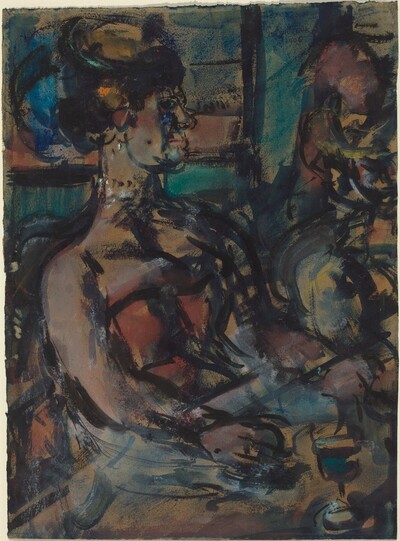
Moslems at Prayer by P. Pavesi, dating from the late 1800s to early 1900s, depicts a subject that fascinated Western European artists during the height of Orientalism. The painting shows Muslim worshippers engaged in salah (formal prayer), a practice that involves a sequence of prescribed physical postures including standing, bowing, prostrating, and sitting, performed in the direction of Mecca. Pavesi's depiction likely shows a group of figures in various postures of prayer, possibly within a mosque or in an outdoor setting, rendered with the atmospheric handling of light and color that characterized Orientalist painting. The period of this work overlaps with the later phase of academic Orientalism, when European painters continued to produce scenes of Islamic religious life for audiences intrigued by what they perceived as the exoticism of non-Western cultures. While such paintings often reflected genuine curiosity about other religious traditions, they also participated in power dynamics that objectified their subjects and reinforced stereotypes about the mysterious or sensual nature of the Orient. More nuanced readings recognize that some Orientalist painters achieved genuine empathy and observational accuracy, even as they worked within a tradition that was inseparable from colonial discourse. The practice of Muslim prayer itself—with its emphasis on communal devotion, physical humility, and spiritual discipline—offered European painters a subject rich in compositional possibilities and dramatic potential.
Cultural Impact
Orientalist paintings of Muslim prayer shaped Western perceptions of Islam, for better and worse, creating enduring visual impressions of Islamic religious practice that were sometimes empathetic and often reductive.
Why It Matters
This work engages with the complex legacy of Orientalist painting, requiring viewers to navigate between the genuine artistic interest in Islamic culture and the colonial framework within which such representations were produced and consumed.