Description
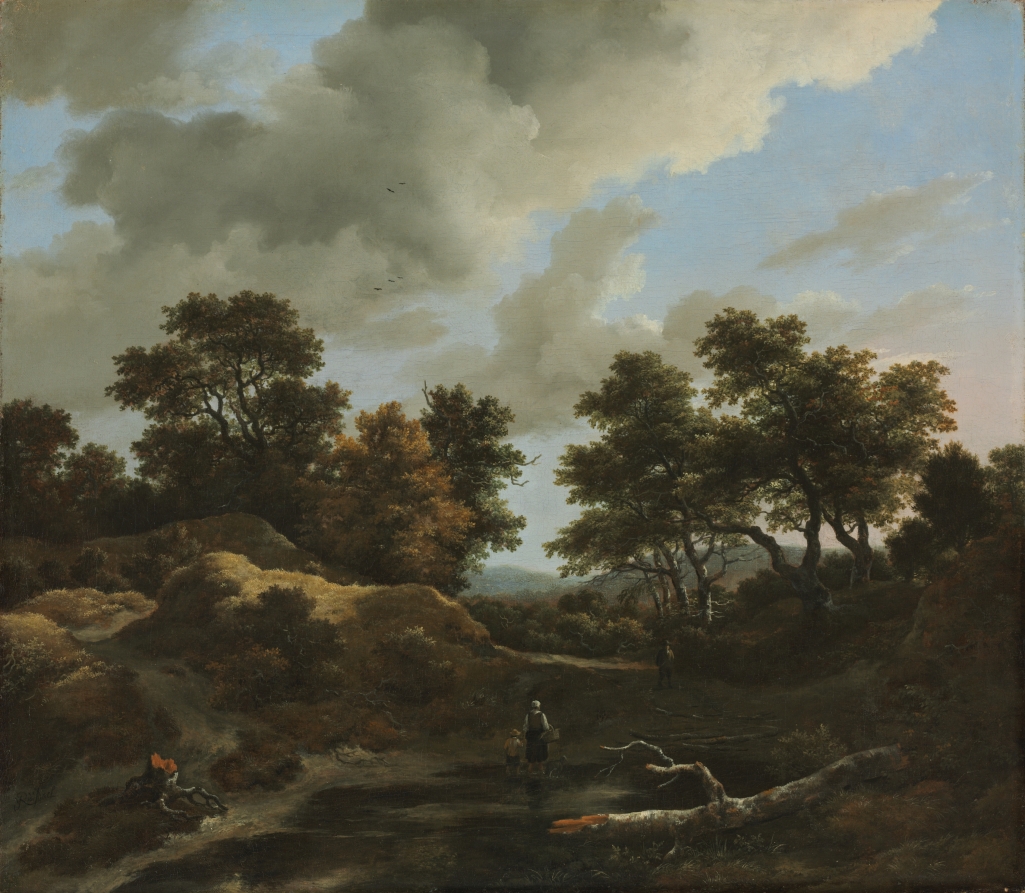
Even this early work by Jacob van Ruisdael—painted while he was still a teenager—shows his unique approach to landscape that made the simplest motifs seem grand and heroic. Dark forms are massed in the foreground, creating a stark contrast to the expansive, sunlit plain at left.
Provenance
Sir Francis Cook;; Sir Frederick Cook;; Sir Herbert Cook, Doughty House, Richmond;; Sir Francis Cook, Le Coin, Jersey, Channel Islands;; Trustees of the Cook Collection (sale: Christie's, London, November 15, 1966, no. 55, listed as Follower of Ruisdael);; [F. Kleinberger & Co., New York], sold to the Cleveland Museum of Art, 1967.
Accession Number
1967.19
Medium
oil on wood
Dimensions
Framed: 69 x 88.5 x 4 cm (27 3/16 x 34 13/16 x 1 9/16 in.); Unframed: 49.5 x 68.5 cm (19 1/2 x 26 15/16 in.)
Classification
Painting
Credit Line
Mr. and Mrs. William H. Marlatt Fund
Tags
Painting Baroque (1600–1750) Oil Painting Dutch Color: Yellow Color: Gray
Background & Context
Background Story
Landscape with a Windmill (1646) is another of Ruisdael's early works, depicting the windmill that was Holland's most iconic structure—the machine that pumped water from the polders and made the Netherlands' existence possible. The windmill's significance in Dutch culture went far beyond its practical function: it symbolized the Dutch people's triumph over the sea and their ingenuity in creating land where water had been. Ruisdael's treatment of the windmill, rising above the flat Dutch landscape with its sails catching the wind, gives the structure a monumentality that its practical origins do not suggest. The 1646 date makes this one of Ruisdael's earliest landscape paintings—painted when he was approximately eighteen—and demonstrates the precocious talent that would quickly establish him as the leading landscape painter in Haarlem. The windmill subject, with its combination of functional architecture and landscape setting, provided Ruisdael with a compositional focus that organized the flat Dutch terrain around a strong vertical element. The painting's atmosphere—the characteristic Dutch sky with its moving clouds and the particular quality of Northern light—demonstrates Ruisdael's ability to render atmospheric effects with a sensitivity that his young age makes remarkable. The windmill, rendered with the structural precision that Dutch painting demanded, stands as a symbol of the engineering ingenuity that made the Dutch Republic both possible and prosperous.
Cultural Impact
Ruisdael's windmill paintings influenced how Holland's most iconic structure was represented in art, establishing the windmill as a symbol of Dutch ingenuity and national identity. The paintings influenced later landscape painters who similarly found significance in functional architecture within scenic settings. The 1646 windmill influenced how Ruisdael's precocity was understood, documenting the talent that would make him the greatest Dutch landscape painter.
Why It Matters
This painting matters because it captures Holland's most characteristic landscape feature—the windmill that made the Netherlands possible—with the dramatic power and atmospheric sensitivity that would define Ruisdael's mature work. The windmill rising above the flat Dutch landscape is simultaneously a functional structure and a symbol of national identity, and Ruisdael's treatment honors both dimensions with equal conviction.