Accession Number
1967.21
Medium
oil on canvas
Dimensions
Unframed: 46.3 x 64.7 cm (18 1/4 x 25 1/2 in.)
Classification
Painting
Credit Line
The A. W. Ellenberger, Sr., Endowment Fund
Tags
Painting Impressionist & Modern (1851–1900) Oil Painting Canvas American Color: White
Background & Context
Background Story
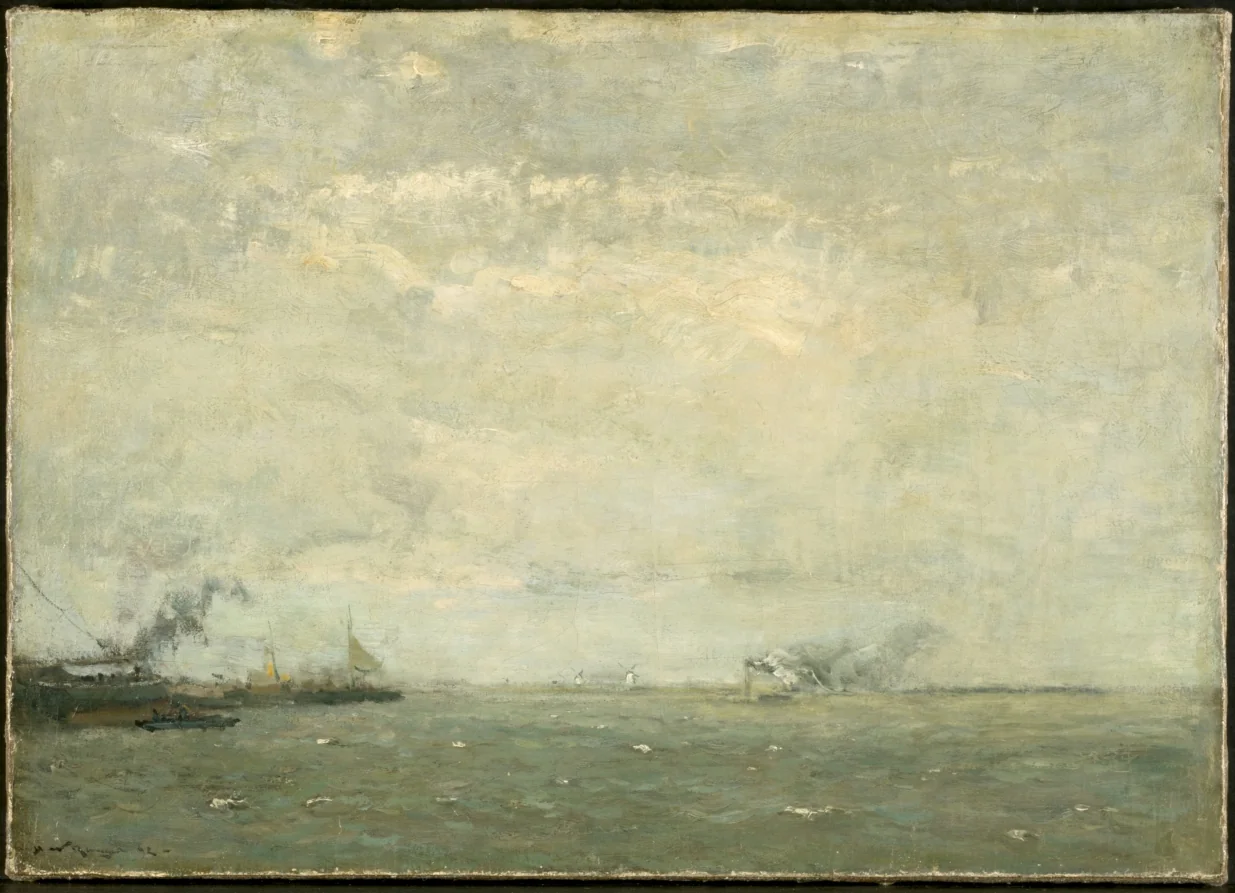
Seascape, painted in 1892, is one of Ranger's earliest mature works and demonstrates his ability to apply Tonalist principles to the marine landscape as effectively as he applied them to the forest. The seascape presents particular challenges for a Tonalist painter: where the forest provides a complex pattern of light and shadow, the sea and sky offer large areas of relatively uniform tone. Ranger meets this challenge by emphasizing the subtle gradations of atmosphere, the variations in cloud cover, and the tonal relationships between water, sky, and horizon that create the mood of a marine landscape.
Cultural Impact
Ranger's early seascape predates his founding of the Old Lyme colony but already shows the Tonalist approach that would define his career. The painting demonstrates that Tonalism was not limited to woodland interiors and pastoral landscapes — it could be applied to any subject where atmosphere, mood, and tonal unity were the primary concerns. The sea, with its constant atmospheric variation, was an ideal subject for this approach.
Why It Matters
Seascape is Ranger proving that Tonalism works at sea as well as on land: water, sky, and horizon organized into a single tonal experience where atmosphere matters more than detail. The 1892 date makes this a young artist's statement — Tonalism is not just a forest style but a comprehensive approach to landscape.



![Saint Bernard and Saint Catherine of Alexandria with the Virgin of the Annunciation [right panel]](https://api.nga.gov/iiif/e6890364-4d99-4684-a62b-5060ee3c3446/full/400,/0/default.jpg)