Description
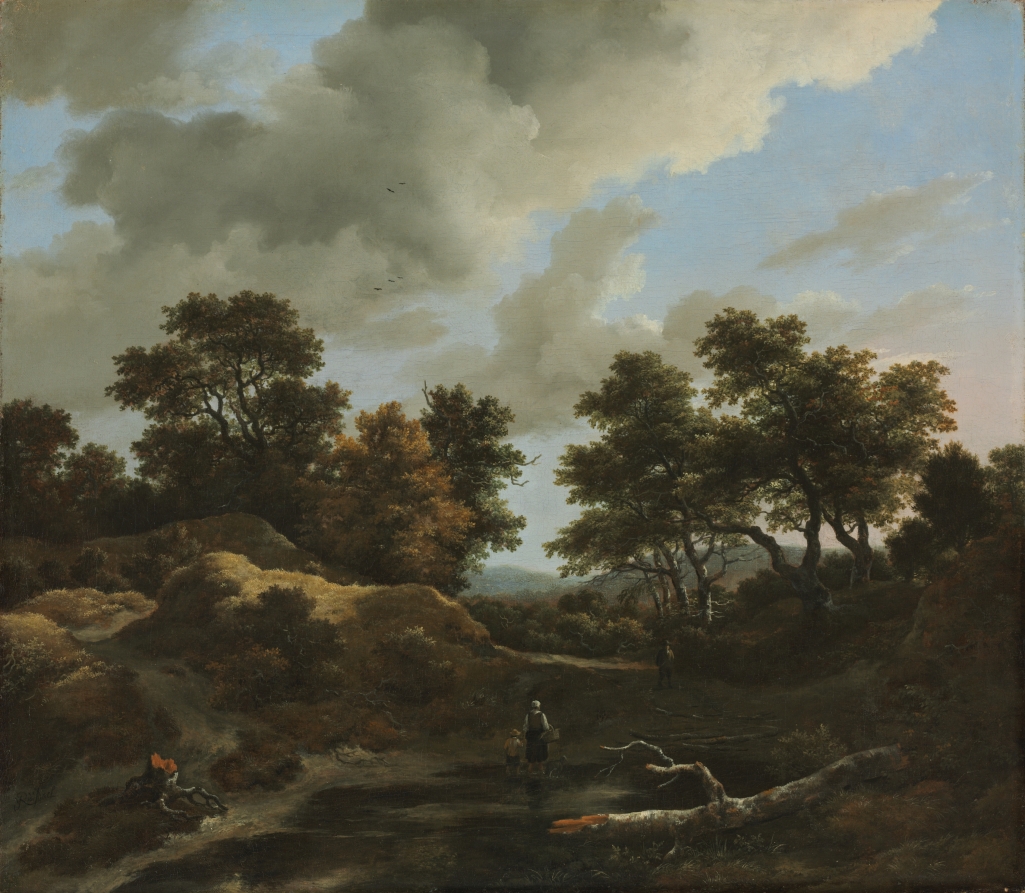
Jutting from a dune in the foreground, the massive silvery trunk of a dead tree leads the eye across a waterfall and toward a distant sunlit field where travelers and a dog traverse a sandy path. Partly masked by trees, a ruined building is turned gold by the sun. In Jacob van Ruisdael’s landscapes, dead trees, waterfalls, and ruined buildings were visual expressions of the passage of time. Ruisdael devoted equal attention to the cloud-filled skies looming above the land, creating dramatic patterns of light and shadow and revealing the unseen movements of the wind.
Provenance
Freiherren von Ketteler (first at Schloss Harkotten near Warendorf, probably by mid-eighteenth century;; later at Schloss Ehringerfeld near Buren, Westphalia, 1904);; J. J. van Leeuwen Boomkamp, Naarden, Holland, 1929;; (sale: Sotheby’s London, November 30, 1966, no. 21; to Legatt);; [Frederick Mont, New York], sold to the Cleveland Museum of Art, 1967.
Accession Number
1967.63
Medium
oil on canvas
Dimensions
Framed: 123 x 157 x 9.5 cm (48 7/16 x 61 13/16 x 3 3/4 in.); Unframed: 99.2 x 131 cm (39 1/16 x 51 9/16 in.)
Classification
Painting
Credit Line
Mr. and Mrs. William H. Marlatt Fund
Tags
Painting Baroque (1600–1750) Oil Painting Canvas Dutch Color: Brown Color: Gray
Background & Context
Background Story
Low Waterfall in a Wooded Landscape with a Dead Beech Tree (c. 1660-70) represents Ruisdael's engagement with the forest landscape at its most emotionally complex—a combination of living nature and death that gave his forest scenes their distinctive melancholy. The dead beech tree, standing leafless among its living companions, is one of the most powerful images in Dutch landscape painting: the tree's massive trunk and bare branches suggest the mortality that underlies even the forest's apparent permanence. Ruisdael's inclusion of dead trees in his forest scenes was unprecedented in Dutch painting—no earlier landscape painter had given death such prominence within compositions that celebrated nature's beauty—and the dead beech tree reflects the 17th-century Dutch understanding of nature as both vital and mortal, growing and decaying, beautiful and sublime. The low waterfall, with its gentle cascade over rocks, provides a compositional counterpoint to the dead tree's vertical presence: water's constant movement contrasts with the tree's stasis, and the waterfall's life-giving flow contrasts with the tree's death. The 1660-70 date places this during Ruisdael's most productive and most emotionally complex period, when his forest scenes were reaching the depth of feeling that made them the most influential landscape paintings in European art.
Cultural Impact
Ruisdael's forest scenes with dead trees influenced how mortality was represented in landscape painting, establishing the dead tree as a symbol of natural mortality that influenced Romantic and Sublime landscape traditions. The paintings influenced later artists from the Barbizon school to the Symbolists who similarly found melancholy in the forest's beauty. The dead beech tree influenced how the relationship between beauty and mortality was visually represented, arguing that landscape painting could carry the same philosophical weight as vanitas still-life.
Why It Matters
This painting matters because it represents Ruisdael's most emotionally complex contribution to landscape painting—the dead tree that gives the forest scene its characteristic melancholy and that argues for the coexistence of beauty and mortality within the natural world. The dead beech tree is one of European art's most powerful images of the impermanence that underlies even nature's most impressive manifestations of vitality.