Description
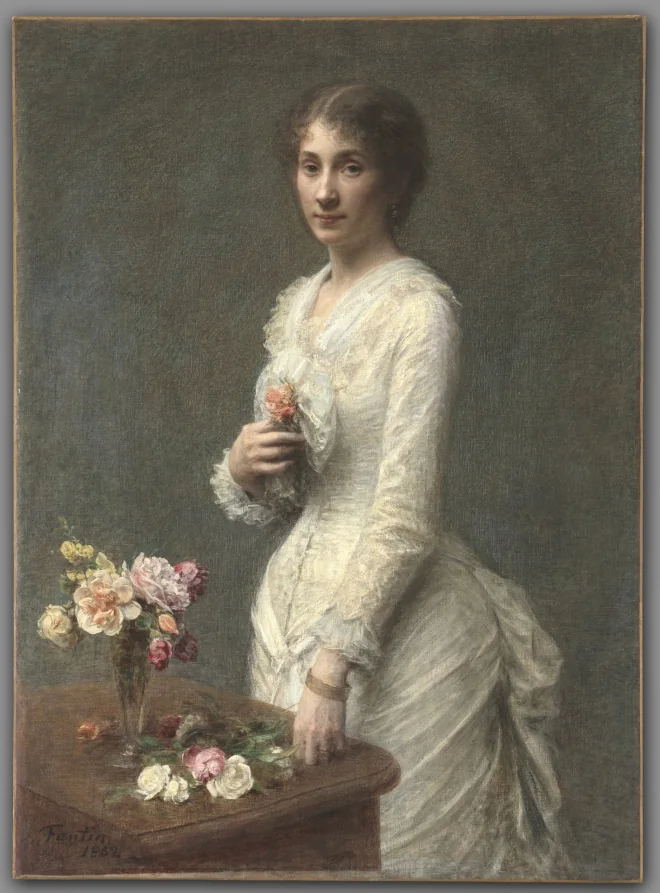
The floral still life of roses enlivens the otherwise restrained palette used by the artist in this portrait. By the time he painted Madeleine Escudier Lerolle (1856–1937), wife of artist Henry Lerolle, the French artist Henri Fantin-Latour had established a steady clientele in Britain for his floral still lifes, arranged in modest vases and depicted against a neutral ground; he included such a still life in this portrait. Madeleine Lerolle and her daughter Yvonne are the subjects of another painting at the CMA by Albert Besnard in gallery 219.
Provenance
Family of the sitter. Hector Brame, Paris. Purchased by the CMA on 10 May 1969.
Accession Number
1969.54
Medium
oil on fabric
Dimensions
Framed: 132.4 x 103.5 x 8.3 cm (52 1/8 x 40 3/4 x 3 1/4 in.); Unframed: 108.2 x 78.9 cm (42 5/8 x 31 1/16 in.)
Classification
Painting
Credit Line
Purchase from the J. H. Wade Fund and the Fanny Tewksbury King Collection by exchange
Tags
Painting Impressionist & Modern (1851–1900) Oil Painting French Color: Brown Color: Black
Background & Context
Background Story
Fantin-Latour's portrait of Madame Lerolle (1882) depicts a member of the Lerolle family—significant patrons of the arts in late 19th-century Paris. The Lerolles were collectors and supporters of progressive artists, and their circle included Renoir, Debussy, and the Nabis painters. Madame Lerolle's portrait thus connects Fantin-Latour to the progressive artistic milieu of the 1880s, even as his personal style remained distinct from the emerging movements. The portrait exemplifies Fantin-Latour's approach to female portraiture: psychological restraint, chromatic subtlety, and an emphasis on the sitter's inner life rather than social display. Madame Lerolle is presented as an individual of taste and intelligence rather than a decorative object—a distinction that separates Fantin-Latour's portraiture from the more conventional society portraiture of the era. The year 1882 places this portrait well into the Third Republic, when the social order had been transformed by the fall of the Second Empire and the Commune. The Lerolles represented the new cultural elite—wealthy but progressive, traditional in taste but open to innovation—that would define Parisian cultural life through the Belle Époque.
Cultural Impact
Fantin-Latour's portrait of Madame Lerolle influenced how progressive cultural patronage was represented in art, documenting the social world that supported artistic innovation. The portrait influenced how women's portraiture was understood, offering a model of intellectual and personal seriousness that contrasted with decorative conventions. The painting also documented the Lerolle circle that was so important to French cultural life at the turn of the century.
Why It Matters
This portrait matters because it reveals Fantin-Latour's position at the intersection of traditional and progressive artistic culture. His technique was rooted in academic tradition, yet his sensibility connected him to the avant-garde. The portrait of Madame Lerolle embodies this duality—a traditional painting of a thoroughly modern woman—demonstrating that the relationship between tradition and innovation in art is more complex than simple opposition.