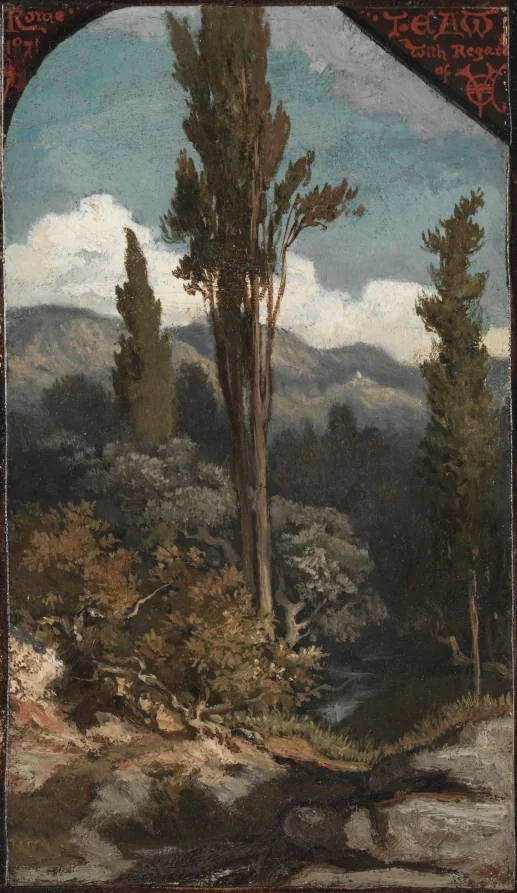
Description
The American painter Elihu Vedder spent almost all of his career after 1866 in Rome, where this small landscape was painted. The inscription shows that it was given as a souvenir to Edmund A. Ward of New York, who had purchased a large painting from the artist.
Provenance
Edmund Augustus Ward, New York; Theodore Paul, Auburn, Maine; Vose Galleries, Boston [sold February 1971]; Sloan & Roman, New York; Purchased from B. Danenberg Galleries, N.Y. with monies previously given-11 December 1971.
Accession Number
1971.263
Medium
oil on card on canvas
Dimensions
Unframed: 22 x 12.7 cm (8 11/16 x 5 in.)
Classification
Painting
Credit Line
Gift of Mrs. John C. Newington
Tags
Painting Impressionist & Modern (1851–1900) Oil Painting Canvas American Color: Orange Color: Brown
Background & Context
Background Story
Elihu Vedder (1836-1923) was an American Symbolist painter known for his mystical landscapes and allegorical subjects, and for his illustrations of the Rubáiyát of Omar Khayyam. Three Trees: Italy from 1871 is a landscape painted during Vedder's years in Italy, depicting three trees with the symbolic resonance that distinguishes Vedder's approach to landscape from the more naturalistic tradition of American landscape painting. The Italian setting and the symbolic treatment of the trees demonstrate Vedder's departure from the Hudson River School's naturalism toward the Symbolist vision that would define his mature work.
Cultural Impact
Three Trees: Italy is important in Vedder's development because it shows the Symbolist approach to landscape that he developed during his years in Italy, departing from the naturalistic tradition of the Hudson River School. The three trees are not simply landscape elements but symbolic presences that suggest the mystical significance that Vedder found in the Italian landscape, and the 1871 date places this at the beginning of his mature Symbolist period.
Why It Matters
Three Trees: Italy is Vedder's Symbolist landscape emerging from Italian experience: three trees rendered with the symbolic resonance that distinguishes his approach from the Hudson River School's naturalism. The 1871 painting shows the departure from American landscape naturalism toward the mystical vision that would define Vedder's mature work.
![Saint Bernard and Saint Catherine of Alexandria with the Virgin of the Annunciation [right panel]](https://api.nga.gov/iiif/e6890364-4d99-4684-a62b-5060ee3c3446/full/400,/0/default.jpg)