Accession Number
1994.286
Medium
oil on panel
Dimensions
Unframed: 9.2 x 17.9 cm (3 5/8 x 7 1/16 in.)
Classification
Painting
Credit Line
Gift of Betty Dunbar Brien in memory of her grandmother, Nancy McLeish Dunbar
Tags
Painting Impressionist & Modern (1851–1900) Oil Painting Panel Painting American Color: Orange Color: Brown
Background & Context
Background Story
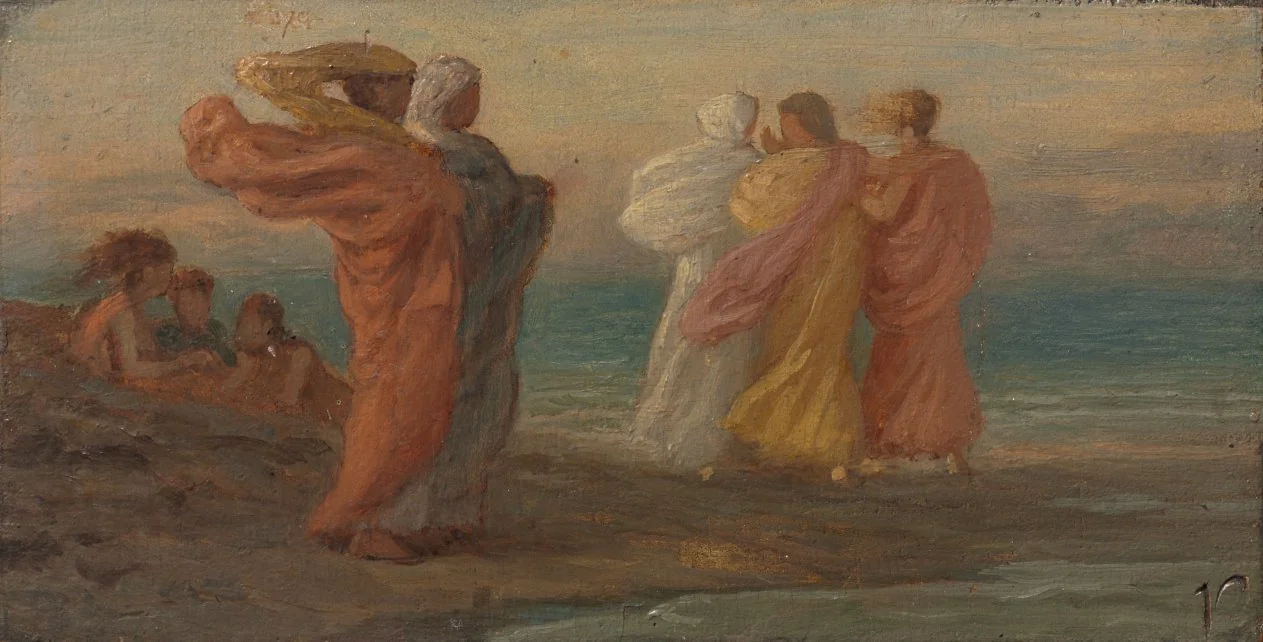
The Music Party from c. 1875 depicts a group of figures making music in the allegorical style that distinguishes Vedder's figure subjects from the more naturalistic approach of his American contemporaries. The musical subject allows Vedder to explore the relationship between music and visual art that was central to the Symbolist movement, in which music was considered the highest of the arts because its meaning was purely formal rather than representational. The c. 1875 date places this in Vedder's most productive period, when he was producing the allegorical figure subjects that would lead to his celebrated illustrations of the Rubáiyát of Omar Khayyam.
Cultural Impact
The Music Party is important in Vedder's development because it demonstrates the allegorical approach to figure subjects that would lead to his illustrations of the Rubáiyát of Omar Khayyam. The musical subject is a Symbolist staple—the idea that music, as the most abstract of the arts, provides the model for all artistic expression—and Vedder's treatment transforms the social occasion of a music party into an allegory of artistic inspiration.
Why It Matters
The Music Party is Vedder's allegory of artistic inspiration: a group of figures making music rendered in the Symbolist style that transforms a social occasion into a meditation on the relationship between music and visual art. The c. 1875 painting anticipates the allegorical illustrations of the Rubáiyát that would make Vedder famous.
![Saint Bernard and Saint Catherine of Alexandria with the Virgin of the Annunciation [right panel]](https://api.nga.gov/iiif/e6890364-4d99-4684-a62b-5060ee3c3446/full/400,/0/default.jpg)