Description
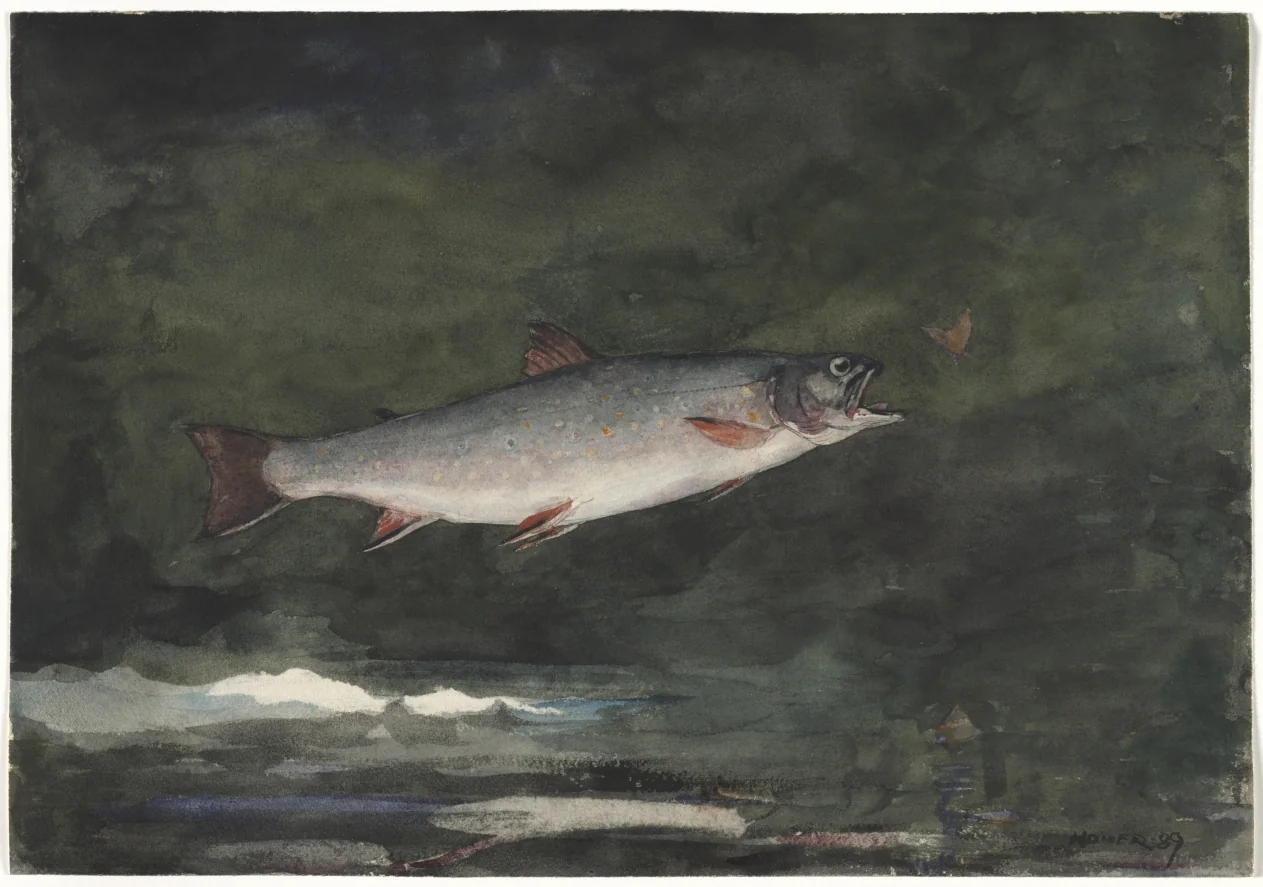
In 1886, Winslow Homer began to produce oil paintings and watercolors of subjects in the Adirondack Mountains, where he and his brother Charles had fished and hunted since the 1870s. In Leaping Trout, a silvery trout propels itself from the water in pursuit of a hapless insect or a fisherman’s fly. Homer’s choice to adopt the fish’s perspective, rather than a fisherman’s, is quite unconventional and heightens the drama and immediacy of the scene. His technique, influenced by the free brushwork of French Impressionism, similarly animates his still-life subject. Luminous washes of transparent blue and grey watercolor suggest the fish’s iridescent skin, while opaque pricks of bright red on its body lend a decorative effect reminiscent of Japanese prints. On the water’s surface, Homer uses scraping to create two brilliant white highlights, and dry brushing to produce the impression of a reflective surface. Although the overall effect is mysterious and dreamlike, the color and movement of the fish is carefully studied, suggesting Homer’s desire to appeal to the sportsmen who might buy his works.
Provenance
(F.W. Bayley & Son, Boston, MA.) (c. 1925); (Macbeth Gallery, New York, New York, sold to Ralph T. King, Sr. on 5/21/1925.) (2/10/1925-5/21/1925); Mr. and Mrs. Ralph T. King, Cleveland, OH. (1925-?); Anonymous donor, purchased from the Ralph T. King, Sr. Collection. (After 1937-1973); The Cleveland Museum of Art, Cleveland, OH, gift of anonymous donor. (1973-)
Accession Number
1973.142
Medium
watercolor over graphite
Dimensions
Sheet: 35 x 50.6 cm (13 3/4 x 19 15/16 in.)
Classification
Drawing
Credit Line
Anonymous Gift
Tags
Drawing Impressionist & Modern (1851–1900) Watercolor Graphite & Pencil American Color: Gray
Background & Context
Background Story
Leaping Trout (1889) exemplifies Homer's late-career mastery of the watercolor medium, depicting a trout in mid-leap—a moment of pure animal energy that Homer renders with the precision of an angler who knows the fish's behavior intimately. The painting belongs to Homer's Adirondack sporting series, where fishing subjects allowed him to combine landscape observation, animal painting, and the sporting experience that he knew firsthand. The leaping trout—a rainbow or brook trout breaking the water's surface to take a fly or escape a predator—is a moment every angler has witnessed and few have captured so precisely. Homer's watercolor technique in this late work is at its most accomplished: the transparency of the medium allows him to suggest water's depth and clarity, while the rapid brushwork captures the trout's movement with an economy that makes the fish's energy palpable. The year 1889 places this during Homer's mature Prouts Neck period, when his annual visits to the Adirondacks provided sporting subjects that balanced the Maine coast's severity with the wilderness's more contemplative beauty. The trout itself—an indigenous species that was being threatened by habitat degradation and introduced species—carries environmental significance that Homer may not have intended but that later viewers cannot ignore.
Cultural Impact
Homer's sporting watercolors influenced American fishing culture's visual representation, establishing how trout and their habitat were represented in art and popular media. The paintings influenced American watercolor practice, demonstrating that the medium could capture animal movement and water effects with a precision that challenged oil painting's traditional advantages. The leaping trout subject influenced sporting art and illustration, establishing a convention for depicting the moment of the rise that persists in fly-fishing imagery.
Why It Matters
This painting matters because it represents the convergence of Homer's artistic mastery, his sporting knowledge, and his technical command of watercolor—a medium he elevated to new levels of achievement. The leaping trout captures an instant of animal energy that Homer renders with a specificity born of intimate familiarity, demonstrating that the best sporting art comes from artists who are also practitioners.