Description
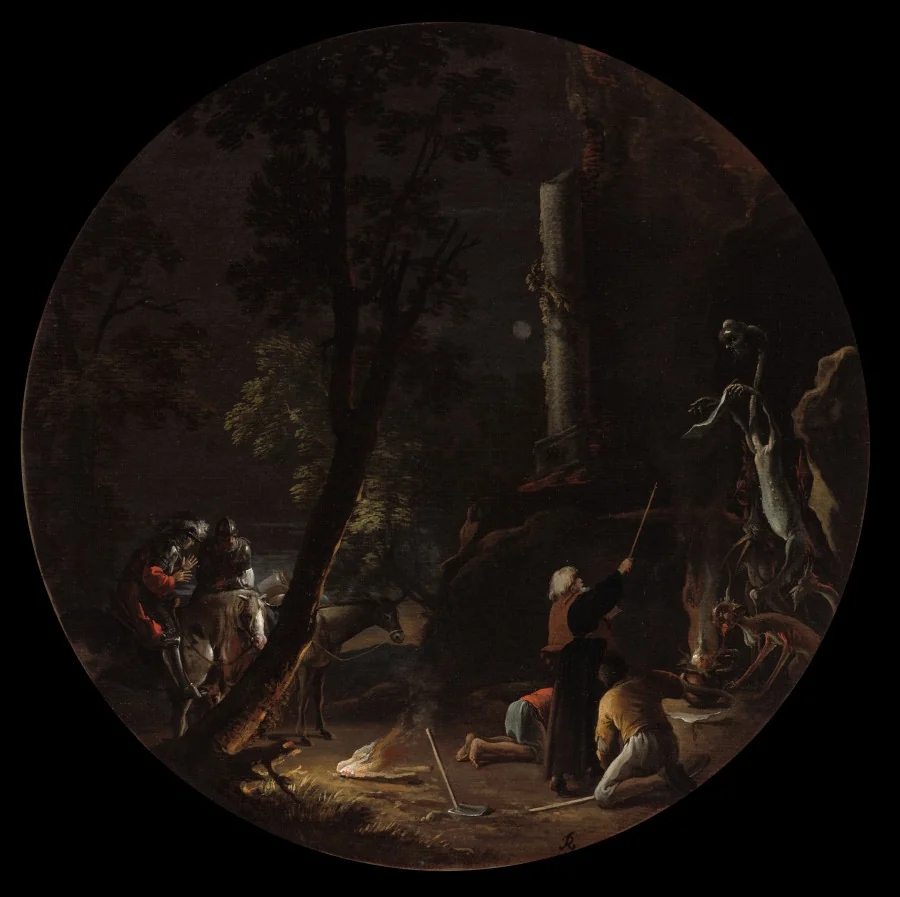
In the pitch black of night, two groups of men are gathered in a forest. To the left, travelers apprehensively pause to watch a magician conjure terrifying apparitions. Since the Middle Ages, necromancy, the act of communing with the dead, was associated with male sorcerers. In Rosa's painting, the wizened necromancer who stands tall and resolute directly below a classical column is reminiscent of Moses, a predecessor to Renaissance depictions of sorcerers. Rosa's learned magicians not only invoke associations with philosophers and intellects, but they would have also referred to the artist himself and the intellectual elite with whom he associated in Florence. Just as a powerful magician could conjure strange creatures with his wand, so too could Rosa shape a strange world with his originality, intelligence, and the skillful use of paint and brush.
Provenance
Family of the Marchese Giovanni Niccolini, Florence; [Heim Gallery, London]. Purchase from the J. H. Wade Fund, 1977.
Accession Number
1977.37.4
Medium
oil on canvas
Dimensions
Framed: 76.2 x 9.6 cm (30 x 3 3/4 in.); Unframed: 54.5 cm (21 7/16 in.)
Classification
Painting
Credit Line
Purchase from the J. H. Wade Fund
Tags
Painting Baroque (1600–1750) Oil Painting Canvas Italian Color: Orange Color: Black
Background & Context
Background Story
Scenes of Witchcraft: Night from c. 1645-49 is one of Rosa's most macabre and influential paintings, depicting a nocturnal scene of witchcraft and sorcery that embodies the dark side of the Baroque imagination. Rosa's witchcraft paintings were among his most popular and widely imitated works, and they influenced the development of the Gothic aesthetic in literature and art throughout the 18th and 19th centuries. The night setting allows Rosa to explore the visual possibilities of darkness: the figures emerge from shadows, the lighting is obscure and sinister, and the composition is organized by pools of lurid light that illuminate the witchcraft rituals without dispelling the surrounding darkness.
Cultural Impact
Rosa's witchcraft paintings were among the most influential works in the development of the Gothic aesthetic because they provided a visual vocabulary for the macabre that poets and novelists would draw on for the next two centuries. The night scene, the obscure lighting, the sinister figures emerging from shadows, and the lurid pools of light all became standard elements of the Gothic visual vocabulary, and Rosa's witchcraft paintings are the source from which many of these elements derive.
Why It Matters
Scenes of Witchcraft: Night is Rosa's Gothic imagination at its darkest: nocturnal witchcraft rendered in obscure lighting with sinister figures emerging from shadows and lurid pools of light illuminating sorcery rituals. The c. 1645-49 painting provided a visual vocabulary for the macabre that would influence Gothic literature and art for two centuries—the source of many standard Gothic elements.