Accession Number
1978.129
Medium
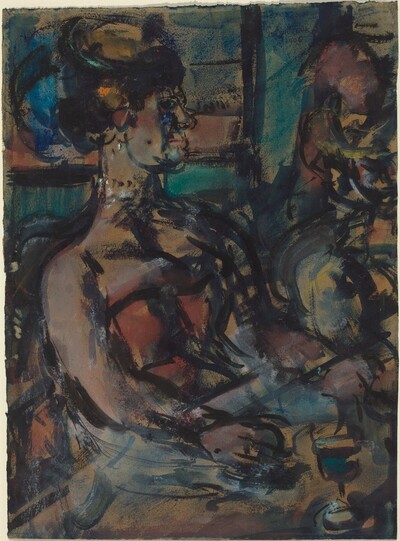
pen and brush and black ink, brush and brown and gray wash, and white and gray-blue gouache, over graphite
Dimensions
Sheet: 30.5 x 43.8 cm (12 x 17 1/4 in.)
Classification
Drawing
Credit Line
Gift of Muriel S. Butkin
Tags
Drawing Neoclassical & Romantic (1751–1850) Ink Graphite & Pencil Gouache French Color: Brown Color: White
Background & Context
Background Story
Edouard Jean Marie Hostein (1805-1889) was a French painter known for the atmospheric, precisely observed landscape paintings of the French countryside that make him one of the accomplished landscape painters of the 19th century. The Neuve River at the End of the Dardenne Valley from the 1800s depicts the Neuve River at the end of the Dardenne Valley in the atmospheric, precisely observed manner that distinguishes Hostein's best work from the more general landscape painting of his contemporaries. The Dardenne Valley subject shows Hostein's talent for combining atmospheric effect with the precise observation of the French landscape that is his most distinctive contribution.
Cultural Impact
The Neuve River at the End of the Dardenne Valley is important in the history of French landscape painting because it demonstrates the atmospheric, precisely observed manner that Hostein brought to French landscape subjects as one of the accomplished landscape painters of the 19th century. Hostein's atmospheric, precisely observed landscapes of the French countryside—combining atmospheric effect with precise observation—represent one of the accomplished traditions in 19th-century French landscape painting, and the 1800s painting shows this tradition at its most atmospheric.
Why It Matters
The Neuve River at the End of the Dardenne Valley is Hostein's atmospheric French landscape: the Neuve River in the Dardenne Valley rendered in the precisely observed manner of one of the accomplished landscape painters of the 19th century. The 1800s painting shows the combination of atmospheric effect with precise observation of the French countryside.