Description
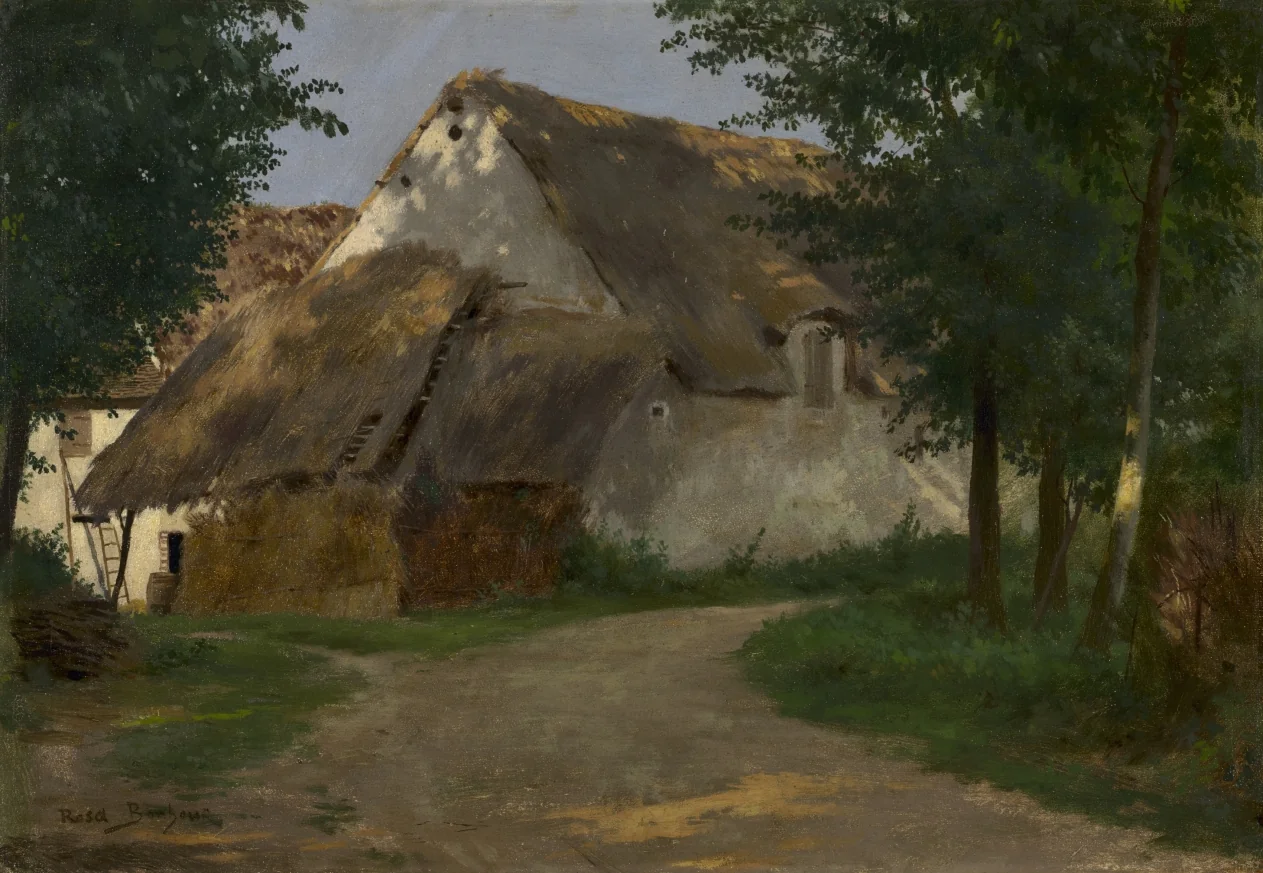
One of the most celebrated female artists of the 19th century, Bonheur established an international reputation by exhibiting at the Paris Salons. Empress Eugénie, wife of Napoleon III, visited her studio to personally confer the Legion of Honor, making Bonheur the first woman to receive the award. This painting may have been inspired by the rustic houses in the vicinity of the Forest of Fontainebleau, where Bonheur lived for more than 40 years.
Provenance
(Georges Petit Galerie, Paris, France, May 30, 1900, Artist's estate sale (lot 884), sold to Homer H. Johnson) (1900); Homer H. Johnson, [1862-1960] Cleveland, OH, by descent to his daughter, Mrs. John B. Dempsey (1900-1960); Mrs. John B. Dempsey [1902-2005] Cleveland, OH, given to the the Cleveland Museum of Art on 20 November 20,1978. (1960-1978); The Cleveland Museum of Art, Cleveland, OH (1978-)
Accession Number
1978.73
Medium
oil on fabric
Dimensions
Unframed: 28.4 x 40.3 cm (11 3/16 x 15 7/8 in.)
Classification
Painting
Credit Line
Gift of Mrs. John B. Dempsey
Tags
Painting Impressionist & Modern (1851–1900) Oil Painting French Color: Green Color: Brown
Background & Context
Background Story
Rosa Bonheur (1822-1899) was the most celebrated female painter of the 19th century, known for her animal paintings that combined scientific accuracy with artistic grandeur. The Farm at the Entrance of the Wood from the 1860-80 period depicts a farmstead at the edge of a forest with the careful observation of animal anatomy and rural architecture that distinguishes all her work. The painting's subject—a working farm surrounded by the forest that provides both shelter and resources—allows Bonheur to combine her two great interests: the domestic animals of the farm and the wild landscape of the forest.
Cultural Impact
Bonheur's farm paintings are important documents in the history of 19th-century rural life because they record the relationship between agricultural practice and the natural landscape with an accuracy that more romantic landscape paintings lack. The Farm at the Entrance of the Wood shows the farm not as a picturesque ideal but as a working enterprise that exists in a specific relationship to the surrounding forest—a relationship of use and shelter that defined rural life in 19th-century France.
Why It Matters
The Farm at the Entrance of the Wood is Bonheur combining her two great subjects: the domestic animals of the farm and the wild landscape of the forest. The farm is not a picturesque ideal but a working enterprise in a specific relationship to the surrounding woodland—Bonheur's scientific accuracy serving both animal anatomy and rural architecture.