Description
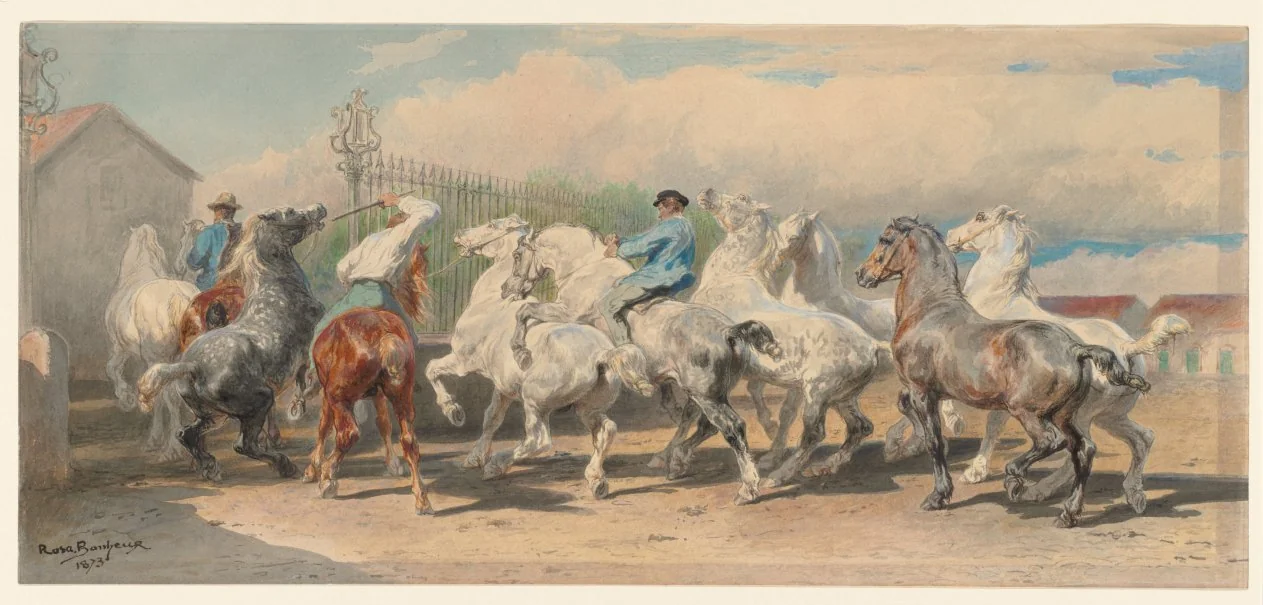
Rosa Bonheur was the first woman artist to receive the Cross of the French Legion of Honor, a French civilian and military decoration. She achieved great official and commercial success, especially for her carefully finished and naturalistic paintings of animals. This watercolor displays Bonheur's technical mastery and her close study of anatomy, as well as her appreciation for the natural beauty of the horses. The animals are arranged in a shallow frieze across the long composition, and their manicured tails, along with the riders' costumes and the finely-wrought iron fence, identify them as stock from the historic national breeding stables.
Provenance
(Christie, Manson & Wood, London, June 28, 1940, no. 3, sold to Gooden and Fox, London) (1940); (Gooden and Fox, London) (1940-?); Estate of Sir Jeremiah Colman [1859-1942], London (?-1955); (Christie, Manson, & Wood, London, Colman estate sale, Mar. 25, 1955, no. 2) (1955); Hentzl, sold to Geraldine Rockefeller Dodge, New York (?-?); Geraldine Rockefeller Dodge [1882-1973], New York (?-1976); (Parke-Bernet, New York, May 14, 1976, no. 22, sold to the Shepherd Gallery) (1976); (Shepherd Gallery, New York, sold to Muriel Butkin, Shaker Heights, OH) (1976-1977); Muriel Butkin [1916-2008], Shaker Heights, OH, by bequest to the Cleveland Museum of Art, Cleveland, OH (1977-2008); The Cleveland Museum of Art, Cleveland, OH (2008-)
Accession Number
2008.410
Medium
watercolor and gouache over graphite
Dimensions
Sheet: 25.9 x 56.7 cm (10 3/16 x 22 5/16 in.)
Classification
Drawing
Credit Line
Bequest of Muriel Butkin
Tags
Drawing Impressionist & Modern (1851–1900) Watercolor Graphite & Pencil Gouache French Color: White Color: Gray
Background & Context
Background Story
Return from the Horse Fair from 1873 is a watercolor and gouache study related to Bonheur's most famous painting, The Horse Fair (1853-55), which made her reputation as the foremost animal painter of her generation. This watercolor study depicts the aftermath of the horse fair that was the subject of the monumental painting, showing the horses and handlers returning from the fair in a composition that reduces the dramatic action of the original to a more intimate and domestic scene. The watercolor and gouache medium allows Bonheur to capture the movement and anatomy of the horses with a directness and freshness that the more deliberate oil painting sometimes lacks.
Cultural Impact
Bonheur's watercolor studies for The Horse Fair are important documents in the history of 19th-century animal painting because they show the working method behind her most famous composition. The Return from the Horse Fair is not a preliminary study for the larger painting but a subsequent reimagining—a smaller, more intimate version of the horse fair subject that allows Bonheur to explore the domestic aftermath of the fair rather than its dramatic centerpiece.
Why It Matters
Return from the Horse Fair is Bonheur revisiting her most famous subject: the aftermath of the horse fair rendered in watercolor and gouache with a directness and freshness that the monumental oil painting sometimes lacks. The study shifts the focus from the fair's dramatic center to its domestic aftermath—the horses and handlers returning home.