Description
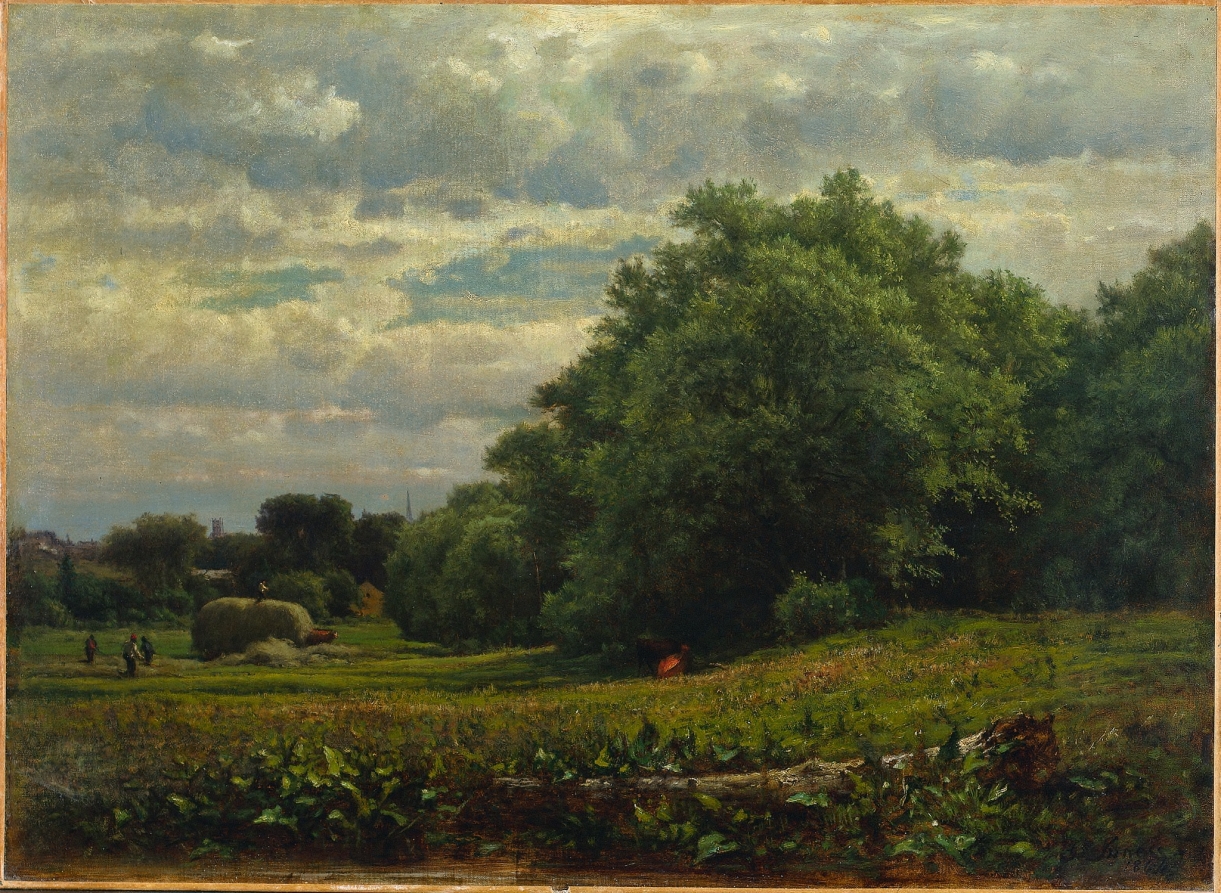
Inness began his career executing detailed, realistic landscapes in a style similar to other artists of the Hudson River School. After a series of trips to Europe, as well as growing involvement in Swedenborgianism—the spiritual doctrines of the theologian Emmanuel Swedenborg—Inness created increasingly free, mystical, and expansive paintings. This work was painted following a visit to France and Italy from 1870 to 1874, during what has been considered the most important phase of Inness’s career. Here a group of farmers harvest grain in the foreground, while a storm seems to be brewing in the background. Inness frequently used approaching storms as a sign of God revealing himself in nature. The notion that the natural world was imbued with the spirit of the divine was an important component of Inness’s religious beliefs.
Provenance
Mrs. J. E. T. Rutter 1899; Mrs. L.W. Rutter, 1918; Mr. and Mrs. Robert S. Copelin
Accession Number
1978.74
Medium
oil on canvas
Dimensions
Unframed: 50.8 x 76 cm (20 x 29 15/16 in.)
Classification
Painting
Credit Line
Gift of Mr. and Mrs. Robert S. Copelin
Tags
Painting Impressionist & Modern (1851–1900) Oil Painting Canvas American Color: Yellow Color: Gold
Background & Context
Background Story
The Wheat Field (c. 1875-77) represents Inness's engagement with the American agricultural landscape during a period of national recovery from the Civil War. Wheat was America's most important cereal crop, and the wheat field symbolized both agricultural prosperity and national self-sufficiency. Inness's treatment transforms this working landscape into a Tonalist vision where the wheat field's golden expanse becomes an atmospheric experience rather than merely an agricultural record. The 1875-77 date places this during Inness's most productive middle period, when he had consolidated the lessons of his European experience and was applying them to American subjects with increasing confidence. The wheat field as subject connects Inness to the broader tradition of agricultural landscape painting that extends from the Dutch Golden Age through the Barbizon School. His treatment, however, differs from both traditions: less detailed than Dutch farm scenes, less socially engaged than Millet's peasant paintings, Inness's wheat field exists primarily as an atmospheric study where the gold of the grain merges with the gold of the sunlight to create a unified visual field. This atmospheric unity reflects Inness's Swedenborgian conviction that the visible world manifests invisible spiritual realities—the wheat field is not just food but evidence of divine bounty.
Cultural Impact
Inness's agricultural paintings influenced how American farmland was represented in art, introducing Tonalist atmospheric treatment to subjects previously treated with Hudson River School topographical precision. The paintings influenced later American painters who similarly sought to combine agricultural subjects with atmospheric effect. The wheat field subject influenced how American agricultural prosperity was understood, connecting economic productivity to spiritual abundance.
Why It Matters
This painting matters because it demonstrates how the most practical of subjects—wheat growing in a field—can become, through Tonalist treatment, a meditation on the relationship between human labor and natural bounty. Inness's wheat field is not merely farmland; it is evidence of the divine order that makes labor productive and the natural world generous—a vision that reconciles spiritual and economic values in a way that remains relevant.