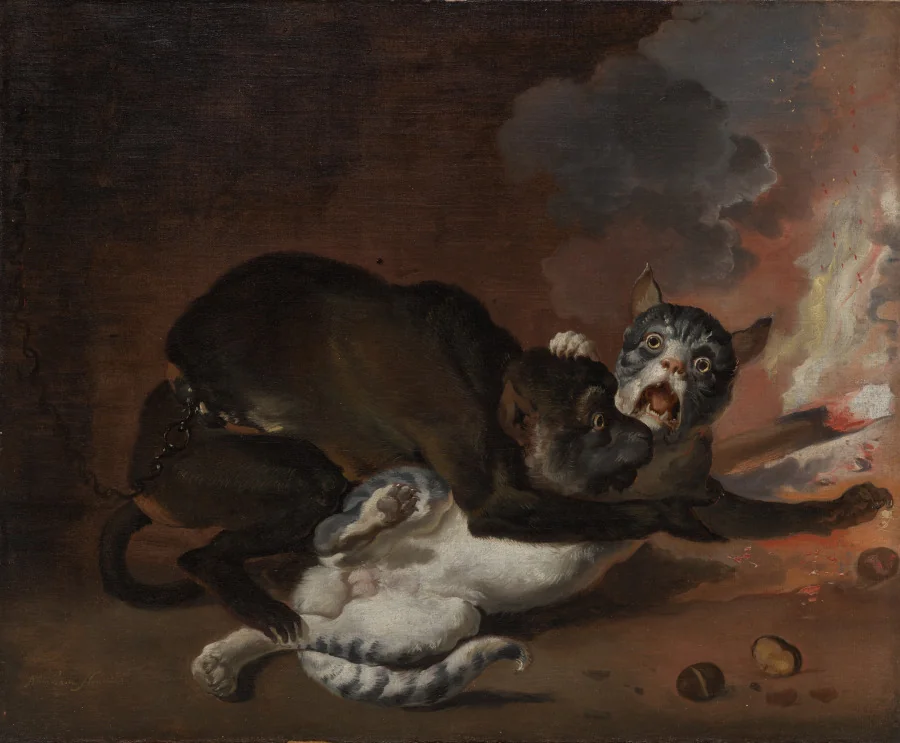
Description
This picture interprets one of Aesop’s ancient Greek fables (or probably the more contemporary interpretation by Jean de la Fontaine, even more famous at the time), which warns of the dangers of flattery. A monkey sweet-talks a cat into pulling scalding chestnuts out of the fire. The cat finishes the risky and painful task to discover that the monkey has already gobbled up nearly all of them.
Provenance
The Cleveland Museum of Art, Cleveland, Ohio (1979-); The Butkin Foundation, Cleveland, OH, by gift to the Cleveland Museum of Art 1 (1974-1979); Noah Butkin [1918-1980], Cleveland, OH, probably by exchange to The Butkin Foundation (c. 1968-1974); (Judson Art Galleries, Kenilworth, IL, sold to Noah Butkin) (Until c. 1968); (Central Picture Galleries, New York, sold to Judson Art Galleries)1 (Probably until the mid-1960s)
Accession Number
1979.82
Medium
oil on canvas
Dimensions
Framed: 80 x 93.5 x 6 cm (31 1/2 x 36 13/16 x 2 3/8 in.); Unframed: 62.2 x 73.7 cm (24 1/2 x 29 in.)
Classification
Painting
Credit Line
Gift of The Butkin Foundation
Tags
Painting Baroque (1600–1750) Oil Painting Canvas Dutch Color: Orange Color: Brown
Background & Context
Background Story
Abraham Hondius's "The Monkey and the Cat" illustrates one of Aesop's most enduring fables — or more precisely, its later adaptation by Jean de La Fontaine, whose version was even more widely known in seventeenth-century Europe. The scene depicts a cunning monkey persuading a trusting cat to pull scalding chestnuts from a fire. The cat obediently performs the painful task, only to discover that the monkey has already eaten nearly all the roasted chestnuts, leaving only burnt paws and empty shells as reward.
The fable of "The Monkey and the Cat" — from which the English word "cat's-paw" derives — is a pointed allegory about exploitation and misplaced trust. The monkey represents those who use others to do their dangerous work, while the cat represents the well-meaning dupe who fails to recognize manipulation. Hondius brings this moral lesson to vivid life with characteristic Dutch Golden Age attention to texture and expression: the cat's anxious face, the monkey's sly grin, the glowing chestnuts, and the domestic interior rendered with the same meticulous detail that Dutch painters brought to all aspects of daily life.
Abraham Hondius (c. 1625–1691) was a Rotterdam-born painter who spent much of his career in London, where he became a significant contributor to English animal painting. He was particularly known for his hunting scenes, animal subjects, and landscapes with dramatic weather effects. His style combined the tonal warmth of the Dutch landscape tradition with a compositional energy that appealed to English patrons. In this painting, his skill at rendering animal expressions — making the monkey's deception and the cat's distress immediately legible — demonstrates why animal genre scenes were so popular in the Dutch Republic, where they served simultaneously as entertainment, moral instruction, and displays of painterly virtuosity.
Cultural Impact
The fable of "The Monkey and the Cat" has entered the English language as the idiom "cat's-paw," meaning someone used as a tool by another. Hondius's painting demonstrates how Dutch genre painters transformed literary fables into vivid visual narratives that could simultaneously entertain, instruct, and showcase technical mastery.
Why It Matters
This painting exemplifies the Dutch Golden Age's gift for transforming moral fables into compelling visual art, combining virtuosic animal painting with pointed social commentary about exploitation and gullibility.
![Saint Bernard and Saint Catherine of Alexandria with the Virgin of the Annunciation [right panel]](https://api.nga.gov/iiif/e6890364-4d99-4684-a62b-5060ee3c3446/full/400,/0/default.jpg)