Provenance
(Shepherd Gallery, New York, NY), sold to The Cleveland Museum of Art, Cleveland, OH (?–1980); The Cleveland Museum of Art, Cleveland, OH (January 30, 1980–)
Accession Number
1980.22
Medium
watercolor
Dimensions
Sheet: 56.8 x 34.9 cm (22 3/8 x 13 3/4 in.)
Classification
Drawing
Credit Line
The A. W. Ellenberger, Sr., Endowment Fund
Tags
Drawing Neoclassical & Romantic (1751–1850) Watercolor British Color: Orange
Background & Context
Background Story
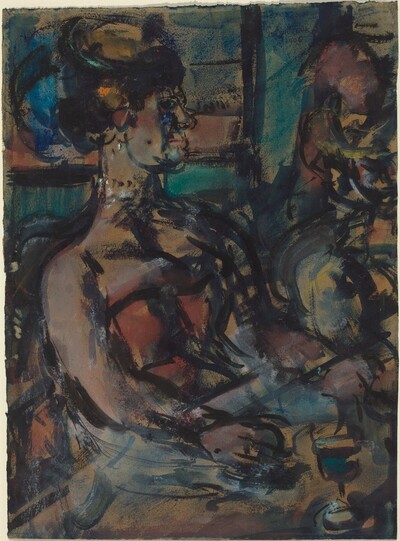
Alfred George Stevens's "Lot's Wife" (c. 1837–75) depicts the dramatic moment from Genesis 19:26 when Lot's wife disobeys the angel's command and looks back at the burning cities of Sodom and Gomorrah, and is instantly transformed into a pillar of salt. The subject — a woman frozen in the act of regretful longing for the world she is leaving — resonated deeply with Victorian artists and audiences, who saw in it a parable about the dangers of attachment to sin and the cost of disobedience.
Stevens (1817–1875) was a British sculptor, painter, and decorative artist of extraordinary range and ambition whose career was marked by both brilliance and frustration. Born in Blandford, Dorset, he trained in Italy and worked in the studio of Bertel Thorvaldsen in Rome before returning to England. His ambitions were grand — he dreamed of creating monumental decorative schemes on the scale of Michelangelo — but the English art establishment of his era was largely indifferent to such projects, and Stevens spent much of his career executing commissions that fell far short of his aspirations.
This watercolor of Lot's Wife demonstrates Stevens's ability to extract maximum dramatic impact from a relatively small format. The subject is inherently theatrical — the moment of transformation, the backward glance, the burning city in the background — and Stevens exploits its full potential. The figure of Lot's wife occupies the compositional center, her body already beginning to stiffen into the mineral immobility that will consume her, while the flames of the destroyed city illuminate the background. The watercolor medium, with its capacity for luminous washes and delicate tonal transitions, is well-suited to the ethereal, otherworldly quality of the subject.
The story of Lot's wife has been interpreted by theologians, poets, and artists as a parable about many things: the danger of looking backward, the cost of attachment to worldly pleasures, the swift and terrible nature of divine punishment, and the impossibility of returning to a life that has been rejected. Stevens's interpretation emphasizes the pathos of the moment — the woman's desire to see her home one last time is understandable, even sympathetic, but the consequence is absolute and irreversible. This tension between human sympathy and divine judgment gave the subject its enduring power for Victorian artists and audiences.
Stevens's reputation has always been higher among artists and connoisseurs than among the general public. His contemporaries recognized his genius — he was described by no less an authority than George Gilbert Scott as "one of the greatest artists that England has ever produced" — but the scale and ambition of his best work was never fully realized in his lifetime, and he remains less well-known than his talents deserve.
Cultural Impact
Though less well-known than his contemporaries, Stevens's ambitions for monumental decorative art and his mastery across multiple media made him one of the most respected artists of Victorian England, influencing the Arts and Crafts movement's emphasis on the unity of art and decoration.
Why It Matters
"Lot's Wife" captures the moment of transformation from human to mineral — a Victorian meditation on the cost of looking back, rendered with the dramatic intensity and technical refinement that characterized Stevens's best work.