Description
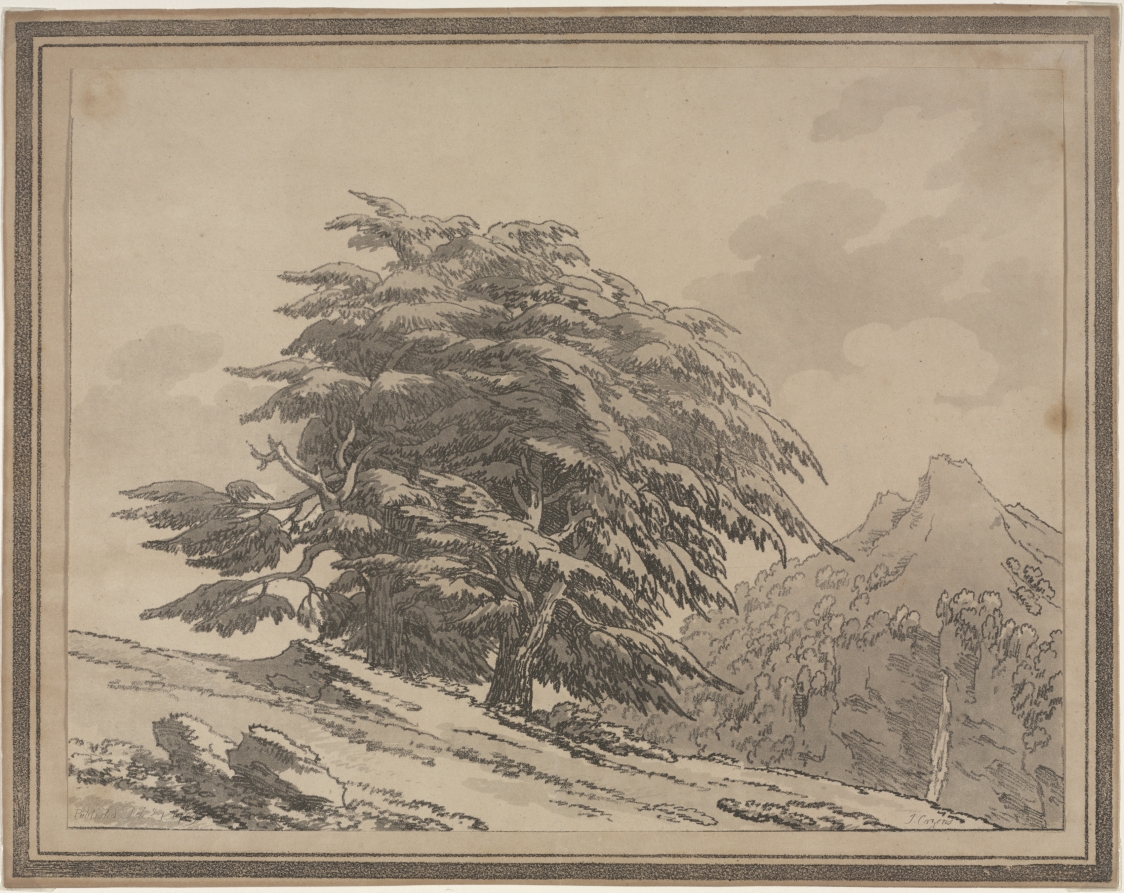
During the 18th century, views of Italy and the Continent were in great demand among British aristocrats on the Grand Tour. Cozens journeyed to Italy and Switzerland twice in his career, making pencil and wash sketches from which he later derived highly finished watercolors for various patrons. The artist’s somber palette, limited to muted greens, grays, and blues, produces a melancholy, hazy effect in this landscape. The site depicted here has thus far proved unidentifiable and may be an amalgamation of memory and imagination. The left portion of the composition relates to another watercolor depicting a view of Velletri, a town outside of Rome; the cottage and trees in the right foreground seem English, and the central plain and winding river appear to be pure invention.
Provenance
Mr. Eden (?-?); Mr. Deverell (?-?); Mrs. Deverell (?-?); William Eden (?-?); Norman D. Newell, New York, NY (?-1979); (his sale, Christie's, London, December 13, 1979, no. 25) (1979); Private Collection (after 1979-before 1996); (sale, Sotheby's, London, November 14, 1996, no. 59) (1996); (Spink-Leger Pictures, London, sold to the Cleveland Museum of Art, Cleveland, OH) (probably 1996-1997); Cleveland Museum of Art, Cleveland, OH (1997-)
Accession Number
1997.137
Medium
watercolor over graphite
Dimensions
Sheet: 48.7 x 66.9 cm (19 3/16 x 26 5/16 in.)
Classification
Drawing
Credit Line
Leonard C. Hanna Jr. Fund
Tags
Drawing Neoclassical & Romantic (1751–1850) Watercolor Graphite & Pencil British Color: Gray
Background & Context
Background Story
John Robert Cozens (1752-1797) was an English watercolorist known for the poetic, melancholy landscapes that make him one of the most important precursors of the English watercolor tradition. Italian Landscape from c. 1790-92 depicts an Italian landscape in the poetic, melancholy manner that distinguishes Cozens's best watercolors from the more topographical work of his contemporaries. The c. 1790-92 date places this in Cozens's final years, when his mental health was declining but he was still producing the poetic watercolors that would influence the development of the English watercolor tradition.
Cultural Impact
Italian Landscape is important in the history of English watercolor painting because it demonstrates the poetic, melancholy manner that Cozens developed as the most important precursor of the English watercolor tradition. Cozens's poetic watercolors—combining topographical observation with melancholy atmosphere—represent the beginning of the English watercolor tradition that would be developed by Turner, Girtin, and others, and the c. 1790-92 painting shows this beginning at its most poetic.
Why It Matters
Italian Landscape is Cozens's poetic watercolor: an Italian landscape rendered in the melancholy, atmospheric manner of the most important precursor of the English watercolor tradition. The c. 1790-92 painting shows the beginning of the tradition that Turner and Girtin would develop—topographical observation combined with poetic atmosphere.